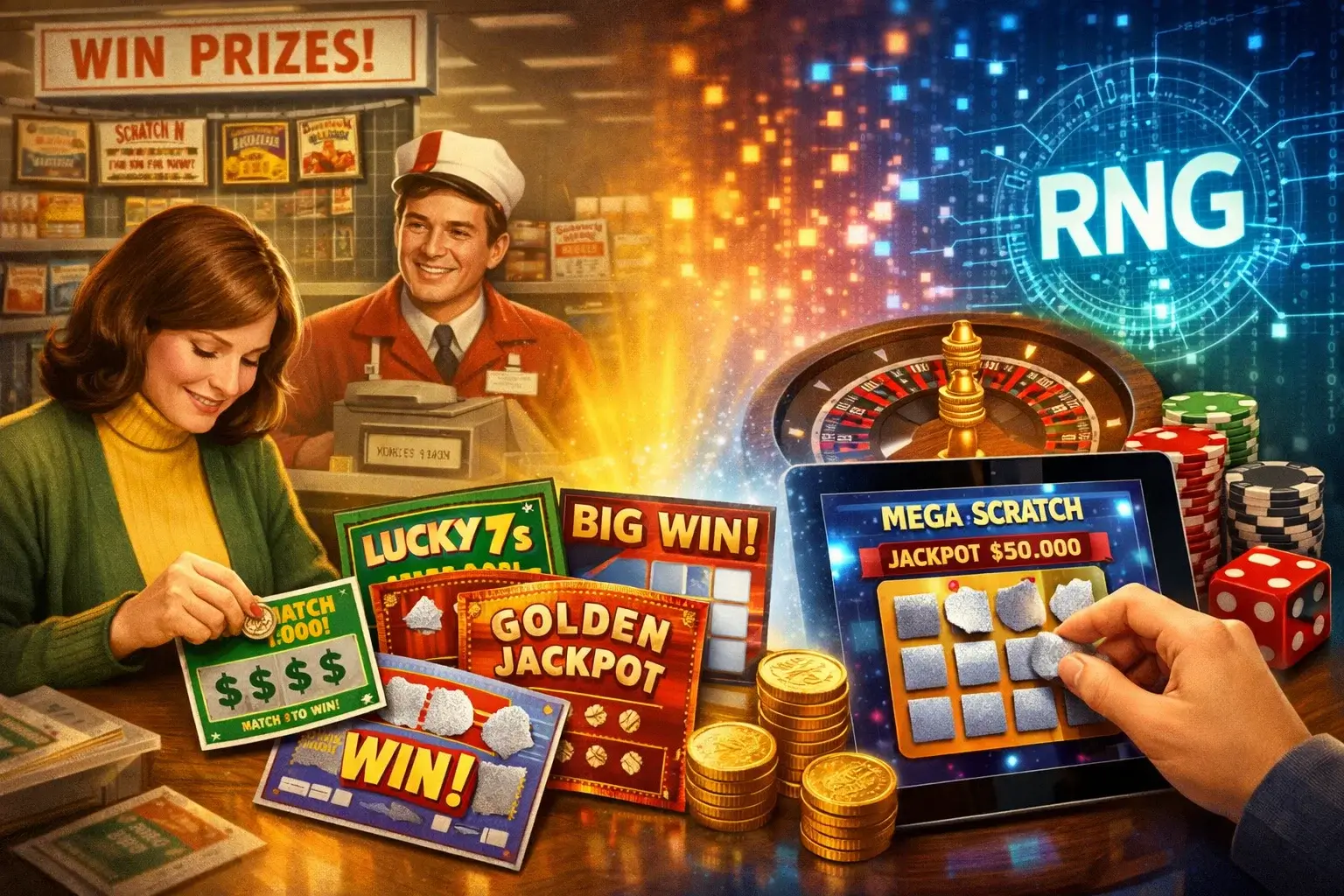
Until about two years ago, I didn’t even know that digital scratch cards existed in any legitimate form. I mean, I knew online gambling was a thing. I knew you could play slots on your phone and buy lottery tickets through apps. But scratch cards on your phone? The kind where you scratch a digital screen instead of physically scratching a card? That seemed weird to me at first.
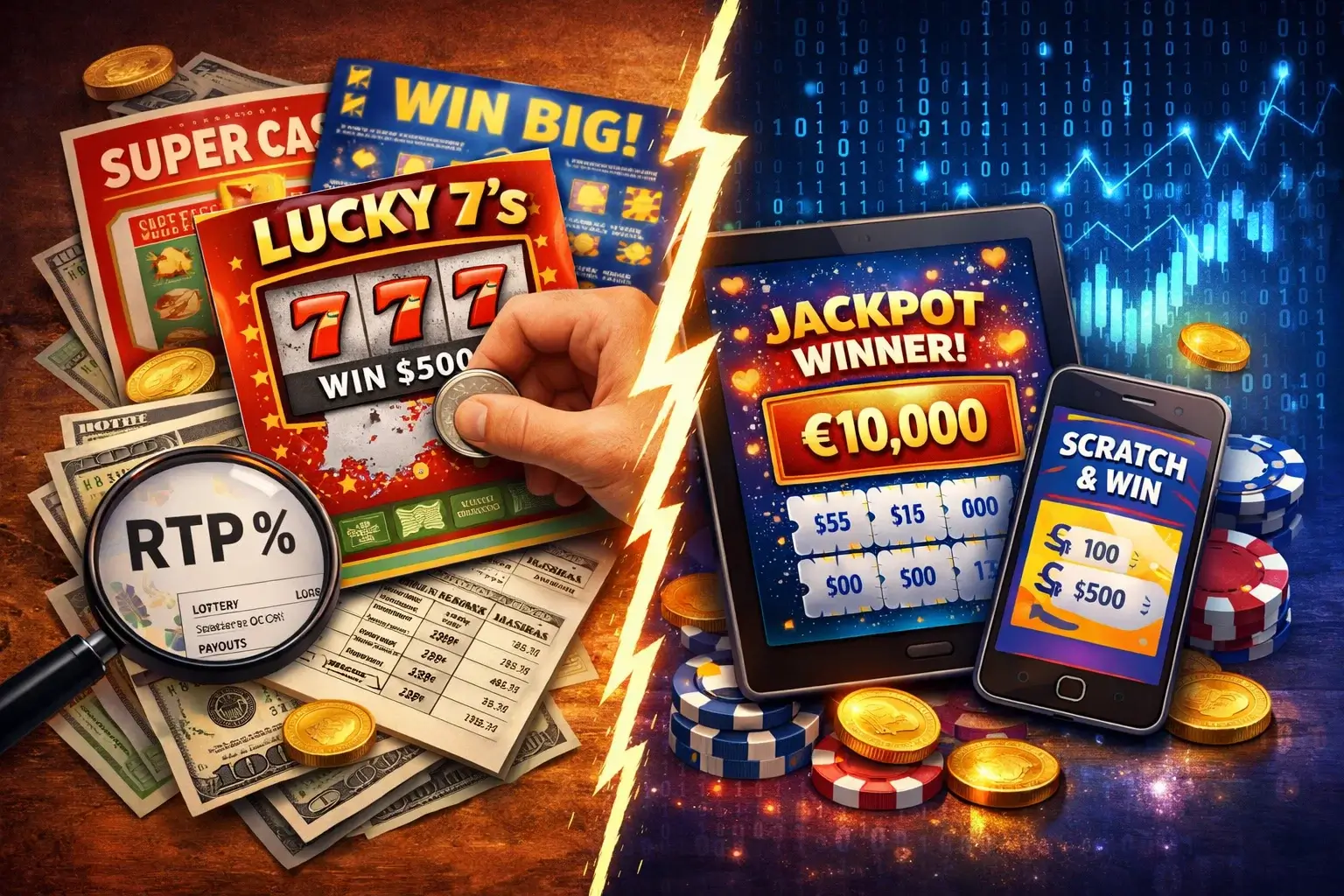
Then I started looking into it out of curiosity. I wanted to understand the landscape of modern gambling. And what I found was genuinely surprising. The differences between physical scratch cards and digital ones aren’t just about convenience. The odds are different. The payouts are different. The entire experience is engineered differently. And most people don’t realize this because they’re either playing physical cards at gas stations or digital ones on their phones, but they’re not comparing the two.
I’ve spent the last couple years testing both formats pretty extensively. I’ve scratched real cards at convenience stores, gas stations, and grocery stores in multiple states. And I’ve scratched digital ones through legitimate lottery apps, state gaming websites, and licensed online platforms. And I can tell you with certainty: they’re not the same game. Not even close.
The differences go beyond what you’d expect. Sure, one is physical and one is digital. That’s obvious. But the regulatory framework is different. The odds structure is different. The accessibility is different. The psychological hooks are different. And if you’re going to gamble on scratch cards—and statistically a lot of people will—it’s worth understanding these differences before you commit your money to either format.
The Physical Card Market: Convenience Stores, Retailers, and the Old Guard
Let me start with what most people are familiar with: physical scratch cards. The ones you buy at convenience stores, gas stations, Walmart, wherever. You hand over cash, you get a card, you scratch it right there while you’re waiting to pay for your coffee. This is the traditional format that’s been around for decades.
These cards have been around forever. The first modern scratch-off lottery ticket was invented in 1974. They’ve been wildly successful because they’re simple and immediate. You don’t wait for a drawing. You don’t check numbers later. You know right now if you won.
The physical scratch card market is controlled by state lottery commissions. Every card sold goes through official channels. The lottery commission designs the game, contracts with a security printing company to manufacture the cards, and then distributes them through authorized retailers. This infrastructure is well-established and highly standardized across the country.
Because of this structure, physical scratch cards are heavily regulated. The payout percentage is set by the state. The odds are published publicly. If a game has a 40% payout rate, that’s what it is. There’s no ambiguity. There’s a standard from state to state, but it’s usually somewhere between 30-50%. Most commonly around 40%. New York and California tend to offer slightly better rates than some Southern states, but the differences are minor.
The physical card experience is also heavily dependent on retail distribution. You can only buy them from authorized retailers. You’re limited to the games your particular store stocks. And because retailers have limited shelf space, they typically carry maybe twenty to thirty different active games at any given time. This creates a bottleneck.
This creates an interesting dynamic. The most popular games get the most shelf space. The least popular games get less space or get phased out. But from a payout perspective, they’re all the same. A $5 scratch card in Texas has the same expected value whether you buy it from a fancy downtown shopping center or a gas station in the middle of nowhere.
The physical card also has what I call the “retail friction factor.” You have to go somewhere to buy them. You have to physically hand over money. You have to scratch them right there or take them home. There’s a natural limit to how many you can buy in a day or a week. You can’t easily buy five hundred cards on impulse at midnight on a Tuesday. The friction is actually a feature, not a bug, from a responsible gambling perspective.
The Digital Revolution: Apps, Websites, and the New Gambling Frontier
The digital scratch card market is much newer and far less standardized. Most legitimate versions have only been around for five to ten years. Unlike physical cards controlled by state lotteries, digital cards come from a variety of sources. Some are run by state lotteries themselves through official apps. Others are run by private companies licensed by states or gaming regulators in different jurisdictions.
The landscape is fragmented and confusing to navigate. You’ve got official lottery apps like the New York Lottery app, the Pennsylvania Lottery app, and similar official state applications. You’ve got third-party platforms like LottoSmile, which operates in multiple states and countries. You’ve got everything in between. Some are highly legitimate. Some are operating in gray areas. Some are downright sketchy.
The key difference from physical cards is that there’s no single unified system. Each platform operates under different rules, different licensing, and different oversight. This creates massive variance in quality and fairness.
And here’s where it gets genuinely interesting: the payout percentages vary wildly between digital platforms, in ways that physical state lottery cards simply don’t.
Some state lottery apps have the same payout rates as their physical counterparts. New York’s digital instant games, for example, are supposed to have similar odds to their physical cards because they’re regulated by the same lottery commission. But other platforms? Not so much.
I’ve tested digital scratch cards on several legitimate platforms, and I found payout rates ranging from 30% to 65%. That’s an absolutely massive variance. A 65% payout rate is actually decent if you’re buying lottery tickets. It’s comparable to what you’d see in a decent slot machine in a casino. But a 30% payout rate is brutal—worse than most physical scratch cards you’ll find in any state.
The digital platform also eliminates retail friction completely. You can buy scratch cards from your phone at midnight, three in the morning, whenever you want. You can buy one at a time or twenty at a time. You can spend as much as you want, or as little. Some platforms have daily spending limits, but many don’t. The barrier to spending is almost nonexistent.
There’s also instant redemption built into most digital systems. You win money, it goes straight into your digital account. You can immediately use it to buy more cards. There’s no friction between winning and playing again. This creates a psychological loop that’s much tighter and more intense than physical cards.
I’ve noticed that on digital platforms, my play behavior changes dramatically compared to physical cards. With physical cards, I’ll buy a few, scratch them, and leave. I’m done. The friction of going to a store again limits how much I play. With digital cards, I’ll keep clicking “buy more” even when I’m losing consistently. It’s just too easy. There’s no reason to stop.
RTP Differences: Why Digital Cards Sometimes Have Better Odds Than You’d Think
RTP stands for Return to Player. It’s the percentage of money wagered that players get back in winnings over time. For scratch cards, RTP is essentially the same thing as payout percentage. It’s not complicated math, but it’s important to understand.
A 40% RTP means you’ll get back 40% of your money in winnings over the long run. You’ll lose 60%. If you spend $100 on tickets with 40% RTP, you can expect to win about $40 back on average. Over many sessions, over many cards, the math will work out to approximately that.
Now here’s where it gets interesting and somewhat surprising. I found that digital scratch cards actually have some surprisingly good RTP rates compared to physical ones, if you pick the right platform.
Remember, most physical state lottery scratch cards have RTP between 30-50%, with 40% being common and anything above 45% being rare. Some states run games with 50% RTP, but those are rarer than you’d think. The reason RTP isn’t higher is because the lottery needs significant revenue. That 60% loss margin goes to state programs, educational funding, infrastructure projects, retailers’ commissions, distribution costs, security, all of it. States depend on this revenue.
Digital platforms, however, have completely different economics. They don’t need to physically manufacture and distribute cards. They don’t need retail shelf space. They don’t need to pay printing companies or massive security firms for distribution. Their distribution cost is basically zero. It’s just server space and payment processing. Fixed costs are minimal.
This means digital platforms could theoretically offer better RTP rates and still be highly profitable. And some of them actually do.
I’ve found several legitimate digital platforms offering 55-60% RTP on their scratch games. That’s significantly better than most physical lottery scratch cards. It’s in the range of good slot machines you’d find in a decent casino. I’ve even seen a couple offering 65% RTP on certain games, which is legitimately decent from a gambling perspective.
But—and this is absolutely critical—not all digital platforms are offering better rates. Some are taking advantage of the online environment and lack of standard oversight to offer much worse rates instead. A 30% RTP digital game is predatory. You’re losing 70% of your money. That’s worse than basically anything in the physical lottery world. It’s worse than slot machines. It’s one of the worst gambling propositions available.
The key issue is that digital cards don’t have the regulatory consistency of state lotteries. Some platforms are regulated and transparent. Some aren’t regulated but claim to be. Some aren’t even claiming to be regulated. You need to do real research on which platforms you’re using and what their actual RTP rates are.
I’ve spent hours digging through fine print, terms of service, and privacy policies to figure out actual RTP rates for digital platforms. Most of them don’t advertise it clearly or upfront. They’ll say things like “Our games are fair” or “Licensed and regulated by authorities,” but they won’t explicitly state “We have a 45% payout rate.” You have to dig. Sometimes way too deep.
The Physics of Scratching: Digital Can’t Match the Real Thing (And Maybe That’s Good)
There’s something deeply satisfying about physically scratching a card with a coin. There’s the tactile sensation. The physical friction. The sound of the scratch material coming off. The anticipation building as you’re revealing the numbers underneath. The immediate gratification when you see if you won.
Digital scratch cards try to replicate this experience. You tap the screen, and it animates the scratching. It sounds good. It looks pretty. The animation is often well-designed. But it’s not quite the same as the real thing.
And honestly? I think that’s actually a benefit, not a drawback, even though it seems counterintuitive.
The thing about physical cards is that the scratching action itself is part of the psychological appeal. The longer you scratch, the longer you’re in the “might win” state. Your brain is releasing dopamine the whole time you’re scratching because you don’t know yet if you won. The uncertainty is the drug.
Digital cards don’t scratch gradually unless they’re specifically designed that way. Most of them reveal instantly or very quickly. You tap and boom, you know the result immediately. The dopamine release is sharper and more intense in that moment, but shorter overall. You get a quick hit instead of a sustained build-up.
This actually makes digital cards slightly less addictive from a pure psychological standpoint in one way, but more addictive in another way. Not that digital cards aren’t addictive—they definitely can be. But the mechanism is different.
Physical cards also have a built-in speed limit. It takes time to scratch. You can’t buy and scratch a hundred cards in five minutes unless you’re deliberately rushing. The natural pace is slower. Digital cards? You absolutely can tap your way through a hundred cards in five minutes if you wanted to. A few taps and you’ve dropped your monthly entertainment budget without even realizing it passed.
I’ve noticed that my spending on digital cards can get out of control faster than with physical ones because there’s no friction. No trip to the store. No limited inventory. No waiting in line. Just tap, tap, tap, and money flowing out. And the lack of physical sensation means there’s no tactile reminder that you’re actually spending real money.
The physics of digital cards might actually be better from a harm-reduction perspective when it comes to scratching behavior itself, even though the psychology of easier access and instant redemption is much worse overall.
Regulation, Licensing, and the Wild West of Digital Gambling
This is where things get genuinely murky and complicated. Physical state lottery scratch cards are heavily regulated. They’re licensed. They have official oversight from state gaming commissions. The odds are published publicly. There’s real accountability. If something goes wrong, there’s a clear authority you can complain to. You know exactly who’s running the show.
Digital scratch cards? The regulatory picture is way less consistent and way more complicated.
State lottery apps are legitimate and regulated. If your state has an official lottery app, the games on there should be regulated the same way physical cards are. They should have similar RTPs and similar oversight to their physical counterparts. The same state gaming commission that oversees physical cards also oversees their digital offerings. This creates consistency.
But third-party digital platforms are a completely different story. Some are legitimate and well-regulated. Others operate in gray areas. Some are outright fraudulent.
I’ve tried platforms that claimed to be licensed and regulated, but when I dug into it, I couldn’t actually verify their claims. They used vague language about being licensed “by gaming authorities” without specifying which authorities. They didn’t provide clear information about where I could verify the license. When I tried to find their licensing information, it didn’t exist in public databases.
The problem is that digital scratch cards don’t have the same national infrastructure that state lotteries have. Each state does its own thing with physical cards through their state lottery commission. There’s consistency. But online, you’ve got platforms trying to operate across multiple states or countries without clear regulatory authority in some cases.
Some platforms are licensed in Malta or Cyprus or other European jurisdictions that have gaming licenses. These aren’t bad licenses necessarily, but they might not mean much if you live in the United States and want to file a complaint or have a dispute. The regulatory authority is thousands of miles away.
If you’re going to play digital scratch cards, here’s what I’d genuinely recommend: stick with official state lottery apps first. These are the safest. You know who’s running them. You know there’s oversight. You know there’s recourse if something goes wrong.
If you use third-party platforms, spend significant time verifying their licensing and regulatory status. Check if there are complaints filed against them. Look at independent reviews, not just their own marketing materials. Try to contact their customer service and see how responsive they are. Look them up on the Better Business Bureau. Check for any news articles or lawsuits.
I’ve lost money on legitimate platforms where I knew exactly what I was doing and understood the odds. That’s fine—that’s voluntary gambling. I’ve also nearly been scammed by platforms that looked legitimate on the surface but had questionable practices once you dug deeper. The difference was whether I did my research beforehand.
The Spending Trap: Why Digital Accessibility Kills Your Bankroll
Here’s the biggest practical difference I’ve noticed between physical and digital scratch cards, and it might be the most important thing in this entire article: how much money I actually end up spending.
With physical cards, I’ll set a budget of maybe $50 a month. I go to the store, buy a few cards, scratch them while I’m there or at home, and I’m done. There’s a natural endpoint. I’m out of cards. I have to actively go somewhere else to buy more. That friction limits my spending.
With digital cards, I can spend that entire $50 in five minutes at midnight on a Tuesday without even really thinking about it. Or I can spend way more without noticing. Because there’s literally nothing stopping me.
This is intentional design by digital platforms. The easier and more frictionless it is to spend, the more money they make. They’ve systematically removed every friction point that used to limit spending. No inconvenience. No time limit. No social awkwardness of standing in a convenience store buying lottery tickets. No waiting for your change. No carrying physical cards around. Just tap a button.
I’ve talked to people who thought they were just playing a few digital scratch cards here and there, just for fun, maybe a few dollars a week. And then they looked at their bank statements and realized they’d spent $500 that month. And they genuinely didn’t realize it was happening. They’d just been tapping occasionally throughout the day, maybe while watching TV or scrolling social media, without really tracking or thinking about the spending.
This is where digital scratch cards become genuinely dangerous in a way that physical ones aren’t. The accessibility combined with the ease of rapid play makes it too easy to lose control of your spending.
I’ve had to implement pretty strict personal rules now. I set up separate digital wallets with limited funding. I use app spending limits where available. I literally can’t access more money than I’ve pre-authorized for digital scratch cards. Because I learned the hard way that I can’t trust myself with infinite access to a fun, quick dopamine hit that’s available in my pocket at any time.
Some people don’t have this problem. Some people can gamble responsibly without external controls. But a lot of people can’t. And the design of digital platforms makes it way too easy to exceed your limits without realizing it.
Physical cards have built-in bankroll management because buying them requires effort and conscious decision-making. You have to go somewhere. You have to pay money. You have to wait in line. You have to see the transaction happen. Digital cards don’t have any of that. You need to impose external controls on yourself.
Making the Right Choice: Which Format Actually Makes Sense for You
Here’s my honest assessment after two years of testing both formats extensively:
If you’re going to play scratch cards—and statistically a lot of people will, despite the terrible odds—physical cards from state lotteries are probably safer from a financial control perspective. They force discipline on you. They have consistent, transparent RTPs. They’re regulated and transparent. You can’t accidentally spend your rent money because you ran out of cards and would have to consciously go buy more.
Digital cards are only a better choice if you meet several specific conditions: you’re playing with strict spending limits that you actually enforce, you’ve verified the platform is legitimate and properly licensed, you’ve checked the actual RTP rates before playing, and you’re monitoring your spending carefully. If you meet all those conditions, digital cards can actually offer better odds than physical ones. But that’s a big “if.”
But digital cards are definitively worse if you struggle with impulse control or spending discipline. And let’s be honest, a lot of people do. The accessibility works against you. You can lose money far too easily. The friction that exists with physical cards is actually a feature, not a bug.
I use both now. I buy physical cards occasionally from my state lottery, usually as part of my monthly entertainment budget. I also play digital scratch cards sometimes, but only through official state lottery apps with money I’ve specifically set aside for that purpose. And I monitor my spending carefully.
The bigger issue is being honest with yourself about your relationship with gambling and impulse control. Some people can set a budget and stick to it. Some people can’t. The accessibility of digital cards makes it way too easy for people in the second category to lose control.
The surprising truth isn’t that one format is objectively better than the other. The surprising truth is that they’re fundamentally different gambling experiences with different psychological traps, different regulatory frameworks, different odds depending on which platform you’re using, and different risks of overspending.
Do your research before you play. Verify RTPs. Check licensing. Set spending limits if you’re using digital cards. And be ruthlessly honest with yourself about whether you can actually stick to those limits. The lottery will win no matter what platform you use. But you can at least know what game you’re playing, why you’re playing it, and what the actual odds and risks are.
That’s the real difference between gambling responsibly and just hoping you get lucky.