Provider: BGaming | Type: Scratch Card | Released: May 8, 2024 | RTP: 90% | Volatility: Medium | Max Win: 1,000x / €10,000
Quick Verdict
Luck & Magic Scratch is a well-executed casual scratch card game that does exactly what it promises — nothing more. It’s clean, fast, and genuinely good-looking by scratch card standards. However, a 90% RTP sits noticeably below what most online scratch titles offer, and the gameplay loop is narrow enough that players who need variety will burn through their interest quickly. If you liked the Luck & Magic slot, this spin-off is worth a look. If scratch cards aren’t already your thing, this one probably won’t convert you.
Background: Where This Game Comes From
BGaming released the original Luck & Magic slot in August 2023. That game was a card-flip slot — instead of spinning reels, cards turned face-up after each spin to reveal symbols and their values. It carried a 96.23% RTP and very high volatility, with a maximum multiplier of x1,059. The concept went down well enough with players that BGaming decided to take its cast of fantasy characters and build a separate casual product around them.
The result, released on May 8, 2024, is Luck & Magic Scratch — a proper scratch card game, not a reskin of the slot. Mikalai Dzneladze, Chief Casual Game Producer at BGaming, described the goal plainly at launch: an easy-to-understand, enjoyable experience for players of different preferences. That description is accurate. The game is exactly as accessible as advertised.
Understanding the relationship between the two titles matters because they serve different audiences in different ways. A player who enjoys the high-volatility swings of the original Luck & Magic slot will find this scratch card version a much calmer experience, with a different risk profile and a very different session feel. They share characters and visual language, but that’s largely where the overlap ends.
Theme and Visual Design
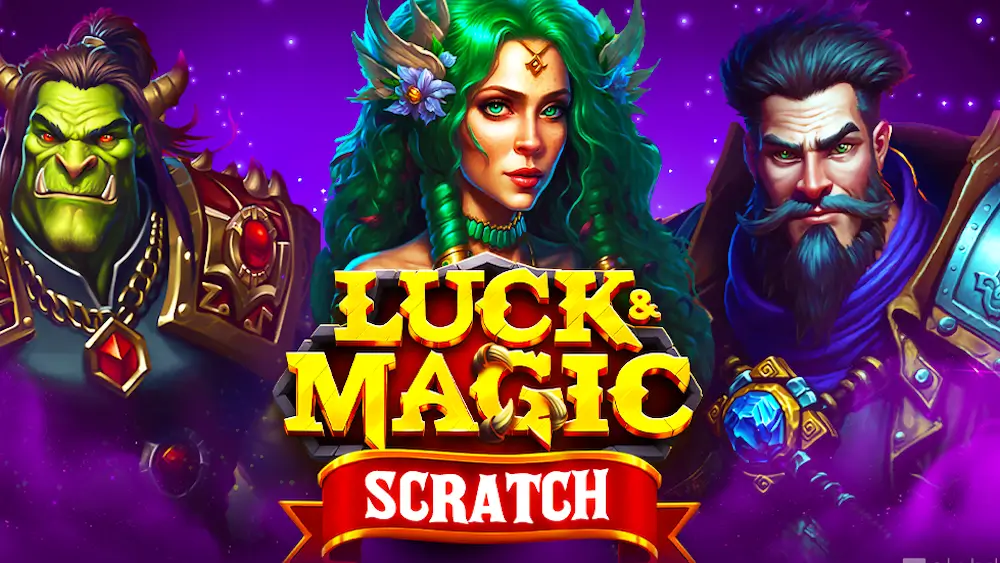
The Luck & Magic franchise is built around fantasy characters drawn in a style that consciously nods to popular video game aesthetics — think detailed illustration work rather than generic casino cartoon graphics. The three characters from the original slot carry over into the scratch card version, each appearing on their own dedicated card.
The artwork is genuinely one of the stronger points of this game. BGaming put visible effort into the visual presentation, and it shows. The cards have atmospheric depth, the color palette is rich without being garish, and the overall production quality is a cut above what you’d expect from a scratch card title, which historically has been a format where design investment is minimal. This is part of BGaming’s broader strategy with the Luck & Magic line — they’ve consistently described it as a franchise built on detailed, video-game-inspired character art, and the scratch card version doesn’t cut corners on that front.
Where this comes to life most is in the character animations. Each of the three heroes reacts to the outcome of a scratch — there are distinct animations for wins and losses, ranging from evident disappointment to a visible nod of approval depending on the result. This is a small detail, but it’s the kind of thing that makes the game feel considered rather than thrown together. Most scratch card games give you a static card and a number match. These give you a reaction, which creates a feedback loop that makes repeated play feel less mechanical. It’s a design choice that benefits players who engage with the game manually rather than through Autoplay, since Turbo mode bypasses the animation entirely.
The audio design complements the visual theme without demanding attention. The soundtrack sits in the background appropriately — atmospheric enough to reinforce the fantasy setting, unobtrusive enough that you wouldn’t notice it missing after ten minutes of play.

How the Game Works
The mechanics of Luck & Magic Scratch are genuinely simple, which is by design for the casual scratch category.
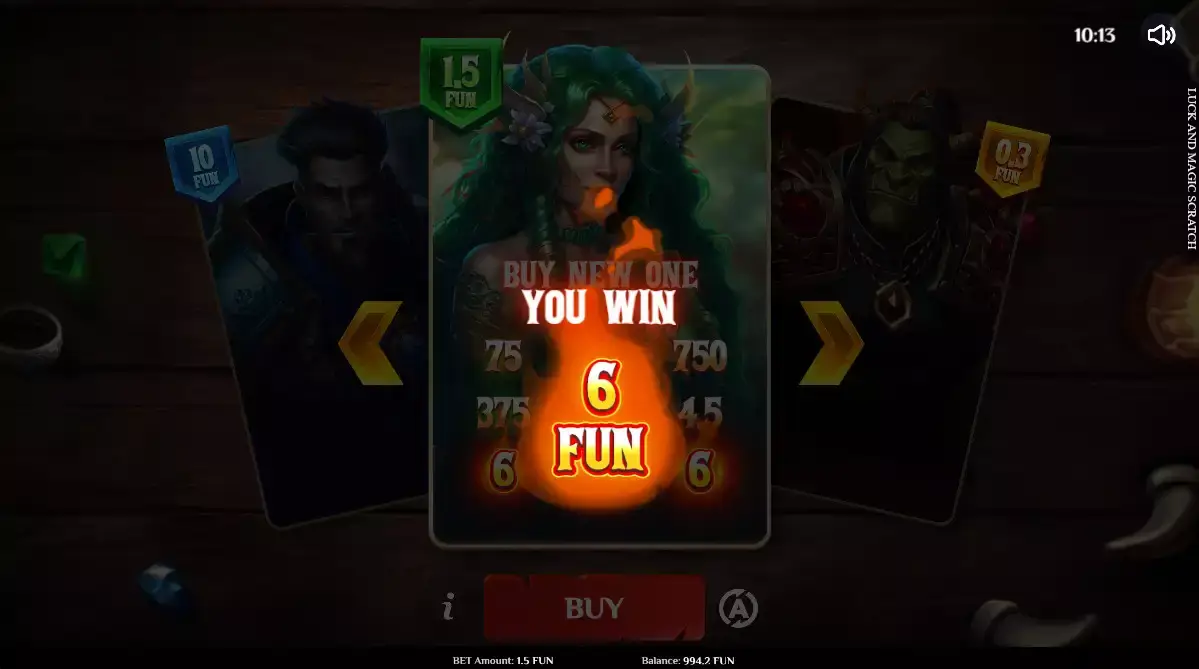
At the start of each round, the player selects one of three scratch cards. Each card has a set price — a fixed bet amount — and features one of the three game characters. The cards are not interchangeable in terms of bet size: different cards correspond to different price points, so selecting a card is effectively also selecting your wager for that round. The minimum bet across the game is €0.30 and the maximum is €10, and the three-card system gives players a structured way to manage their stakes rather than a free-input bet field.
Once a card is selected and purchased, the player faces a grid of nine covered cells. These can be scratched individually using cursor or touch input, or all at once using the Scratch All button. Beneath each cell is a numerical value — a prize multiplier expressed as a multiple of the bet. If three identical values appear anywhere on the nine-cell grid, that amount is paid out immediately. There are no paylines, no patterns required, and no position dependency — any three matching values across the nine cells trigger the win.
It’s worth being explicit about what “three matching values” means in practice. The nine cells don’t form a grid with payline logic — it’s not like matching symbols on reels where position matters. You simply need to find three cells showing the same number anywhere on the card. Whether those three are clustered in a corner or spread across the grid doesn’t matter. This makes the win condition genuinely easy to evaluate at a glance once the cells are revealed.
The prize values shown on the card correspond to specific multiples of the bet placed. The full range of possible prizes is visible in the game’s rules section, and reviewing this before playing — rather than discovering it mid-session — gives a clearer sense of what a winning combination actually pays at your chosen stake. At the minimum €0.30 bet, a 1,000x win returns €300. At the maximum €10 bet, the same multiplier returns €10,000, which is where the cap applies.
The hit rate for this game is listed at 5.63, which means roughly one in every 5.63 rounds produces a winning combination. That’s a meaningful frequency for a scratch card — it translates to regular small wins across a session, which aligns with the medium volatility classification. You’re not sitting through long losing runs before a large payout; the distribution of results is more even than that, though the ceiling on individual wins is also lower than a high-volatility title would offer.
There is no bonus game built into the scratch mechanic itself. The win condition is purely the three-match across nine cells. What BGaming has added instead is a set of gameplay control features, covered below.
Autoplay, Turbo Mode, and Session Controls
This is the section most reviewers cover in a single sentence. It’s worth spending more time on, because these features meaningfully change how the game plays in practice.
Autoplay allows the player to set a number of rounds to run automatically without manual input between each card. The game will purchase a card, scratch it, register the result, and move on to the next round on its own. For players who use scratch cards in a casual, low-engagement way — something to run in the background rather than actively attend to — Autoplay is how the game actually gets used.
Within Autoplay, the player can set two stop conditions. A loss limit will pause Autoplay when cumulative losses in the current session reach a specified threshold. A win limit does the same when cumulative winnings hit a target amount. Both options put a practical boundary on how much a session can extend without the player actively making a decision to continue. This isn’t a novel feature in iGaming broadly, but it’s the right call for a scratch card format where the speed of play can accumulate losses quickly.
Turbo mode is available exclusively within Autoplay, and it’s worth understanding what it actually does. In standard Autoplay, the scratch animation plays through before the result is displayed — the player watches the cells reveal. In Turbo mode, this animation is skipped entirely. The round completes and the result appears immediately without any visual scratching process. For players running through a long Autoplay session, this significantly increases the speed of play. For players who are there for the satisfaction of watching the scratch reveal — which is part of the tactile appeal of the scratch card format — Turbo mode removes that entirely. Which mode a player prefers will depend entirely on what they want from the session.
One thing worth noting: if you’re playing manually rather than through Autoplay, Turbo mode is not available. It’s a batch-processing tool, not a general speed toggle.
RTP and Volatility: The Numbers That Matter
The 90% RTP is the most significant number in this game’s spec sheet, and it deserves an honest assessment rather than a buried mention.
Theoretical Return to Player of 90% means that, over a statistically significant number of rounds, the game returns €90 for every €100 wagered. That 10% theoretical house edge is meaningfully higher than most online scratch card titles, which commonly sit between 92% and 97% RTP. BGaming’s own scratch catalogue includes titles with higher RTPs. For context, the Luck & Magic slot — the same franchise — carries 96.23% RTP, more than six percentage points higher than this scratch spin-off.
This doesn’t mean a session at 90% RTP will always produce worse results than one at 96% RTP — variance over short sessions can produce anything. But over time, the lower RTP creates a steeper expected cost for the same volume of play. To put it in practical terms: if you play 200 rounds at €1 per card, you’re wagering €200 in total. At 90% RTP, the theoretical return is €180 — a theoretical loss of €20. Run those same numbers at 96% RTP and the theoretical loss drops to €8. For a player who plays scratch cards regularly, that gap compounds. For a player who dips in for a short casual session occasionally, it’s less consequential in absolute terms, though the math doesn’t change.
Players who tend to run long Autoplay sessions should factor this in, particularly relative to what they’re used to from slots or other scratch titles. The 90% figure is not a reason to avoid the game entirely, but it’s a reason to be clear-eyed about what you’re signing up for — and to use the session limit features the game provides rather than running indefinitely.
The 90% RTP is certified by BGaming and backed by their standard Provably Fair system, which allows outcome verification. The figure represents the theoretical return under standard configuration. It is worth noting — and this applies across the iGaming industry, not just to this title — that operator-configured RTP variants can differ from the certified default. Different casinos may run different RTP settings on the same game. If this matters to you, check the game’s info panel on the specific platform you’re playing at, rather than assuming the certified default is always active.
Medium volatility, combined with the 5.63 hit rate, means the session experience is relatively balanced. You won’t go twenty rounds without a win very often. The flip side is that the wins that do land are generally modest — the big multipliers are present in the paytable, but the frequency of large hits is low enough that most sessions will consist of smaller wins and losses rather than dramatic swings. The medium volatility label is accurate: this isn’t a grind-and-pray high-variance experience, but it’s also not a steady stream of meaningful wins. It sits in the middle, which suits the casual format well.
The Three Cards: What the Choice Actually Means
Most reviews treat the three-card selection as a cosmetic choice — pick your favourite character, proceed. In practice, the choice is primarily about bet sizing, which is a more consequential decision than character preference.
Each of the three cards represents a different price point within the €0.30–€10 bet range. The prize values displayed on the card are expressed as multiples of the bet, so the absolute amounts shown on each card will differ depending on the card’s price level. A player selecting the lowest-priced card is wagering less per round and will see smaller absolute prize amounts; a player selecting the most expensive card is wagering more per round and will see proportionally larger absolute amounts. The win probabilities and the maximum multiplier (1,000x) are consistent across all three cards.
The practical implication is that card selection is a bankroll management decision. For a fixed session budget, choosing a lower-priced card extends the number of rounds available. Choosing a higher-priced card concentrates the budget into fewer rounds with larger individual stakes. Neither approach changes the expected return — both will trend toward 90% RTP over time — but they produce noticeably different session experiences in terms of duration and stake-per-outcome.
There is no mechanic that makes one card inherently better than another in terms of win probability. The three-card format is BGaming’s way of building bet-level selection into the game’s interface rather than offering a traditional bet slider.
Mobile Performance
Luck & Magic Scratch is fully browser-based — no download, no app installation required. The game is optimized for both desktop and mobile play, with touch controls that work cleanly on the scratch interaction. The interface adapts to different screen sizes without the layout becoming cramped or the cells becoming difficult to interact with.
The scratch mechanic specifically — where touch input needs to register accurately on small cells — functions correctly on mobile. This isn’t guaranteed for all scratch card implementations, particularly on lower-end devices, but BGaming has handled it adequately here. The Scratch All button provides a reliable alternative if manual scratching on a small screen feels imprecise or slow.
Load times are reasonable, the game doesn’t require significant processing resources, and performance on mid-range mobile hardware is consistent. The interface is straightforward enough that there’s no learning curve on a small screen — card selection, the scratch action, and the Autoplay controls are all accessible without needing to navigate through multiple menus. For players who primarily use mobile for casino sessions, there’s nothing in the technical implementation that creates friction. The Turbo mode within Autoplay is particularly suited to mobile use, since it removes the need to watch the scratch animation play out on a small display and simply delivers results at speed.
Luck & Magic Scratch vs. Luck & Magic Slot
Since the two games share a name and visual identity, it’s worth making the comparison explicit for players considering which one to play.
The Luck & Magic slot (August 2023) is a high-volatility product with 96.23% RTP, a maximum multiplier of x1,059, and a bonus game where players choose from five cards to reveal a hidden multiplier. It uses a card-flip mechanic in place of traditional reels, and it functions like a slot in terms of how sessions play out — long periods of moderate results with the possibility of significant single-round payouts.
Luck & Magic Scratch (May 2024) is a casual scratch card with 90% RTP, medium volatility, and a maximum multiplier of 1,000x capped at €10,000. There is no bonus game, no multiplier mechanic beyond the base three-match system, and no equivalent of the slot’s Bonus Buy. The session experience is calmer, more predictable, and lower-ceiling.
The slot is the better choice for players who want higher RTP, higher variance, and a more complex game structure. The scratch card is the better choice for players who want a faster, simpler format with no learning curve and a lower minimum bet floor (€0.30 vs. the slot’s bet structure).
If you are specifically drawn to the Luck & Magic characters and aesthetic, either game delivers. But treating them as equivalent alternatives — rather than different products for different moods and player types — leads to the wrong choice for what a given session actually requires.
Bonus Availability
BGaming offers free scratch cards for Luck & Magic Scratch as a welcome bonus through participating casino operators. This means new players at casinos running BGaming content may receive access to free rounds on this title as part of a deposit or no-deposit bonus package. The specific terms — number of free cards, wagering requirements on any winnings, expiry conditions — vary by operator and should be checked against the casino’s bonus terms rather than assumed to be standardized.
The availability of free cards as a bonus mechanic is worth knowing because it’s one of the more practical ways to try the game at no cost in a real-money environment, as an alternative to the free demo available on BGaming’s site and various affiliate platforms.
What Other Reviews Get Wrong
The majority of published content on Luck & Magic Scratch contains a few recurring inaccuracies worth flagging.
Several affiliate sites list the RTP as 95% or even higher. The correct certified RTP is 90%. This is confirmed by BGaming’s official game page, the BGaming Players Hub, SlotBeats, and multiple other industry sources. Any review citing a higher RTP figure is either working from outdated data or repeating an error.
Some sites describe the game as having “high volatility.” The correct classification is medium volatility, per BGaming’s own documentation.
A handful of reviews describe bonus mechanics — multiplier features, randomly triggered bonuses — that do not appear in the game’s official rules documentation. The base game has one win condition: three matching values on the nine-cell grid. The only additional mechanics are Autoplay, Turbo mode, and the win/loss limit session controls. If a review describes gameplay elements beyond this, treat it with skepticism.
Who Should Play Luck & Magic Scratch
Luck & Magic Scratch is a good fit for players who actively enjoy the scratch card format and want a title that looks better than average, plays cleanly, and gives them some session-management tools beyond just manual scratching. The hit rate is high enough to keep a session feeling active, the mobile experience is solid, and the production quality justifies a try.
Players who already spend time on scratch card games and are comfortable with the format will feel at home here from the first round. The learning curve is essentially zero — if you understand how a scratch card works in a physical context, you understand this one. The additional features (Autoplay, Turbo, session limits) add useful control without adding complexity that casual players have to learn before they can enjoy the game.
It’s not a good fit for players who prioritize RTP — 90% is genuinely low relative to alternatives in both the scratch and slot categories. Players who spend significant time on scratch cards would be better served by titles offering 94%–96% RTP unless the Luck & Magic visual theme specifically appeals to them. This matters more at higher bet levels and longer sessions, and less for occasional low-stakes play.
It’s also a relatively limited experience in terms of depth. There’s one mechanic, three cards, and a set of Autoplay controls. That simplicity is deliberate and appropriate for the casual category, but players who need layers of features, bonus games, or escalating complexity to stay engaged will exhaust what this game offers quickly. This is a game that does one thing well, not a game that does many things at varying levels of quality. If that distinction matters to how you choose games, it’s the honest assessment here.
The sweet spot is a casual session of 15–30 minutes, using Autoplay with sensible win and loss limits set, on mobile or desktop. Within that use case, Luck & Magic Scratch does its job well.
Key Specs at a Glance
| Spec | Detail |
|---|---|
| Provider | BGaming |
| Game Type | Scratch Card |
| Release Date | May 8, 2024 |
| RTP | 90% |
| Volatility | Medium |
| Hit Rate | 5.63 |
| Max Multiplier | 1,000x |
| Max Win | €10,000 |
| Min Bet | €0.30 |
| Max Bet | €10 |
| Mobile | Yes, browser-based |
| Autoplay | Yes |
| Turbo Mode | Yes (Autoplay only) |
| Provably Fair | Yes |
Final Take
Luck & Magic Scratch earns a clear recommendation for scratch card players specifically — it’s polished, honest in its simplicity, and the character animation detail puts it ahead of most titles in the category. The 90% RTP is a real drawback that shouldn’t be glossed over, and the gameplay ceiling is low by design. Know what you’re getting into, set your session limits before you start, and this is a perfectly decent way to spend time in the casual category. Just don’t come looking for the depth or return of the slot it was built from.
All game data referenced in this review is sourced from BGaming’s official game page and Players Hub. RTP and volatility figures reflect certified default values; operator-configured variants may differ.