
The third Destiny Spin is already running. The Multi-Pick multiplier is sitting at x5 from the base game, carried over from a card pick two minutes ago. Imperial Spin cleared the low-value symbols on the previous free spin, and now the Mega Wild is covering reel three from top to bottom. The card suits are gone, the Sultan landed on reel one and four, the tiger is sitting across reels two through five, and that x5 is about to be applied to whatever this reel state produces.
That moment is what 10001 Nights by Red Tiger Gaming is actually about. Getting there takes patience — more than most high-volatility slots require. But the game is built around that specific kind of stacking event, and once you understand the mechanics driving it, the slower pace of the base game starts to make more sense.
Released on 26 December 2020, 10001 Nights is Red Tiger’s take on the One Thousand and One Nights — the collection of Middle Eastern folk tales most people know through Aladdin, Ali Baba, and Sinbad. Red Tiger added an extra zero to the title deliberately. The 10,001 refers to win potential rather than nights. The max win ceiling is 10,347x your stake, which for a Red Tiger title is genuinely high — most of their catalog sits considerably lower. Scheherazade told one story per night to survive; the slot asks you to collect lamps, spin by spin, to unlock the conditions that make the big numbers possible.
That structure — progression toward a goal, then a payoff — is either this game’s best quality or its main limitation, depending entirely on how you like to play.
What the Game Looks Like
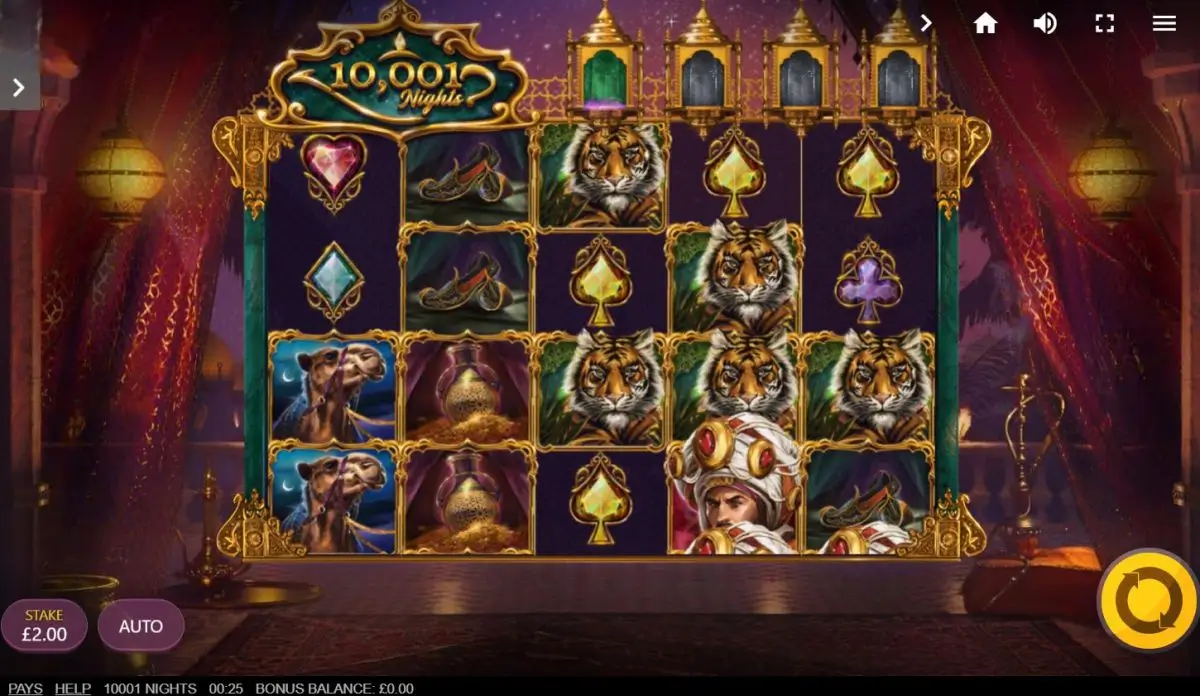
The visual environment is an interior room of an Arabian palace. Gold-edged reels sit in front of a balcony opening onto a star-filled desert night. Curtains in deep red and gold frame the sides. Patterned carpets fill the floor. The overall effect is rich without being garish — Red Tiger’s design work here is genuinely strong.
The symbol set is split into two clear tiers. Low pays are four gemstone-style card suits: spades, clubs, hearts, and diamonds. Their crystal-shaped styling fits the aesthetic well enough that they don’t feel like a placeholder. For five of a kind, these pay between 1x and 2.5x your total bet — you need them to land frequently, not to pay well.
The high-pay symbols are the ones that matter. Embroidered shoes pay 3x for five of a kind. The ceramic vase pays 4x. A camel pays 6x, and a tiger pays 8x. Then there’s the Sultan — the top regular symbol, paying 40x for five of a kind. The Sultan has a specific quirk worth understanding: he pays on two or more matching symbols, not three like every other symbol in the game. That means two Sultans on a payline is already a winning combination. In a high-volatility slot where extended dry spells are normal, that two-Sultan hit provides a small but genuine cushion. It lands more often than a 40x max hit, obviously, but at lower counts it provides something rather than nothing.
The wild is an Arabian woman — dressed ornately, half-masked — and pays 55x for five of a kind. She substitutes for all standard paying symbols and appears stacked as a Mega Wild when that modifier activates. The scatter is a palace building. The lamp symbol is the functional core of the entire feature system: it appears on the reels, disappears immediately on landing, and each one fills the meters above the reels.
The symbol hierarchy matters in practice more than most reviews acknowledge. During base game play before the modifiers unlock, the card suits land often and pay little. Counting on them to sustain a session bankroll is not realistic — they are the buffer between losses and the higher-value hits, not a source of meaningful returns. The shoes, vase, camel, and tiger are where base game wins of any substance come from, and they land less frequently. The Sultan’s two-symbol minimum is a design choice that gives the top symbol a slightly different role from the others — a two-Sultan connection on a payline might return only a small multiple of your stake, but it is a return where nothing else would have connected. Over a long session those small hits accumulate into base game sustainability that the standard three-of-a-kind minimum symbol structure would not provide.
Animations run between spins. The tiger blinks. The card suits catch light. It is subtle rather than distracting during normal play, though after two hours on autoplay at the minimum stake you tend to stop noticing the blinking tiger entirely.
The soundtrack is Middle Eastern instrumentation — oud, strings, light percussion. Ambient and appropriately atmospheric for sessions that run long. It loops without jarring transitions. Through device speakers it holds up better than most slot audio at this production level; through headphones, the layering is more apparent and the mood sustains better.
The Lamp Collection System: How It Actually Works
Four meters sit above the reels on the right side of the screen. These meters fill when lamp symbols land anywhere on the grid. The lamp symbol disappears on landing — it doesn’t count toward paylines, it simply converts into oil that flows into the lowest unfilled meter. Once a meter is full, the corresponding modifier activates on the very next spin.
The sequence is fixed and always runs in the same order regardless of bet level:
Stage 1 requires six lamps total. This unlocks the Imperial Spin. On the triggered spin, all low-paying symbols — the four card suits — are removed from the reels entirely. Only high-value symbols, the wild, scatter, and lamp can appear. The result is a respin played on a cleaner reel set where every symbol that lands has meaningful payout weight.
Stage 2 requires seven additional lamps (thirteen collected total). This unlocks Random Wilds. A random number of wild symbols are placed across the reels. The count varies; it’s not always the same number. Some spins land one or two scattered wilds, others more.
Stage 3 requires eight more lamps (twenty-one total). This unlocks Multi-Pick. Three face-down cards appear and you select one. Each card reveals a win multiplier — confirmed values are x3, x5, or x8, with some sources citing x9 as a possible outcome. The multiplier does not expire after one spin. It stays active and applies to the next winning spin, regardless of how many non-winning spins occur in between. Critically, it also carries over into the Destiny Spins bonus round if you trigger free spins while a multiplier is live.
Stage 4 requires nine more lamps (thirty total). This unlocks Mega Wilds. Up to four full-reel wild symbols can land on reels two, three, four, and five. These are 1×4 column wilds — they cover an entire reel. Multiple mega wilds on the same spin creates wide wild coverage across the middle and right portions of the grid.
Once all four modifiers are unlocked at a given stake level, the lamp collection mechanic stops. No more lamps appear. From that point forward, modifiers fire randomly on any spin. More than one can fire on the same spin — a Random Wilds activation and an Imperial Spin on the same spin, for example, or Multi-Pick stacked with Mega Wilds.
This is where things get interesting and where most reviews drop the subject. The post-unlock phase is where the vast majority of real-money session time is spent. The early game has a clear goal: collect thirty lamps across four stages, each one unlocking a new capability. That progression loop has a beginning, middle, and end. Once it concludes, the game shifts into a different mode — features arrive randomly, you no longer track your progress toward anything, and sessions take on a different character. Whether that feels like a natural transition or a deflation depends on how invested you became in the meter-filling loop.
For players who run long autoplay sessions, the post-unlock phase is actually the main game. The lamp grind is the introduction.
One more rule that has real practical weight: if you change your stake mid-session, your lamp progress at that stake level resets to zero. You lose every lamp collected toward the next modifier. If you return to your previous stake, the progress you had at that level is saved. This is not a minor footnote — it is a meaningful constraint on stake management during a session. Deciding to raise your bet when the meters are close to filling means starting the lamp sequence over from scratch at the new level. Most reviews mention this in a single sentence. It deserves more than that.
Destiny Spins: The Free Spins Round
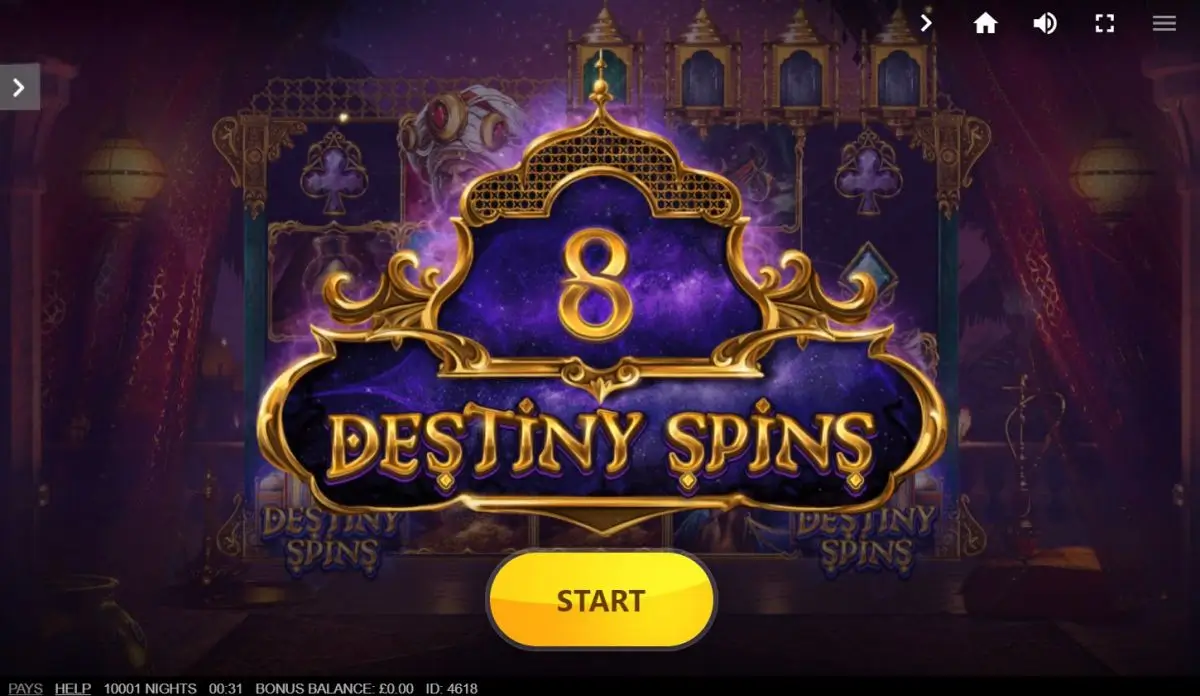
Destiny Spins trigger when the palace scatter lands on three, four, or five reels simultaneously. Three scatters award eight free spins. Four award ten. Five award twelve.
During the bonus round, all four reel modifiers remain active and can trigger randomly on any free spin. The same stacking rules apply — multiple modifiers can fire together. A Multi-Pick multiplier earned in the base game carries into the bonus. If you enter Destiny Spins with an active x5 multiplier, that x5 applies to every winning spin in the bonus until it is consumed. There is no built-in progressive multiplier in the original version — unlike the Megaways follow-up, which adds a multiplier that increases by x1 with each cascading win during free spins and can reach x20.
Retriggers are possible. Landing three, four, or five scatters during Destiny Spins adds six, seven, or eight free spins respectively. There is no limit on how many times this can occur.
Here is what the bonus looks like at its best — and this is a plausible scenario, not a guaranteed one. You enter Destiny Spins having just triggered Multi-Pick in the base game, and your selected card revealed x5. The modifier carries over. On the fourth free spin, Imperial Spin fires: card suits disappear from the reels, leaving only high-value symbols. On the same spin — or the next one — Mega Wilds activates and drops full-reel wilds on reels three and four. The reel state is now high-value symbols only, with two columns of wilds completing any line they touch, and a x5 multiplier sitting on top of the result.
That is where the 10,347x ceiling becomes a realistic rather than theoretical reference point. Getting all those conditions to converge in a single bonus requires everything to fall in the right order — active multiplier from Multi-Pick, Imperial Spin clearing the low symbols, Mega Wilds covering the right reels. Each element is individually achievable. Stacking all three in the same window is not common.
Without the Multi-Pick multiplier carrying over, Destiny Spins tends to produce more modest outcomes. The modifiers still help — Imperial Spin in particular changes the reel composition meaningfully — but the ceiling drops significantly when there is no multiplier in play. This is the honest version of how this bonus round works. The biggest numbers require multiple preceding conditions to align before you even get to the scatter trigger.
There is also a retrigger dynamic worth understanding. Landing three or more scatters during the free spins round adds further spins — six, seven, or eight depending on scatter count. A retriggered bonus that entered with an active multiplier and continues to stack modifier fires across an extended sequence is where the game’s outer edge becomes reachable. Retriggers are not frequent, but they are not theoretical either. When one lands during a spin where high-value symbols are already covering the grid from an Imperial Spin activation, the resulting additional spins play on favorable ground. The free spins round does not reset modifier states between spins — every spin in the bonus is played with whatever conditions are currently active, building on whatever came before.
Volatility, RTP, and How to Budget a Session
The RTP on 10001 Nights is 95.73% by default. That places it slightly below the industry midpoint, which most review aggregators set around 96%. The more important thing to understand is that the figure you see in a game’s Help screen may not be 95.73%. Red Tiger games — like many NetEnt-associated titles — are distributed with configurable RTP ranges, and operators set the version running on their platform. Some platforms display 94.73%. Some show 94.37%. Before you play a session for real money, open the Help section in-game and check which version is active. The difference between 95.73% and 94.37% is meaningful over any extended session.
Volatility is high. The game itself rates its hit rate at around 4/5, which means wins occur with reasonable frequency — but the average size of those wins is weighted toward infrequent larger events rather than steady small returns. What this produces in practice is a playing pattern where the base game generates small hits from card suits and the occasional two-Sultan landing while the lamp collection inches forward, then the modifier fire either does something meaningful or misses the right symbol alignment, and the significant wins concentrate in Destiny Spins when stacking conditions align.
The lamp grind has a specific bankroll implication. Collecting thirty lamps across four stages — with lamp symbols appearing randomly and not on every spin — takes time. During that grind, especially through Stages 1 and 2, there is no modifier cushion. The first Imperial Spin is a notable shift in the game’s texture when it finally fires. Before that point, sessions can feel like the game is withholding something. Because it is. That is the design intent.
Budget for at least enough spins to complete the lamp sequence before expecting to evaluate whether the game suits you. If you play ten or fifteen spins and leave having only seen Stage 1 unlock once, you haven’t really seen the game. You’ve seen the opening.
The visual pull of the lamp meters filling toward a new stage is deliberate. When Stage 3 is two lamps away from unlocking, there is a natural pressure to continue past a planned stopping point. If you’re using autoplay — which is available for up to 100 spins with configurable loss limits and win stop-points — set those limits before you start. The slow-build structure of this slot specifically rewards having clear boundaries before the session begins, not during it. Set a stop-loss at the autoplay screen, decide on a session budget that accounts for the lamp collection time, and let the game run on its own terms.
Playing on Mobile
10001 Nights runs on iOS, Android, and Windows Mobile across all major browsers. The 5×4 grid scales down to compact screens without losing legibility on the symbol level — camel, tiger, Sultan, and vase are distinct enough in their designs that recognition is not an issue on a 5.5-inch or 6-inch display.
The lamp meters, which sit above the right side of the reels, are the more critical concern on smaller screens. In windowed or browser-embedded mode, the UI overhead competes with the reel area for vertical space, and the meter display can feel cramped. Red Tiger’s own recommendation is to use full-screen mode, and that advice is worth following. In full-screen, the meters are clearly visible, the reels have room to breathe, and the overall layout handles the 5×4 format without element crowding.
Touch controls are responsive for standard play. The spin button, stake adjustment, and autoplay access are all reachable without awkward reach zones on standard phone dimensions. The Multi-Pick card selection — where you tap one of three face-down cards to reveal a multiplier — works cleanly on touchscreen. There is no precision requirement; the cards are large enough to tap without misselection.
Autoplay deserves a specific note for mobile sessions. Running the lamp collection sequence consistently at a fixed stake is easier on autoplay than on manual tap-to-spin, and for mobile specifically, sustained manual tapping through a 30-lamp collection is less comfortable than letting the game run. The autoplay configuration allows you to set maximum loss limits and win-stop triggers. Use them.
The soundtrack through phone speakers is serviceable — the Middle Eastern instrumentation retains its character at low volume and doesn’t collapse into muddy frequencies. Through headphones, the ambient layering and the subtle percussion work considerably better for extended sessions.
10001 Nights vs 10001 Nights Megaways
Red Tiger released a Megaways conversion of the original after the base game had established itself. The two versions share a name, a theme, a lamp collection system, and an identical max win ceiling (10,347x vs 10,346x — effectively the same number). Everything else is different enough to matter.
The original plays on a static 5×4 grid with 20 fixed paylines. Each spin is self-contained — symbols land, wins calculate, the spin ends. The Megaways version uses a dynamic grid where each reel holds between two and seven symbols per spin, creating anywhere from 62 to 117,649 ways to win on a given spin. This is not a minor variation in grid size. It changes the entire cadence of the game. Megaways spins produce more micro-hits simply because the ways-to-win count fluctuates so widely, and the cascading win mechanic — where winning symbols are removed and replaced, allowing chain reactions on a single spin — adds a layer of volatility that is absent from the original.
The most significant mechanical difference between the two versions is the Destiny Spins multiplier. In the original, the only multiplier available during free spins is the one carried over from a Multi-Pick activation in the base game. If you enter the bonus without a live Multi-Pick multiplier, no multiplier applies at all. The Megaways version adds a progressive multiplier that starts at x1 and increases by one for each cascading win during Destiny Spins, capping at x20. That progressive multiplier makes the Megaways bonus ceiling higher in conditions where cascades chain repeatedly. The Megaways version also has a confirmed x2–x7 multiplier range attached to Mega Wild symbols specifically.
The lamp collection system is preserved in both versions, which means the core progression loop — collecting thirty lamps across four stages to unlock modifiers that then trigger randomly — is the same experience in both. The modifiers can stack in both versions. The Destiny Spins retrigger structure is comparable.
RTP: the original defaults to 95.73%, while the Megaways version reaches up to 96% at its highest operator configuration.
The decision between them comes down to what you want from the format. If you prefer the predictability of a static grid where each spin delivers a fixed payline structure and cascading chains don’t complicate the win calculation, the original is the cleaner experience. If you want the progressive multiplier in the bonus round, the cascading mechanic, and more ways-to-win per spin, the Megaways version is mechanically superior in its best-case bonus scenarios. The original is the more straightforward slot. The Megaways version has a higher ceiling under optimal bonus conditions, but the base game is more turbulent.
The Bonus Buy Option
A bonus buy feature exists in some markets and is disabled in others. Regulated jurisdictions — including the UK — restrict or prohibit bonus buy as a feature, so availability depends entirely on where and through which operator you’re playing. If it is active on your platform, you can purchase direct access to Destiny Spins without waiting for the scatter trigger. Whether it’s worth the cost depends on whether you’ve already unlocked the modifiers, since a purchased bonus entered without active modifiers or a carried-over multiplier produces lower expected outcomes than one entered after a full lamp sequence completion.
What the Game Actually Is
10001 Nights is a session-length slot. It is not designed for ten-minute visits. The lamp collection sequence, the progression through four modifier stages, and the conditions that produce the largest Destiny Spins outcomes all require time to develop. If you’re the kind of player who runs autoplay at a fixed stake for extended periods, tracks modifier states, and finds genuine engagement in watching a game’s mechanical conditions accumulate over time, this game suits you well.
If you want consistent volatility peaks without a preceding grind, or if short sessions are your norm, the lamp system will mostly feel like delay rather than structure.
The visual quality is high for a 2020 release and has aged well. The four modifiers provide a level of base-game variation that keeps extended sessions from becoming monotonous once all four are active. The post-unlock phase, where modifiers fire randomly rather than in a trackable progression, is quieter than the meter-filling stage — the game loses the directional pull that makes the early portion engaging, though the random modifier fires continue to produce meaningful spins.
At 95.73% default RTP — or lower, depending on your operator — you are already playing slightly below the industry midpoint. That’s not disqualifying, but it is a real number worth knowing before you run a three-hour session.
The max win of 10,347x is not decorative. It reflects a genuine mechanical possibility when Multi-Pick, Imperial Spin, and Mega Wilds converge during a retriggered Destiny Spins sequence. Getting there is not common, but the path to it is a real sequence of events rather than a lottery draw.
One line of honest assessment: the game loses a specific kind of spark after all four lamps are complete. The collection phase has narrative direction — you’re building toward something. The random phase after is still functional, still produces modifier hits, still delivers Destiny Spins. But the clear sense of progress is gone. That shift is the main mechanical limitation of the design, and it’s worth knowing about before you commit to this game as a regular in your rotation.
Key Specs at a Glance
Provider: Red Tiger Gaming (NetEnt subsidiary) Released: 26 December 2020 Grid: 5×4, 20 fixed paylines RTP: 95.73% default (check in-game Help for operator-configured version) Volatility: High Max win: 10,347x stake Free spins: 8, 10, or 12 (3/4/5 scatters); retriggerable Modifiers: Imperial Spin, Random Wilds, Multi-Pick (x3/x5/x8), Mega Wilds Devices: Desktop, iOS, Android, Windows Mobile Bonus buy: Available in some markets; check your platform
Always gamble within your means. High-volatility slots require a session budget that accounts for extended periods without significant wins. If gambling is causing you stress, visit BeGambleAware.org or the relevant support resource in your country.