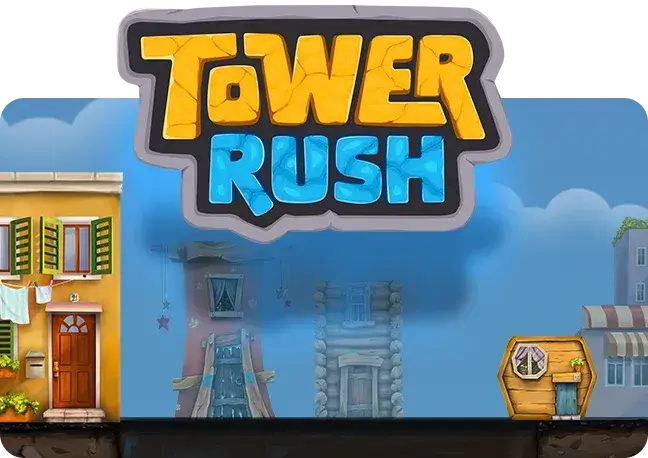
The floor is swinging. It hangs from a crane somewhere above a cartoon skyline, drifting left, drifting right — and you have about two seconds to decide whether to drop it or let it pass. Drop it too early and the tower wobbles. Too late, same result. Get it right and a number flashes on screen, your running multiplier ticks upward, and the crane swings another floor overhead.
That moment — that small, repeating window of decision — is what Tower Rush by Galaxsys is actually built around. Not a rising graph you watch until you panic. Not spinning reels you hope align correctly. You are the person dropping floors onto a building, one by one, and every successful placement moves a number in your favor. It’s a straightforward idea, borrowed directly from a type of game that existed on Siemens button phones twenty-something years ago. Galaxsys took that nostalgic mechanic, added proper bonus systems, wrapped it in competitive RTP, and released it in late 2024 — where it promptly won three awards at SiGMA 2025: Best New Game (Eurasia), Best Crash Game (Africa), and Best New Casino Game (Europe).
Whether the hype is justified is what this review addresses.
What Kind of Game Is This
Tower Rush sits in the instant game / turbo game category alongside titles like Aviator, Balloon, and Mines. The crash-game family resemblance is obvious: there is a multiplier that grows over time, you decide when to collect, and if you wait too long you lose everything. That’s the genre.
But the mechanical difference from Aviator is not cosmetic. In Aviator, you watch a plane climb a curve and press “cash out” at some point before it flies off screen. Your only input is timing that single cashout decision. The multiplier rises whether you do anything or not.
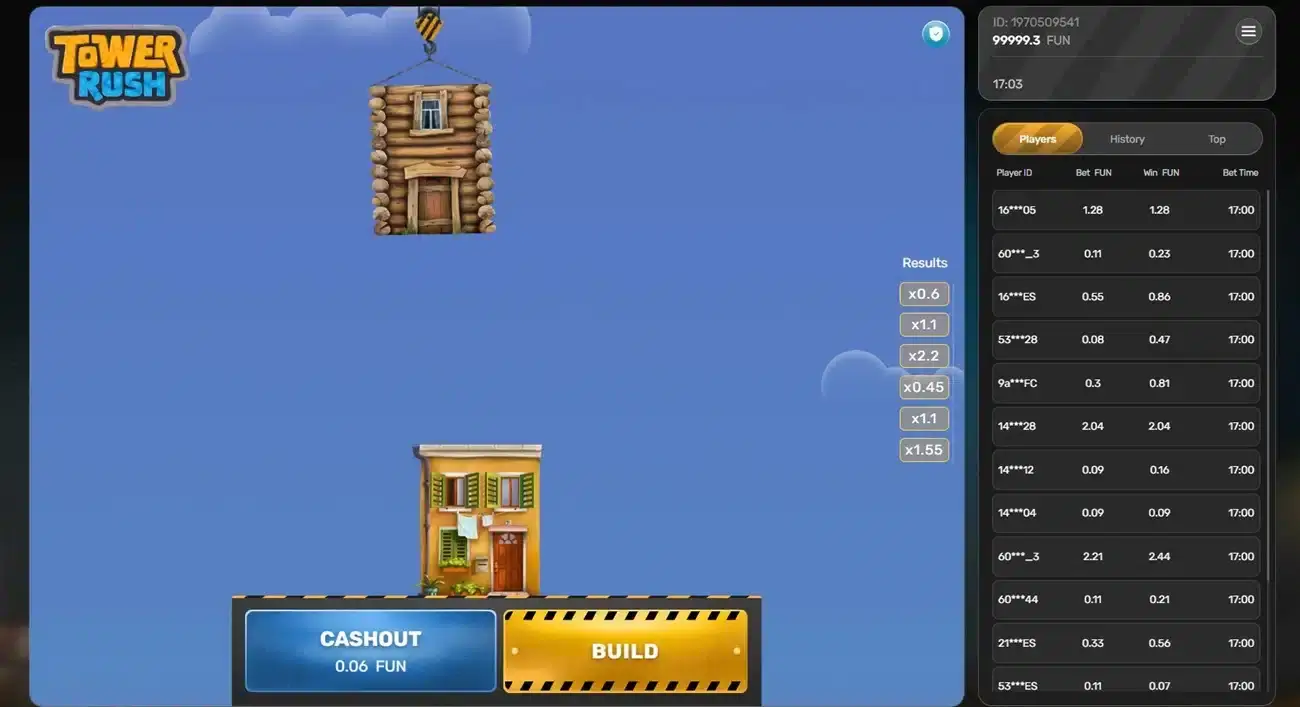
In Tower Rush, you have an active input every single floor. A floor segment drops from a crane and you press a button to release it onto the existing tower. If your timing is wrong, the floor doesn’t land cleanly and the tower collapses — round over, bet lost. If your timing is right, the floor locks in, a multiplier value gets added to your running total, and the crane swings the next one. At any point before that next floor drops, you can press “Cash Out” and take whatever multiplier you’ve accumulated.
The active input is real. The crane does swing, the floor does move, and mistimed releases do end rounds. What’s less clear — and most reviews skip this entirely — is how much that timing input actually controls your outcome versus how much the RNG is running in parallel. The answer matters, and we’ll get to it.
The Core Loop, Explained Properly
Here is exactly how one round of Tower Rush works.
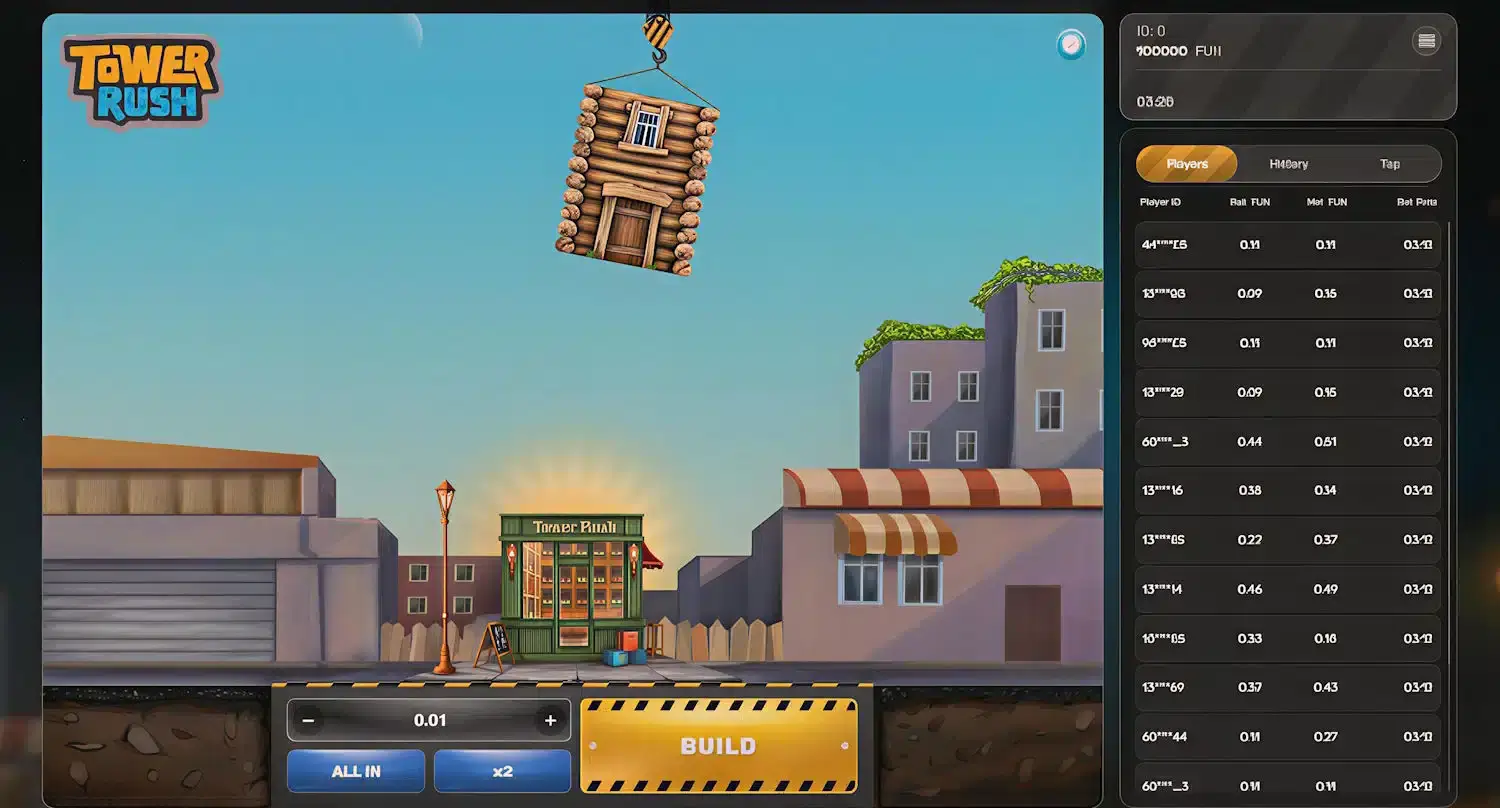
You select your bet — minimum $0.01 on most platforms, maximum $100. Then the round begins. A floor segment swings from a crane above the base of your tower. You watch it move and press “Build” to drop it. Land it well, it locks in. The game assigns that floor a multiplier value — something like x1.4, or x2.7, or occasionally x0.8 — and your session multiplier updates accordingly.
The critical detail most reviews get wrong: these multipliers are not added together. They are multiplied together. If your first floor gives x1.4 and your second gives x1.6, your running multiplier is approximately 1.4 × 1.6 = 2.24. Add a third floor at x1.9 and you’re at roughly 4.26x. The compounding effect means that a string of solid floors can move the total multiplier quickly — and it also means that a low multiplier floor (say x0.9 or x1.0) can actually pull the running total back down, not just slow its growth.
After each successful placement, the game presents you with a choice: cash out at your current multiplier, or wait for the crane to swing another floor. If you cash out, your original bet is multiplied by the current total and the round ends. If you wait and drop the next floor poorly — mistimed release, wrong angle — the tower collapses and you lose the bet.
Now, the part about collapse that no review explains clearly: there are two separate events that can end your round early. First is placement failure, where your timing is off and the floor doesn’t land on the tower. That is a direct result of your button timing. Second is tower collapse — where the structure becomes unstable and falls regardless of how well you placed the last floor. That second event is determined by the RNG. The game can decide, at any floor level, that the tower will fall on this attempt. Your placement precision doesn’t prevent it.
Galaxsys’s own documentation confirms the game uses certified RNG technology for each construction attempt. What isn’t publicly disclosed is the exact collapse probability formula — whether it increases as the tower gets taller, follows a flat probability per floor, or works through some other model. That uncertainty is real, and any review that tells you otherwise is filling gaps with assumptions.
Visual Design and the Siemens Connection
The art direction is deliberately cheerful. The tower base sits in a cartoon city — round-edged buildings, bright colors, no visual aggression. As the tower grows taller through a session, the background transitions from bright day to evening light, and eventually into a city-at-night palette. It’s a small detail that most players probably won’t notice consciously, but it contributes to the sense that something is actually happening as you build higher.
The animations are well-executed. Floor segments swing visibly on the crane, the drop has physical weight to it, and successful placements have satisfying lock-in feedback. There’s an audio layer that responds to the action — placement sounds, multiplier ticks, the audio shift when a bonus triggers. Nothing particularly innovative, but it holds together and doesn’t get irritating across multiple sessions.
What gives Tower Rush a grounding the visual polish alone wouldn’t provide is the lineage. The mechanic is explicitly inspired by a game type — most commonly remembered as Tower Bloxx — that shipped on Siemens mobile phones in the mid-2000s. You built a tower by timing floor drops from a swinging crane, the floors got progressively harder to place, and the whole thing ran on a 2-inch screen. Galaxsys has publicly acknowledged this inspiration. The connection isn’t just marketing. It explains why the mechanic feels immediately legible to anyone over thirty who remembers the pre-smartphone era of mobile gaming. For players who don’t have that reference, it makes no difference to the experience. But for those who do, there’s something satisfying about this particular nostalgia being brought into a context where the stakes are real.
RTP: What the Range Actually Means
Tower Rush carries an RTP of 96.12% to 97%. You’ll see this cited in every review, almost always without any explanation of why there’s a range rather than a fixed number.
Here’s why it’s a range. The RTP in Tower Rush is not a static configuration the way it is in most slots. The return you get is influenced by how you play: how many floors you build before cashing out, whether bonuses trigger and which ones, and potentially your placement precision (more successful floors means more multiplier accumulation before a given stake is resolved). A player who consistently cashes out at floor 2–3 operates under a different effective return profile than someone who regularly pushes to floor 8+. The bonus features — especially Frozen Floor and the Temple Floor wheel — materially affect individual session outcomes and skew the average return calculation.
The 96.12% represents the lower end of expected return under normal conditions. The 97% represents a higher-activity scenario where bonuses trigger and deeper building is sustained. Galaxsys has not published the full mathematical model determining exactly where in this range any given session falls, which is standard practice in the industry but worth acknowledging.
For context: the industry average RTP for crash-style games sits around 95%–96%. Aviator, one of the most played crash titles, is configured at approximately 97% — though operator settings can adjust this. Tower Rush at 96.12%–97% is competitive. The low end of Tower Rush is marginally below Aviator’s published default, but the high end matches it. The meaningful advantage Tower Rush has is low volatility, which affects how that RTP is distributed across sessions.
Low volatility means more frequent payouts, lower variance in individual session outcomes, and a longer average session before bankroll depletion at a given bet size. For casual players or those managing a limited bankroll, this is a practical advantage over medium-to-high volatility crash titles.
The Three Bonus Mechanics — Decision Logic, Not Just Names
Tower Rush has three bonus features. Every review lists them. Almost none explains what they actually mean for how you should play when they appear.
Frozen Floor
At a random point during a session, a floor segment appears covered in ice. If you successfully drop it into place, your current accumulated multiplier is locked. “Locked” means: even if the tower later collapses, you receive the payout corresponding to the multiplier value at the moment the Frozen Floor was placed. Your downside is capped.
Additionally, every floor you place after a Frozen Floor is guaranteed to carry a multiplier of at least x1.5. The floor cannot contribute a sub-x1.5 value once the Frozen Floor is active.
What this changes practically: before a Frozen Floor, aggressive building is a risk-reward gamble — you might collapse and lose everything. After a Frozen Floor, the calculation shifts. You have a guaranteed minimum payout locked in, and every subsequent floor adds to it with a floor on individual multiplier values. This is the point in a session where extending your tower becomes significantly more rational. The Frozen Floor doesn’t eliminate collapse risk — the tower can still fall — but it eliminates the possibility of walking away with nothing.
Temple Floor (Wheel of Fortune)
Another random event: a floor segment shaped like a temple appears. Drop it successfully and you activate a bonus wheel. The wheel has ten sectors. Eight sectors award instant multipliers between x1.5 and x7, applied directly to your current session total. One sector awards a fresh Frozen Floor. The final sector’s outcome varies by source, so treat the “one Frozen Floor sector” as confirmed and the full sector breakdown as approximate.
The Temple Floor can trigger more than once in a single session. This is significant because a well-timed Temple Floor landing during a run that already has a Frozen Floor active creates a compounding effect: your locked minimum is already set, and the wheel spin multiplies the value of everything above it. A x7 wheel result during a high-multiplier run can dramatically alter what looked like an ordinary session.
Triple Build
Triple Build drops three floor segments simultaneously. Each one carries a multiplier above x1. Crucially: the tower cannot collapse during these three guaranteed placements. The Triple Build floors are safe.
This means Triple Build is the only moment in Tower Rush where you know the next three outcomes in advance. The multiplier will go up, the tower will not collapse. Triple Build can also trigger more than once per session.
The strategic reading: when Triple Build activates, you are in an acceleration window. Three guaranteed positive-multiplier floors land, no collapse risk during that sequence. When they’re done, normal probability resumes. If you’ve accumulated a satisfying total multiplier by the end of the Triple Build sequence, that is a rational cashout point. The risk environment changes back to default the moment Triple Build resolves.
Bonus Interactions
The three bonuses can appear in any order within a single session, and they can stack in terms of effect. The highest-value sequence — Frozen Floor locking in a base payout, then Temple Floor landing and awarding a second Frozen Floor via the wheel, then Triple Build accelerating the multiplier with zero collapse risk — is low probability but mechanically possible. Players who have reported their largest Tower Rush wins often describe some variation of this sequence. It’s not a strategy you can engineer; it’s a combination of RNG events that occasionally align favorably.
Skill vs. RNG: An Honest Assessment
Tower Rush is marketed as having a skill element. The marketing is partially accurate and partially misleading, and the distinction matters.
The skill that is real: your placement timing directly determines whether a floor lands. A mistimed drop means a failed placement and a collapsed tower. Practicing in demo mode does improve your timing accuracy. That improvement is meaningful — it reduces the rate at which you lose rounds to placement failure specifically.
The skill that doesn’t exist: your precision cannot influence when the RNG-determined collapse event occurs. The game runs a separate probability calculation for whether the tower will fall on any given floor attempt, independent of how well you placed the floor. You can time every drop perfectly across eight floors and still have the tower collapse on floor nine because the RNG generated a collapse event for that floor.
This is essentially the same situation as Aviator. In Aviator, you can feel like you’re controlling the outcome by pressing cash out at a particular moment, but the crash point was determined before the round began. In Tower Rush, you can feel like your precision controls the outcome, but tower collapse events are RNG-determined ahead of your action.
The difference is that in Tower Rush, poor placement skill genuinely does cause additional losses that pure RNG wouldn’t cause. Your skill floor has real economic consequences. An Aviator player who watches the multiplier passively and cashes out is not making a worse mechanical decision than one who is more “engaged.” A Tower Rush player with poor timing will lose rounds they would not have lost with better timing.
So the answer is: skill matters for avoiding self-inflicted placement failures, but it does not protect against RNG-determined collapse events. Both things are true simultaneously.
Tower Rush vs. Aviator: A Practical Comparison
This comparison gets lazy in most content — usually amounting to “Tower Rush has better features and higher RTP.” The truth is more nuanced.
RTP: Aviator’s default configuration sits at approximately 97%. Tower Rush runs 96.12%–97%. At the high end they’re equivalent; at the low end, Aviator nominally edges Tower Rush by about 0.88 percentage points. Over a 100-round session at $5 average bet, that difference amounts to roughly $4.40 in expected return. Not trivial, but not decisive.
Volatility: Tower Rush is explicitly classified as low volatility. Aviator’s volatility is medium and can vary by operator configuration. For a player whose priority is session longevity over maximum win potential, Tower Rush’s low volatility is a practical advantage.
Player input: Aviator requires one decision per round (when to cash out). Tower Rush requires one decision per floor (when to drop, then when to cash out at the end). The additional input per round increases engagement and also introduces an additional failure mode — placement errors — that Aviator doesn’t have. Whether you experience the extra input as more engaging or more stressful depends on your play style.
Bonus systems: Aviator has no in-round bonus mechanics. Tower Rush has three. The Frozen Floor specifically has no Aviator equivalent — it’s a downside-protection mechanic that fundamentally doesn’t exist in standard crash-game formats. This is Tower Rush’s clearest structural advantage for players who want some risk management built into the game rather than relying entirely on manual cashout timing.
Social features: Aviator displays other players’ live cashout activity, which creates a social feed that many players find engaging (and that research suggests acts as an anchoring bias — you see someone cash out at x4 and start calibrating your own behavior around it). Tower Rush has no equivalent social layer. Which version of this you prefer is a matter of taste.
Brand recognition: Aviator has been in the market since 2019 and is available on thousands of platforms globally. Tower Rush launched in late 2024. For new players entering crash-style games in 2026, both are readily accessible at most major operators. For players on smaller regional platforms, Aviator’s wider distribution still gives it an availability edge.
The honest verdict: they’re different enough that “which is better” is the wrong frame. Aviator suits players who want minimal interface, passive-style play, and a social feed. Tower Rush suits players who want an interactive input mechanic, built-in risk management via Frozen Floor, and lower volatility. Both are legitimate choices.
Betting Range and What the Max Win Actually Means
The bet range runs from $0.01 to $100 per round. The minimum is low enough to make Tower Rush genuinely viable for micro-staking — a $10 bankroll spread across $0.10 rounds gives you 100 rounds of runway, which is enough to experience the full range of bonus features without meaningful financial exposure.
The stated max win is $10,000. This figure appears consistently across sources and appears to be an absolute cap per session, independent of what the multiplier reaches. The theoretical max multiplier in a single session is very high — some sources cite 10,000x — but the $10,000 monetary ceiling means the bet size at which the multiplier cap becomes the binding constraint is relatively low. At $1 per round, a x10,000 multiplier would produce $10,000. At $0.01 per round, the max payout is $100 regardless of multiplier. At $100 per round, the $10,000 cap is reached at x100 multiplier, which is within the range of documented single-floor maximums.
Practically: the $10,000 cap is relevant for high-stakes players and essentially irrelevant for anyone playing below $10 per round.
Three Cashout Approaches That Are Actually Specific to Tower Rush
Generic crash-game strategy (cash out early, set a target multiplier) applies here, but Tower Rush has enough mechanical specificity that it supports more tailored thinking.
Conservative floor targeting. Cash out after floors 3–5, before any bonus events, targeting a 2x–4x multiplier range. This approach treats Tower Rush like any low-volatility game — small, frequent returns, limited exposure per round. Given the low-volatility classification, this is a legitimate approach that will produce more sessions in profit than loss over time, while never producing large individual wins. This works best with bet sizes of $1–$5 per round and a session budget that can absorb the natural variance of RNG outcomes.
Frozen Floor anchoring. Rather than planning a specific cashout floor, play each round until either a Frozen Floor triggers or the tower collapses — whichever comes first. When a Frozen Floor triggers, your downside is set. Now build aggressively. The guaranteed x1.5 per-floor minimum post-Frozen means you’re accumulating value with a known worst case. Cash out when the multiplier reaches a personally satisfying level or when you’ve built as far as you’re comfortable. This approach extends average session length and improves the probability of encountering the Temple Floor bonus during a protected run. Set a per-session loss limit before you start — even with Frozen Floor protection, sessions without a Frozen Floor trigger will resolve as losses.
Temple Floor escalation. When a Temple Floor triggers and the wheel spins, cash out immediately after regardless of the result. The wheel awarded you a multiplier boost — x1.5 to x7 added to your current total — and the temptation is to keep building on the elevated number. The counter-argument: the Tower Floor appeared randomly, the wheel was favorable, and the run that produced both favorable events has no reason to continue producing favorable events. Taking the guaranteed boosted payout and starting a fresh round is often the more disciplined choice. The exception is when the Temple Floor triggers immediately after a Frozen Floor — in that scenario, you have a protected floor and a multiplied total, and continuing to build carries meaningful value.
Mobile Performance and Technical Notes
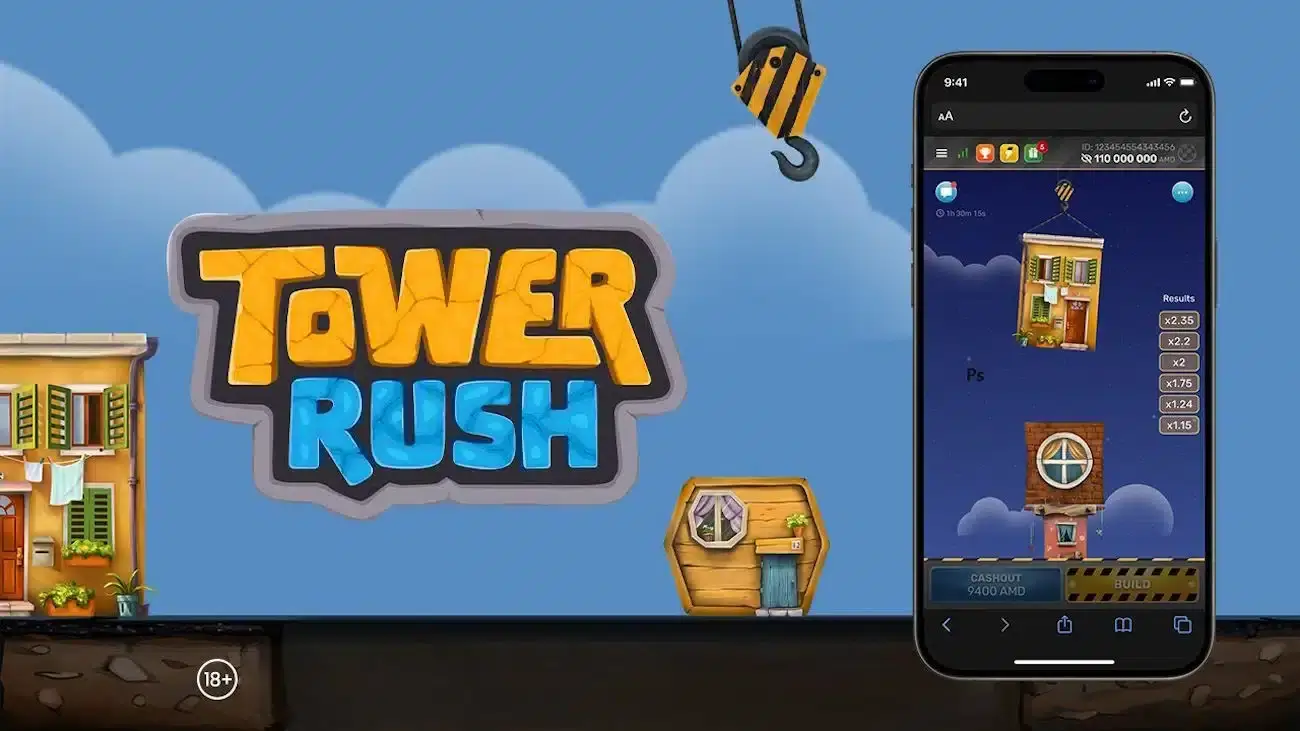
Tower Rush runs on HTML5 and loads directly in browser — no download, no app required. This is standard for the category and the implementation is solid. The game loads quickly on 4G connections and functions without notable lag on mid-range Android devices tested during this review.
The timing mechanic is worth thinking about specifically on mobile. The “Build” button press is the critical input, and on touchscreen it needs to register immediately. In testing, there was no perceptible delay between tap and release — the placement feels responsive at the same level as mouse click on desktop. That responsiveness matters more in Tower Rush than in a standard slot or even most crash games, because a delayed input genuinely affects your placement outcome.
The visual clarity of the floor position and swing arc holds up on a 6-inch phone screen. Some elements scale more tightly than on desktop, but the relevant information — current multiplier, crane position, Build button — remain clearly accessible.
Demo Mode and Provably Fair
Demo mode is available without registration at licensed casinos and at the Galaxsys developer site. The demo uses virtual credits with no real money and no real payouts. All three bonus features appear in demo mode at the same rates as real-money play. This is the right way to learn the timing mechanic — demo sessions let you calibrate how long you can wait before the floor swings too far and how precise your release needs to be.
On Provably Fair: this is a certification that most reviews mention and almost none explains. Provably Fair means that each round’s outcome is generated using a combination of a server seed (held by the casino) and a client seed (held by the player). Before a round begins, the casino commits to an encrypted hash of the server seed. After the round ends, the casino reveals the full server seed, and the player can independently verify that the result they received matches the hash they were shown before play started. This means the casino cannot manipulate outcomes after seeing how you’re betting.
Tower Rush’s Provably Fair certification is verified by eCOGRA and iTech Labs. These are independent testing laboratories. The certification applies to the RNG, not just the hash chain, meaning the randomness quality of the outcomes is also audited. For players in markets where regulatory oversight of online gambling is limited or absent, this certification provides a meaningful assurance level that the game is not rigged against them.
The Verdict
Tower Rush is a properly built game. The mechanical novelty is real — floor-by-floor building with timing input is genuinely different from a passive crash curve, and the active placement element makes individual rounds feel more involved than Aviator sessions tend to. The three bonus systems add depth that doesn’t exist in the crash-game standard: Frozen Floor in particular provides a risk-management mechanic that changes how rational players should think about session length.
The RTP range (96.12%–97%) is competitive for the category. Low volatility makes it accessible for players managing modest bankrolls. The $10,000 max win and $100 max bet give it enough ceiling for the occasional high-stakes session. The Provably Fair certification and award recognition from SiGMA 2025 confirm this is a serious commercial product, not a quick reskin of existing mechanics.
The limitations are real too. There is no autoplay and no auto-cashout — every placement and every collection requires a manual button press. Players who want to run sessions in the background won’t be able to. The bonus trigger frequency is not publicly documented, so players who go multiple sessions without seeing a Frozen Floor have no published baseline to reference. And the collapse mechanic — while RNG-certified as fair — operates as a black box from the player’s perspective. The exact probability model is not disclosed, which is industry-standard but still worth acknowledging.
For players new to crash-style instant games, Tower Rush is a more forgiving entry point than most alternatives: lower volatility, active engagement to maintain interest, and a protective mechanic in Frozen Floor that limits catastrophic rounds. For experienced Aviator players evaluating whether to try something different, the mechanical differences are substantial enough that Tower Rush doesn’t feel like the same game with a visual refresh.
Go in with a per-session budget you’re comfortable losing entirely. Use demo mode until the timing feels natural. When Frozen Floor appears, treat it as permission to build further than you otherwise would. Everything else follows from there.
Game specs at a glance:
| Detail | Value |
|---|---|
| Provider | Galaxsys |
| Game type | Instant / Turbo / Crash-style |
| RTP | 96.12% – 97% (variable) |
| Volatility | Low |
| Min bet | $0.01 |
| Max bet | $100 |
| Max win | $10,000 |
| Bonus features | Frozen Floor, Temple Floor (Wheel), Triple Build |
| Certification | eCOGRA / iTech Labs, Provably Fair |
| Platform | HTML5, desktop, mobile, tablet |
| Awards | SiGMA 2025: Best New Game (Eurasia), Best Crash Game (Africa), Best New Casino Game (Europe) |