Provider: TaDa Gaming | Released: September 2022 | RTP: 97% | Volatility: Medium-High | Max Win: 6,000x | Game Type: Arcade Plinko | Theme: Ancient Egyptian
What Is Plinko Empire, Exactly?
Before getting into the specifics, it’s worth clearing up something that confuses a lot of players searching for this game: Plinko Empire is not a slot. There are no reels, no paylines, no spin button. It belongs to the arcade-format Plinko genre — the kind of game where a ball drops from the top of a board, bounces off pegs, and lands in a prize slot at the bottom. TaDa Gaming released it in September 2022, and it sits in their portfolio alongside two other Plinko titles: Plinko (2023) and Plinko of Mine (2025).
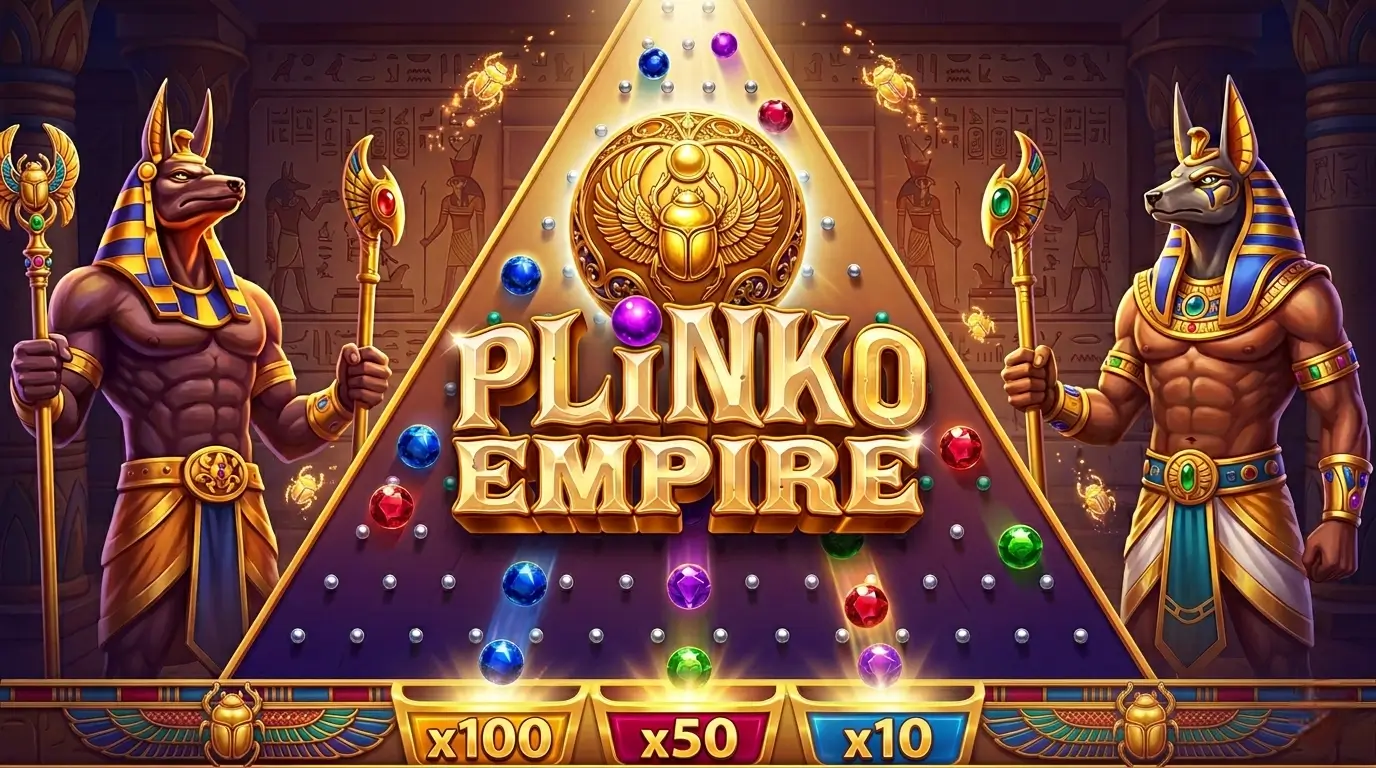
Some aggregator sites have mislabelled the theme — you’ll find “dinosaur” and “medieval knights” both floating around in descriptions online. Neither is accurate. The actual setting is Ancient Egyptian: a pyramid-shaped board, Anubis statues in the background, and visual language borrowed from pharaoh-era aesthetics. It’s a consistent theme that runs through the board design and the Wheel of Fortune bonus element.
TaDa Gaming is a Taiwanese studio founded in 2019, operating from Malta, with MGA and UKGC licenses. Their RNG certification comes from three independent labs — GLI, BMM, and GA — which is a solid credentialing stack for a mid-sized provider. The game is available across roughly 30 markets, with the strongest footprints in Canada, Austria, Poland, and Norway. It’s a fairly limited distribution compared to something like a Pragmatic Play title, but that’s partly a reflection of TaDa’s market positioning rather than any issue with the game itself.
Key Specs at a Glance
| Stat | Detail |
|---|---|
| Provider | TaDa Gaming |
| Release Date | September 2022 |
| RTP | 97% |
| Volatility | Medium-High |
| Max Win | 6,000x bet |
| Game Type | Arcade / Plinko |
| Theme | Ancient Egyptian |
| Jackpot Types | Lucky Jackpot, Super Jackpot |
| Min Balls Per Round | 5 |
| Paylines | None |
| Platform | HTML5 (mobile and desktop) |
| RNG Certification | GLI, BMM, GA |
| Available Markets | ~30 countries |
The Core Mechanics: More Agency Than a Typical Plinko Game
Standard Plinko games across the industry — BGaming’s version, Spribe’s interpretation, various unnamed clone formats — all follow a similar logic: you drop a ball, it bounces randomly, it lands somewhere. You pick a risk level and bet size, and that’s more or less the extent of your input. Plinko Empire adds one specific layer on top of that, and it’s worth understanding because it’s the mechanic that makes this game distinct.
The threshold system. Before each round begins, you can manually adjust the position of a threshold line on the board. This is your main decision point. When a ball passes through the threshold during its descent, its color changes — and that color change carries a multiplier bonus:
- 1 threshold pass: ×2 multiplier on the slot payout
- 2 threshold passes: ×4 multiplier
- 3 consecutive passes: ×6 multiplier
To put this in concrete terms: if you land in a slot worth 10x your bet and the ball passed through the threshold twice on the way down, your actual return is 10x × 4 = 40x. If you hit a 50x slot with three threshold passes, you’re looking at 50x × 6 = 300x on that single ball.
The placement of the threshold is where the partial strategy element comes in. Position it higher on the board and you’re giving balls more opportunity to pass through it multiple times, but you’re also increasing the number of peg deflections before the ball reaches the slot — which means more variance in the landing zone. Position it lower and you get fewer multiplier opportunities but more predictable ball trajectories toward specific slots. It’s not a deep strategy layer by any means, but it’s a genuine decision with real trade-offs, which puts Plinko Empire a step above purely passive Plinko formats.
Each round fires a minimum of five balls, so you’re never watching a single drop determine everything. That minimum creates a session rhythm — you’re evaluating a cluster of results per round rather than individual drops, which smooths out the moment-to-moment volatility somewhat.
It’s worth sitting with the threshold mechanic a bit longer because it’s easy to underestimate what it actually does. In most Plinko games, you set a risk level once and then passively drop balls for however long you’re playing. The risk level determines the spread of payout multipliers across the slots at the bottom — high risk concentrates value in edge slots, low risk spreads smaller returns more evenly. You make that choice once per session, or once per configuration, and then the game just runs.
In Plinko Empire, you’re making a placement decision before every single round. The threshold isn’t a global setting — it’s a per-round variable. That means you can shift your positioning based on how your session is going: if you’re running a decent balance and want to push for the multiplier chain, you angle for more threshold passes. If you’re in a tight spot and want to focus on the Spin Gate pathway toward the Wheel of Fortune, you position accordingly. The decisions aren’t complex, but the repetition of them across a session creates genuine engagement that passive drop games don’t produce.
There’s a ceiling on how meaningful this agency actually is, and it’s important to be honest about that. The ball trajectory through the peg field is still RNG-driven — the threshold position shifts probabilities, not guarantees. You can set the threshold in what seems like an optimal position and have five consecutive balls avoid it entirely. You can set it in what seems like a poor position and have three balls chain through it consecutively. The RNG governs outcome; the threshold position governs opportunity. That’s the distinction that separates partial agency from actual skill, and Plinko Empire sits clearly in the partial agency category.
The Spin Gate and Wheel of Fortune
The second key mechanic is the Spin Gate. This is a separate gate element on the board, and when a ball passes through it during descent, it triggers the Wheel of Fortune bonus.
The Wheel of Fortune can award direct cash prizes and — more significantly — can advance you toward the two jackpot tiers that sit at the top of the reward structure:
- Lucky Jackpot — the lower of the two jackpot tiers
- Super Jackpot — the higher tier
Specific prize amounts for the jackpots aren’t published as fixed figures; they’re operator-configurable and will vary depending on which casino you’re playing at and what the current jackpot pool looks like. That’s standard for jackpot-style mechanics in this category — the point is that the Wheel of Fortune creates a separate prize pathway that’s independent of where the ball lands in the slot grid.
The interaction between the threshold and the Spin Gate is the tactical core of the game. Both are gates on the board; positioning the threshold inevitably affects where balls are likely to deflect relative to the Spin Gate. You can’t optimize for both simultaneously with a single threshold placement. You’re always making a choice: chase the multiplier chain or angle for the Wheel of Fortune trigger. In practice, that choice depends on your session goals and current bankroll position, which makes the game more interesting to think about than most arcade Plinko titles.
RTP and Volatility: What 97% Actually Means in Practice
A 97% RTP is genuinely strong for this game format. To give some context: BGaming’s Plinko runs at a higher rate but is a fundamentally different game structure (adjustable rows 8–16, provably fair, no bonus wheel). TaDa’s own Plinko of Mine sits at 96.8% RTP with a 1,000x max win ceiling. Plinko Empire’s 97% with a 6,000x ceiling is a competitive combination on paper.
In practice, medium-high volatility means your session experience will feel inconsistent. The threshold multiplier chain — particularly the ×6 on three consecutive passes — is not something you’ll see in most rounds. On medium-high volatility, the game will have stretches where balls land in lower-value slots without triggering meaningful threshold chains, punctuated by rounds where the multipliers and a strong slot position align and produce a disproportionate return.
The 6,000x maximum win is achievable in theory (high-value slot + ×6 multiplier chain + Wheel of Fortune jackpot converging), but realistically it requires several elements to align simultaneously. This isn’t a criticism — it’s the mathematical reality of how variance works in medium-high volatility games. The 97% RTP means the return rate over a large sample of rounds is favorable compared to many slot games, but the per-session distribution will be uneven.
For bankroll management purposes, treat Plinko Empire like any medium-high volatility arcade game: session swings will be significant. A 50–100 round sample isn’t enough to see the RTP smooth out meaningfully. If you’re playing with a limited budget, the minimum 5-ball round structure gives you some floor on how quickly a single round resolves, but it won’t prevent extended losing sequences during cold variance runs.
One practical implication of the medium-high volatility is that the threshold multiplier chains — specifically the ×6 that requires three consecutive threshold passes — function more like jackpot events than regular occurrences. You’ll have rounds where the threshold fires once or twice, rounds where it doesn’t fire at all, and occasional rounds where you hit the full chain. The mathematical expectation of 97% RTP is real, but it’s a long-run average across a high volume of rounds, not a per-session guarantee.
This is also why the Wheel of Fortune pathway matters for the session experience. The jackpot tiers give players a secondary goal that doesn’t depend on threshold alignment — you can be in a cold stretch on threshold chains and still be making progress toward a Spin Gate trigger and a Wheel of Fortune spin. That dual-pathway structure (threshold multipliers + jackpot via Spin Gate) is more psychologically satisfying during variance stretches than a game that has only one reward pathway.
Theme and Presentation
The Ancient Egyptian setting is executed competently without being particularly distinctive. The pyramid-shaped board is the most visible design element — it gives the board a recognizable silhouette that fits the theme better than a generic rectangle would. The Anubis statues in the background are present and recognizable but don’t animate as active game elements. The Wheel of Fortune adds a visual break when triggered, with the spinning wheel sitting distinctly against the main board aesthetic.
The overall visual production quality is what you’d expect from a 2022 TaDa Gaming title: clean, functional, with Egyptian motifs used consistently throughout the UI. It’s not the most visually ambitious game on the market, but the theme is coherent and accurately rendered, which puts it ahead of some competitors that slap a superficial theme onto a generic board.
Sound design follows the standard arcade Plinko pattern — ball impact sounds, distinct audio for threshold passes, a separate audio cue when the Spin Gate fires. The Wheel of Fortune trigger has its own audio sequence. None of this is groundbreaking, but it does what it’s supposed to: create audio feedback that confirms what happened on screen without being intrusive.
The HTML5 build runs on both desktop and mobile without layout adjustments required. The portrait-friendly format that TaDa uses for their Plinko games works well on smartphone screens — the board, controls, and prize display all fit within a standard mobile viewport without needing to zoom or scroll.
How Plinko Empire Compares to Other TaDa Plinko Games
TaDa Gaming has built a small Plinko sub-portfolio, and it’s worth understanding how Empire relates to the other two titles.
Plinko of Mine (2025) is the most recent and most mechanically developed of the three. It offers adjustable volatility (player-configurable, not just one fixed setting), a Free Balls feature that grants additional drops when a ball lands in a specific zone, and a Special Game bonus round that can deliver up to 99 free balls with a separate multiplier configuration. The RTP is 96.8% and the max win caps at 1,000x. Plinko of Mine is the better-featured game in terms of bonus depth, but the 1,000x ceiling is a significant constraint compared to Empire’s 6,000x.
Plinko (2023) is TaDa’s basic Plinko title — the stripped-down entry in the catalog. Less documented in available reviews; primarily referenced as a simpler format.
Plinko Empire sits in an interesting middle position: more bonus depth than the basic Plinko, less configurable than Plinko of Mine, but with the highest max win of the three. For players who prioritize upside potential and are comfortable with the fixed volatility setting, Empire is the one to choose. For players who want the ability to dial in their own risk level session by session, Plinko of Mine is more flexible.
Plinko Empire vs. BGaming Plinko
The comparison that comes up most often for players researching Plinko games is with BGaming’s Plinko, which is a fundamentally different product built on a different philosophy.
BGaming’s Plinko uses provably fair technology — every round’s outcome can be verified independently through server and client seeds, which is a transparency feature that TaDa’s certification approach (GLI/BMM/GA auditing) doesn’t replicate in the same way for players. BGaming also allows players to adjust the number of rows (8–16) and switch between Manual and Auto drop modes, plus maintains a board history that some players use to inform their dropping strategy. The RNG-certified approach of Plinko Empire means TaDa controls the backend verification rather than exposing it at the player level.
On pure functionality, BGaming’s configurability is deeper. Plinko Empire’s advantage is the threshold mechanic, the Egyptian aesthetic, and the Wheel of Fortune jackpot pathway — none of which exist in BGaming’s more minimal format. They’re solving different preferences. If you want maximum transparency and configuration flexibility, BGaming. If you want a more narrative-inflected experience with a jackpot path and partially interactive board, Plinko Empire.
There’s also a structural difference worth noting in how the two games handle session pacing. BGaming’s Plinko, particularly in Auto mode, can run very quickly — balls drop at high frequency, results accumulate fast, and you’re primarily watching rather than deciding. Plinko Empire’s per-round threshold placement creates natural pause points that slow the session cadence slightly. For some players, that’s friction they don’t want. For others, the decision moment makes each round feel more deliberate. Whether that’s a feature or a limitation depends entirely on what kind of session experience you’re after.
Certification, Licensing, and Trust Signals
TaDa Gaming’s dual licensing under MGA (Malta Gaming Authority) and UKGC (UK Gambling Commission) puts them in the credible tier of providers. Both licenses carry genuine compliance requirements, and the RNG certification from three independent labs — GLI, BMM, and GA — means the outcome generation has been externally verified through established testing frameworks.
The ~30 country availability is partly a consequence of this licensing scope. MGA and UKGC licenses cover a wide range of regulated markets, though not all global regions. Players in the top markets (CA, AT, PL, NO) will find the game more widely available at licensed operators.
Who Should Play Plinko Empire?
The game fits a specific player type:
It works well for players who: want a Plinko-format game with above-average RTP (97% is genuinely good); appreciate partial decision-making within a game round rather than fully passive dropping; are drawn to Egyptian aesthetics; find the jackpot pathway via Wheel of Fortune an appealing session goal; and are comfortable with medium-high volatility swings over extended sessions.
It’s less suited to players who: want provably fair verification at the player level; need operator-configurable volatility (Plinko Empire uses a fixed medium-high setting); are playing with a small bankroll that can’t absorb extended cold variance; or prefer a max win ceiling higher than 6,000x (some crash-format games go well beyond this).
The minimum 5-ball round structure means each round has slightly more action than a single-drop Plinko format, which helps with engagement without artificially extending rounds unnecessarily. The game doesn’t have an Auto mode documented in available specifications — if session automation is important to your workflow, verify this with the specific casino offering the title.
What the Competing Reviews Get Wrong
Most published content on Plinko Empire contains at least one factual error worth flagging:
Theme confusion is the most common. Multiple aggregators describe a medieval or dinosaur setting. The actual theme is Ancient Egyptian — pyramid board, Anubis statues — which is confirmed by both GamblersPick’s player review (citing the “brown pyramid-shaped gaming field and Anubis statues”) and the game’s visual materials on TaDa’s own site.
Genre mislabelling. Several sites categorize it as a slot game. It is not. Zero paylines, no reels — it’s an arcade Plinko game. TaDa’s own site has categorized it variously as “Fish and Arcade” and “Slot” across different page versions, which is probably why the confusion propagates, but the gameplay is definitively non-slot in structure.
Threshold mechanic vagueness. Most reviews describe the threshold mechanic in one or two sentences without explaining the actual multiplier values (×2/×4/×6). Without that information, a new player has no idea what the threshold is actually doing for them during a round. It’s the game’s defining mechanic and deserves more than a passing mention.
Fabricated jackpot figures. Some content invents specific jackpot prize amounts. These are operator-configured and not fixed values — any specific number cited without attribution to a specific casino and date should be treated skeptically.
Finding Plinko Empire in 2026
Availability is one of the game’s genuine constraints. With a footprint of around 30 markets, it’s not ubiquitous the way Pragmatic Play or Evolution titles are. The strongest availability is in Canada, Austria, Poland, and Norway, according to aggregator data from SlotCatalog. If you’re outside those markets, availability will depend on whether your local licensed operators have a TaDa Gaming partnership.
TaDa Gaming’s dual MGA/UKGC licensing means the game is accessible through a reasonable range of regulated European and North American operators, but you’ll encounter more gaps than with a provider that has broader global distribution. If you can’t find Plinko Empire at your current casino, TaDa’s other titles (Plinko of Mine, Andar Bahar, Crown of Fortune) can indicate whether the casino has a TaDa relationship at all — if those games appear in the library, Plinko Empire may simply not be part of that operator’s specific title selection.
It’s worth checking whether the specific casino you’re using is running jackpot-enabled versions of the game. The Lucky Jackpot and Super Jackpot are operator-configured — some implementations may not have the jackpot pools active, which changes the Wheel of Fortune’s value proposition considerably. If jackpot access is important to you, confirm this with the operator before playing.
Verdict
Plinko Empire is a solid, competently executed arcade Plinko game with one genuine design contribution: the threshold mechanic. The ability to position a threshold on the board before each round, combined with the ×2/×4/×6 multiplier chain that fires when balls pass through it, creates a decision layer that most Plinko games don’t have. It’s not deep strategy, but it’s real agency — you’re making a trade-off every round between optimizing for threshold chains and angling for Spin Gate triggers, and those trade-offs have actual mathematical consequences.
The 97% RTP is the game’s strongest selling point alongside the threshold system. That rate is genuinely favorable for the genre and volatility level. The 6,000x max win is achievable through the alignment of multiple favorable events (high-value slot + ×6 threshold chain + jackpot via Wheel of Fortune), which means it’s a realistic ceiling rather than a theoretical one, but it requires the game to run hot in several dimensions simultaneously.
The main limitations worth acknowledging: the casino footprint is limited at roughly 30 markets, meaning availability varies considerably depending on where you’re playing. The volatility is fixed at medium-high — unlike Plinko of Mine, you can’t dial this down for lower-variance sessions. And the bonus feature depth is shallower than what Plinko of Mine offers in TaDa’s own lineup.
For players coming specifically from the slot format looking for something with a similar session feel, Plinko Empire will require some adjustment — rounds resolve differently from spins, and the threshold decision before each round is a new type of input to build habits around. For players already familiar with arcade Plinko games, the threshold mechanic adds enough novelty to distinguish this from the generic drop-and-watch format.
The Egyptian theme is accurate and well-executed for what it is. The Anubis statues and pyramid board give the game a consistent visual identity rather than a superficially applied coat of thematic paint. The HTML5 build handles mobile cleanly.
If you’re evaluating Plinko-format games specifically, Plinko Empire earns its place in the conversation primarily on RTP and the threshold decision system. It’s not the most feature-rich Plinko game available in 2026, but it’s a well-built one with genuine design intentions behind its distinguishing mechanics.
Score: 7.5 / 10
Strong RTP, honest volatility, and a genuinely interesting threshold mechanic carry the game. Limited distribution and fixed volatility hold it back from the top tier.