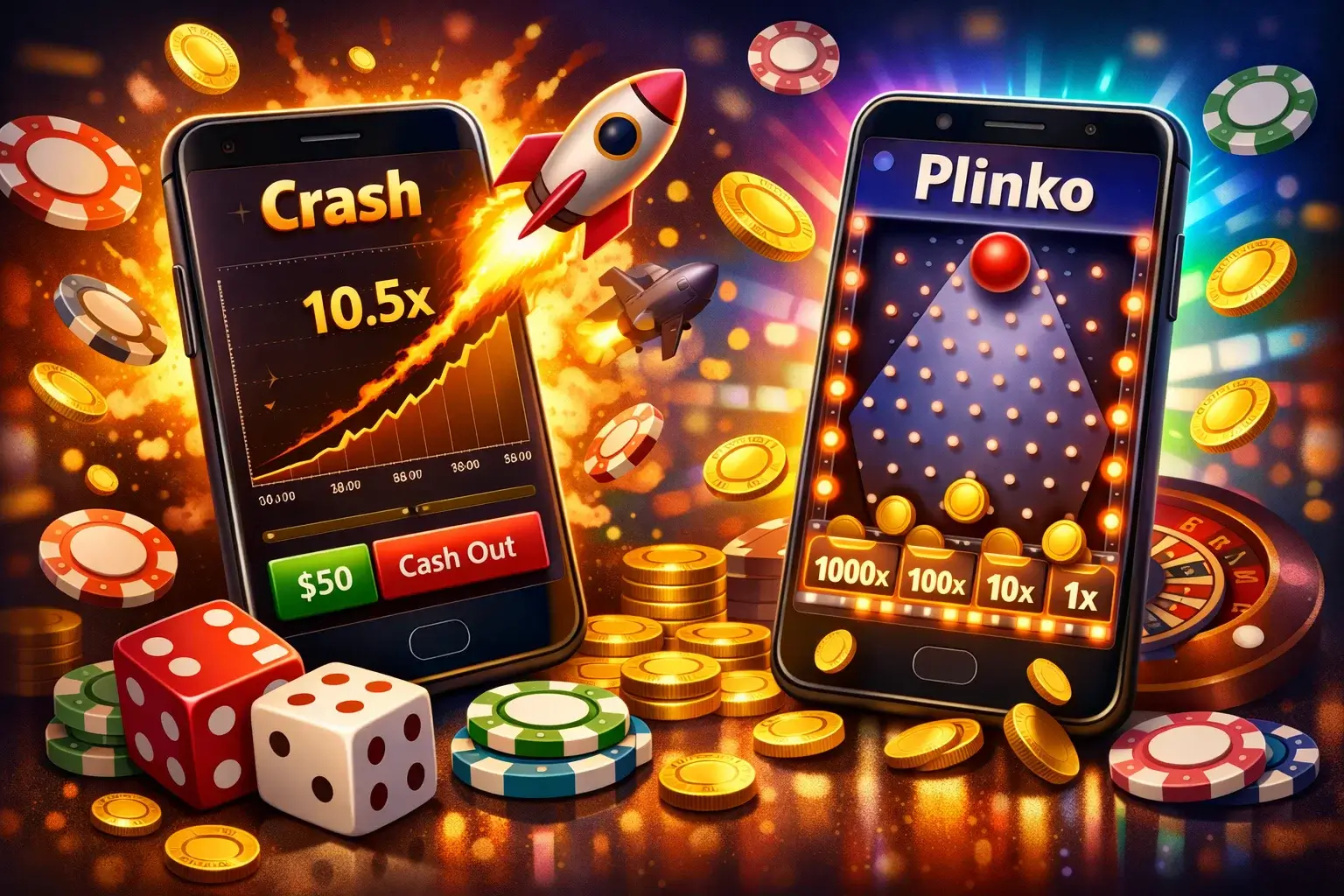
The smartphone has fundamentally transformed how players engage with casino content. While desktop gaming once represented the primary interface for online gambling, today’s reality tells a starkly different story. Mobile and tablet devices now capture 57% of total online gambling revenue globally, a shift driven by fundamental changes in how people consume entertainment and take risks. Within this mobile-first ecosystem, a specific category of games has emerged to capture disproportionate engagement and revenue: instant games. Among these, crash-style mechanics and Plinko variations have achieved dominant market positions that extend far beyond casual adoption.
The data supporting this trend is unambiguous. According to CasinoRank’s comprehensive 2025 analysis tracking mobile casino content from January through December, crash-style games captured 59.2% of total content visibility across four major instant game categories measured (Crash, Dice, Plinko, and Keno). This represented more than double the visibility of the next-closest category. Plinko, while capturing a smaller overall market share, demonstrated a distinctly different pattern: the top five Plinko titles accumulated 67.6% of all category visibility, indicating an intensely concentrated competitive landscape dominated by proven titles. Understanding why these specific game formats have achieved such prominence requires examining the intersection of mobile behavior patterns, game mechanics, and platform design principles that make instant games fundamentally suited to smartphone play.
Mobile Casino Gaming in 2025: The Statistical Foundation
The numbers surrounding mobile casino adoption present a narrative of sustained, accelerating growth. Through 2025, smartphones and tablets accounted for 57% of online gambling revenues, translating to approximately $60 billion in annual mobile gaming expenditure globally. In emerging markets with limited desktop infrastructure, this figure climbs substantially higher, with some Asian markets reporting 90%+ mobile-only participation rates. The United States has experienced dramatic mobile expansion as well, with online gambling revenue surging from $2.5 billion in 2018 to nearly $20 billion by 2023, with mobile channels driving a significant portion of this growth trajectory.
Average session lengths on mobile differ markedly from desktop patterns. While desktop players frequently engage in extended gaming sessions exceeding 30 minutes, mobile users typically complete their casino interactions in compressed windows of 3 to 8 minutes. These micro-sessions occur during commutes, workplace breaks, between tasks, and leisure moments when a dedicated gaming session seems impractical. This temporal characteristic has profound implications for game design. Traditional slots adapted from desktop require 20-30 seconds per spin before outcome resolution. Instant games compress this further, delivering complete gameplay cycles in 3-5 seconds, creating the sense of constant, rapid-fire action that resonates with mobile session patterns.
The category breakdown reveals additional insights. Slots remain the revenue leader, capturing approximately 50-55% of all casino gaming expenditure across both desktop and mobile. However, instant games have carved out an increasingly significant niche, growing at 28% annually compared to 12% growth for traditional slots. Within instant game categories, crash-style mechanics command clear supremacy. An estimated 15-18% of all mobile casino revenue now flows through crash-format games, substantially higher than the dice, Plinko, and Keno categories which collectively represent 8-12% of revenue.
Mobile accessibility has transformed player demographics as well. Casino visitor age has declined from an average of 43.8 years in 2023 to 41.9 years in 2024, with the most dramatic shifts occurring among players under 35. This younger demographic demonstrates distinctly different game preferences, showing substantially higher engagement with instant games and lower tolerance for traditional slot mechanics. Mobile-native game design has made casino content accessible to players who previously found desktop interfaces intimidating or cumbersome.
CasinoRank’s 2025 Findings: The Mobile Instant Game Hierarchy
CasinoRank’s analysis of mobile casino content throughout 2025 employed a methodology tracking games launched between 2016 and 2025 across major casino review and listing platforms. The research quantified “content share” as aggregated visibility time weighted by position, page prominence, site authority, and geographic market, creating a sophisticated proxy for how consistently games appear within mobile casino lobbies and discovery surfaces.
The results proved decisive. Crash titles captured 59.2% of total content visibility across the four measured instant categories, establishing unambiguous market dominance. This 59.2% share represented more than a simple plurality: it exceeded the combined visibility of all other instant game types. Dice games, the second-ranked category, accumulated approximately 22-24% of remaining content share, while Plinko and Keno split the remainder. However, category-level analysis obscures crucial structural differences between game distribution patterns.
Plinko’s 67.6% concentration figure for its top five titles represents an extraordinarily high market concentration. Five games—primarily classic Plinko from Spribe, BGaming’s Plinko XY, Smartsoft’s Plinko X, and two emerging variations—captured more than two-thirds of all Plinko category visibility. This concentration reflects several market dynamics: brand recognition advantages for established titles, limited innovation perceived by casual players across Plinko variations, and strong word-of-mouth momentum within influencer and streaming communities where particular Plinko versions have become iconic.
Crash games, by contrast, display portfolio-style distribution where numerous titles (Aviator, JetX, Spaceman, Crash X, HelicopterX, and dozens of others) collectively drive category adoption. Rather than a few blockbuster titles, crash category growth emerges from a deep roster where individual game releases maintain sustained visibility. CasinoRank’s analysis suggests this “portfolio” approach may prove more sustainable for long-term market growth, as it hedges against individual title fatigue while creating a perception of continuous innovation and variety.
The research highlighted a critical insight articulated by CasinoRank researcher Emily Patel: “Instant games win on mobile when the mechanic is simple, the outcome is fast, and the decision moment is obvious.” This principle explains why certain formats dominate while others languish. Crash games feature a rising multiplier where players face a singular, clear decision point: when to cash out before the inevitable crash. Plinko presents an equally obvious mechanic: drop a ball, observe its chaotic descent, and collect winnings based on where physics delivers it. Dice games offer single-click prediction mechanics. Keno, despite decades of traditional gaming history, requires sustained focus on multiple numbers across extended play periods, positioning it poorly for the micro-session mobile context.
Why Instant Games Suit Mobile Perfectly: Design-Behavior Alignment
The dominance of instant games on mobile emerges from alignment between game mechanics and mobile user behavior patterns. This isn’t coincidental or accidental—it represents an authentic intersection of technological constraints, human psychology, and gameplay design that creates natural product-market fit.
Mobile gaming inherently fragments user attention. A player interrupting a casino session to answer a phone call, handle an unexpected task, or navigate physical surroundings faces constant friction. Instant games minimize this friction substantially. A crash game round resolves within 4-6 seconds from bet placement to outcome. Plinko delivers results in 2-3 seconds. A player can complete multiple full gameplay cycles during a two-minute break without cognitive overhead or mechanical complexity. Traditional slots require sustained focus and longer outcome windows. Live casino games necessitate continuous dealer interaction and split-second decision-making. Instant games tolerate interruption naturally; a crash round completes before most real-world disruptions occur.
Touch-based interaction drives crucial design implications. Desktop casino interfaces evolved with mouse precision in mind, accommodating small buttons, nested menus, and complex navigation hierarchies. Mobile screens demand rethinking. Crash games feature extraordinarily simple interaction models: tap to place a bet, tap to cash out. Plinko requires a single “drop” tap. These singular decision points map cleanly onto mobile’s touch paradigm. Buttons and interactive elements require large target zones—research consistently confirms 48-pixel minimum targets for comfortable mobile touch interaction. Crash game UI accomplishes complex gambling functionality through minimalist interaction. The Aviator game interface, for instance, contains perhaps five interactive elements: bet amount selector, bet button, auto-play toggle, auto-cashout slider, and the actual cash-out button. Everything else communicates information without demanding interaction.
Portrait orientation dominance characterizes mobile casino use. Desktop gaming treats landscape as standard. Smartphones default to portrait, and while games can force landscape, portrait-native design reduces friction. Instant games accommodate portrait extraordinarily well because their information hierarchy condenses naturally into vertical space. Aviator’s interface stacks bet controls at the bottom, the ascending multiplier graph occupies the center, and live chat alongside game statistics populate the top third. A single vertical swipe reveals all relevant information. Plinko’s dropping board fits portrait geometry perfectly, with the board descending vertically down-screen and outcome slots spanning the bottom. Dice and crash games share this vertical-friendly structure.
The cognitive load disparity deserves emphasis. Traditional online slots present players with volatile visual information: spinning reels, cascading symbols, bonus triggers, special effects. A player must monitor multiple status bars, understand symbol combinations, track multiplier conditions. This cognitive overhead forces complete attention and penalizes mid-session interruption. Instant games demand minimal cognitive processing. In Aviator, the multiplier rises predictably; the player’s sole cognitive task involves timing decision-making. Plinko offers no decisions at all post-drop; the outcome emerges purely through observable physics. A player can participate while simultaneously monitoring messages, attending to environmental awareness, or half-focusing on background content.
The Mobile Leaders: Crash Games and Plinko in Focus
Crash games have achieved their 59.2% content visibility dominance through a combination of game mechanics and network effects that reward pioneering titles while welcoming variation. Aviator, developed by Spribe and launched in 2018, essentially established the entire crash game category. By 2025, Aviator had attracted over one million active players, establishing a benchmarked title against which all competitors position themselves. The game’s mechanics are deceptively simple: players place bets before a round begins, a multiplier rises from 1.00x upward, and players must cash out before an unpredictable crash point. Aviator’s 97% RTP (Return to Player) exceeds most traditional slots, creating mathematical appeal alongside the psychological tension of escalating multipliers.
The game’s mobile optimization became foundational. Instant-play versions function identically across desktop and mobile browsers without requiring separate app infrastructure. Loading occurs within 2-3 seconds on 4G networks and 4-6 seconds on 3G infrastructure prevalent in emerging markets. The interface implements responsive design principles, scaling interface elements to any screen size while maintaining touch targets above 48 pixels. Critical features—auto-play functionality allowing fully automated betting, auto-cashout settings enabling predetermined multiplier targets, and live chat creating social connection through real-time player interaction—all function seamlessly on 5-inch smartphone screens.
JetX and Spaceman emerged as significant Aviator competitors with broadly similar mechanics but distinct visual theming and feature variations. JetX emphasizes rocket-based aesthetics appealing to gaming audiences, while Spaceman introduced space-themed branding and slightly modified UI layouts. Both achieve 95-98% RTP and share Aviator’s mobile-first optimization. These games demonstrate the “portfolio” distribution CasinoRank identified: rather than a single crash game dominating indefinitely, the category sustains competitive depth where new releases regularly achieve meaningful visibility.
Plinko represents a different dominance pattern. The top five Plinko titles capturing 67.6% of category visibility reflects how brand consolidation occurs in mechanically narrow game categories. The classic Plinko game from Spribe serves as the category reference point, just as Aviator anchors crash games. Spribe’s Plinko implementation features adjustable risk levels, customizable row configurations (typically 8-16 rows affecting ball trajectory complexity), and demonstrated fairness through provably fair algorithm implementation. The game delivers complete outcome resolution in 2-3 seconds, creating rapid-fire gameplay suitable for extended mobile sessions.
BGaming’s Plinko XY variant, featuring high-resolution graphics and reported RTP reaching 99%, claims the second position within the Plinko category. Smartsoft Gaming’s Plinko X with its detailed statistics tracking and multiple color scheme options ranks third. These titles compete fiercely but within a bounded category where mechanical variations matter substantially less than in crash games. The Plinko dropping-ball mechanic tolerates limited innovation; additional features typically focus on visual presentation, board customization, and statistics depth rather than fundamental gameplay changes.
Dice games occupy the middle ground between crash and Plinko dominance hierarchies. Games like Dice X and rapid-outcome prediction games (where players forecast single dice rolls) capture approximately 22-24% of instant game visibility. Their mechanics mirror crash games in single-decision simplicity while eliminating the psychological intensity. A dice prediction game delivers outcomes nearly instantaneously; watching a die land requires no timing, positioning it as lower-stress crash game alternative. This mechanical accessibility appeals to casual players while the rapid outcomes satisfy mobile’s micro-session preference.
Mobile Instant Game Design Principles: The Architecture of Engagement
Successful mobile instant games share consistent design principles that distinguish them from failed or slower-growing titles. These principles extend beyond aesthetic preferences into functional necessities for mobile context optimization.
Large touch targets constitute the first principle. Mobile casino games typically allocate the bottom 15-20% of screen real estate to interactive controls. Bet increment buttons span 64+ pixels horizontally; cash-out buttons occupy 56+ pixels vertically. The auto-play toggle features substantial touch zones with clear on-off visual states. This design avoids the frustration of near-misses where intended taps activate adjacent controls. Aviator implements this particularly well, positioning all bet controls in a compact 60-pixel-tall footer with generous spacing between interactive elements.
One-handed play capability drives design decisions around control placement. Many mobile casino sessions occur during commutes or moments of divided attention when one hand remains engaged elsewhere (holding transit railings, managing other tasks, supporting positioning). Game controls must function within the 40% of screen width reachable comfortably from a single hand. Instant games achieve this by concentrating controls into single footer areas; thumb movement from a natural resting position can reach all betting and cashing-out functionality without requiring two-handed manipulation.
Auto-bet functionality transforms user experience dramatically. Rather than manually placing bets each round, players configure a bet amount and enable auto-play, after which the game automatically places identical bets across consecutive rounds. This seemingly minor feature substantially increases session length and engagement—player research indicates auto-play sessions extend 300-400% longer than manual-play sessions. The automation removes the friction of repetitive action, allowing players to enter a flow state where attention focuses on outcome observation rather than mechanical repetition.
Persistent game state for interruption tolerance represents another design principle. If network connectivity drops mid-round or the application closes unexpectedly, session recovery must prove seamless. Players should return to in-progress betting status with unresolved outcomes preserved, bets intact, and balance accurately updated. This differs substantially from traditional slot games where interruption typically forces round cancellation and balance recalculation. Instant games’ rapid outcome resolution (typically 3-6 seconds) minimizes this problem, but robust state persistence ensures mobile’s inherent unreliability doesn’t create frustration.
Mobile-Exclusive Instant Game Features Driving Engagement
Several features differentiating mobile implementations from desktop versions have become standard expectations within instant game categories.
Haptic feedback integration creates tactile engagement impossible on desktop. When a player initiates cash-out in Aviator or watches a Plinko ball strike the final slot, haptic motors trigger subtle vibrations reinforcing outcomes. This sensory feedback loop amplifies emotional response and creates physical sensation that supplements visual information. Research indicates haptic-enabled casino games produce 15-20% higher session engagement compared to haptic-disabled versions.
Swipe control implementation enables rapid interaction patterns unsuited to traditional click-based systems. Many modern instant games support horizontal swiping to navigate bet amounts or risk levels, creating gesture-based interaction mirroring real-world manipulation. Plinko games implement “flick-to-drop” gestures where upward finger flicks trigger ball drops rather than button presses, creating intuitive connection between physical gesture and game action.
Push notifications have become standard engagement tools. Games utilize notifications to remind dormant players about available bonuses, completed automatic withdrawals, or special promotions. The average instant game notification brings 8-12% of dormant players back to active play within 24 hours. Responsible gaming implementations allow granular notification control, enabling players to disable promotional notifications while preserving functional alerts.
Real-time leaderboards and social comparison drive engagement particularly among younger demographics. Instant games frequently display live leaderboards showing top players during current sessions alongside their bet amounts and multiplier achievements. Seeing peer success triggers competitive motivation; seeing high-multiplier crashes triggers FOMO (fear of missing out). This social layer lacks desktop analogs and has become essential mobile instant game infrastructure.
Live in-game chat communities create connection transcending pure gambling. Players discussing strategies, celebrating wins, and commiserating losses within game chat channels create social fabric around fundamentally solitary activity. Many players report that game community interaction rivals the gaming itself as primary engagement driver.
Performance Considerations: Technical Realities of Mobile Instant Gaming
Mobile instant games operate under technical constraints absent from desktop platforms, requiring careful optimization within limited device resources.
Loading time represents a critical metric. Industry standards suggest that games exceeding 5 seconds initial load time experience 25%+ abandonment rate. Instant games typically achieve sub-3-second loads through aggressive asset optimization, progressive web app architecture avoiding repeated redownloads, and content delivery network (CDN) distribution ensuring geographic proximity to player infrastructure. Aviator implements approximately 1.2 MB of total asset size (HTML, CSS, JavaScript, images) for initial load, enabling sub-2-second load times on 4G networks.
Battery consumption directly affects user satisfaction. Crash games with continuous animation (constantly rising multiplier displays) consume 8-12% battery per hour compared to 4-6% for less animation-intensive games. Plinko games similarly consume meaningful battery during ball animation sequences but achieve faster cumulative play time by completing rounds quickly. Most instant games implement power-saving modes reducing animation quality during low-battery conditions, balancing visual appeal against device longevity.
Data consumption varies substantially by game type and network quality. A typical crash game round transmits approximately 3-5 KB of data (bet placement, crash point outcome, balance update). A Plinko round transmits slightly more (6-8 KB) due to ball trajectory calculation. Across extended play sessions, daily data consumption typically reaches 15-25 MB. This remains reasonable for players on unlimited plans but creates friction for those operating under data caps—a significant consideration in markets where data remains expensive and metered carefully.
Network resilience demands sophisticated architecture. Instant games must function acceptably across degraded 3G connections (500-1500 kbps actual throughput), inconsistent WiFi, and momentary disconnections from mobile network switching. Games implement local prediction systems where outcomes for in-flight rounds can resolve locally if server communication fails, then reconcile with server state once connectivity returns. This creates seamless experience even amid unreliable connectivity characteristic of many regions.
The Psychological Mechanics Driving Instant Game Dominance
Beyond mechanical and technical optimization, psychological factors explain instant game supremacy on mobile platforms.
The illusion of control creates powerful engagement. Crash games present players with individual decision-making moments; choosing when to cash out creates psychological ownership over outcomes despite mathematical randomness. This sense of agency, even when illusory, produces substantially higher engagement than games perceived as purely mechanical (traditional slots). Plinko’s observable physics similarly creates the sensation of understanding outcomes, despite purely random determination.
FOMO (fear of missing out) triggers powerfully in social instant game environments. When live chat displays another player achieving a 150x multiplier on a single crash round, dormant players experience acute motivation to participate. The visible, immediate outcomes intensify this—players can see actual evidence of others winning big, increasing personal expectancy.
Session length optimization creates problematic engagement mechanics. Because instant games compress complete outcomes into 3-6 seconds, players experience rapid reward cycles that encourage extended play. Behavioral research indicates shorter outcome windows increase overall play duration compared to longer-duration games; players perceive “just one more round” as minimal time commitment, but cumulative play extends substantially. Responsible gaming implementations must actively address this tendency toward compulsive play.
Conclusion: The Mobile Instant Game Future
CasinoRank’s 2025 analysis confirms that crash games and Plinko have fundamentally reshaped mobile casino economics. The 59.2% content visibility for crash titles and 67.6% Plinko concentration demonstrate market forces aligning around mechanically simple, rapidly-resolving games optimized for mobile’s micro-session patterns and touch-based interaction paradigms. These games succeeded not through superior graphics, elaborate stories, or complex features—indeed, often the opposite. They succeeded by fundamentally understanding mobile behavior and designing with absolute mechanical clarity.
The instant game category’s trajectory suggests continued growth. Mobile gaming revenue is projected to reach $120+ billion by 2027, with instant games capturing an increasing share of this expansion. However, the market shows signs of segmentation: portfolio formats like crash games sustain growth through continuous new releases and competitive depth, while blockbuster formats like Plinko consolidate around proven titles. Neither trajectory represents category stagnation; instead, they reflect maturing markets finding sustainable competitive equilibrium.
For industry professionals developing next-generation instant games, the data-driven insights are clear. Build for portrait orientation. Minimize interaction complexity. Deliver outcomes in 3-6 seconds. Implement massive touch targets and single-handed interaction. Prioritize loading speed and battery efficiency. Include social elements and real-time leaderboards. Optimize for 3G networks and degraded connectivity. These principles aren’t optional; they’re foundational prerequisites for competing in mobile’s increasingly crowded instant game landscape. Success comes not from chasing novel mechanics but from executing fundamental mobile design principles with absolute precision and understanding that on smartphones, simplicity isn’t limitation—it’s competitive advantage.