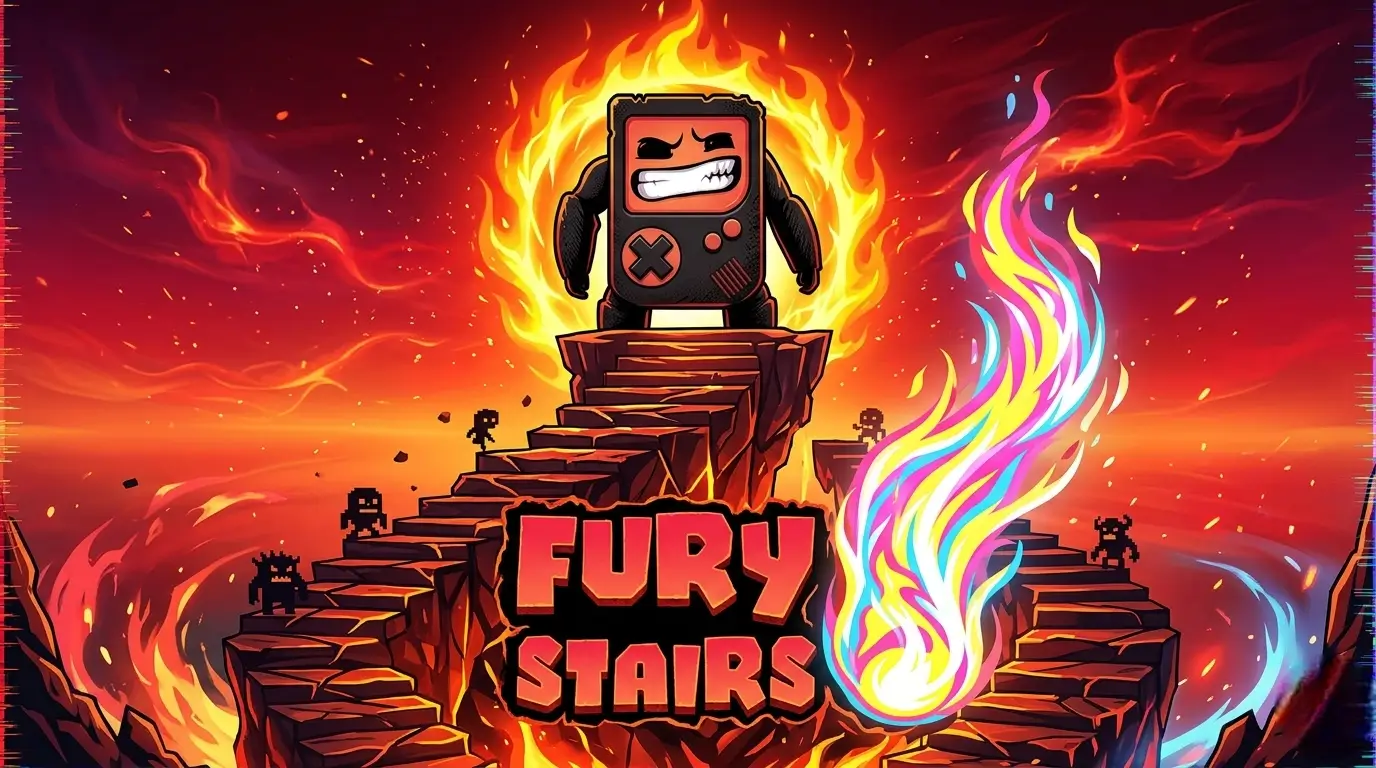
Turbo Games is not the kind of studio that hides its influences. Crash X looks like Aviator with better sound design. Hamsta borrows the grid format and flips it upside down. And Fury Stairs — released in late 2021 and still holding its place in lobbies heading into 2026 — lands squarely in the middle of two genres: crash games and mines. The result is something that handles differently from either.
Whether that’s a good thing depends entirely on what you’re looking for. This review covers every part of the game — mechanics, RTP, risk controls, payout ceiling, Provably Fair status, and the honest case for why you might want to skip it — based on confirmed specs and first-hand play.
What Kind of Game Is Fury Stairs?
Most crash games are passive in one key sense. You place a bet, watch a multiplier climb, and try to cash out before it crashes. The primary skill, if you can call it that, is timing a button press. Mines games add a grid — you tap tiles, reveal safe squares, and build a multiplier. Each pick is a binary outcome: safe or not.
Fury Stairs takes the grid logic from Mines and layers the escalating multiplier structure of a crash game on top of it. There are 13 rows of stairs per round. Each row contains a number of blocks — some safe, at least one containing a fireball. You pick a block. If it’s safe, your character climbs and a multiplier is locked in. You then choose: take the money now, or keep climbing for a higher multiplier. If your block has a fireball, your character is blown to pieces and the round ends. Bet lost.
That’s the whole game. But the decision of when to stop — and the fireball-count setting that determines how dangerous each row is — gives the game more texture than most of its genre neighbors.
How a Round Actually Plays Out
When you open Fury Stairs, the layout splits into two sides. The left panel is where you set your bet (between $0.10 and $100) and choose how many fireballs appear per row — anywhere from one to five. The right side shows the staircase grid with the rows of blocks and the multiplier attached to each successfully cleared row.
Once you hit Start, the first row appears. The blocks are all face-down — you don’t know which one has the fireball. You pick one. Your character climbs. If you cleared the row, the multiplier for that row appears, and you get a prompt: cash out or continue. If you hit a fireball, the round is over.
The rows are not uniform — they don’t all have the same number of blocks. This affects the probability of picking safely. More blocks per row with fewer fireballs means better odds on each individual pick. Fewer blocks and more fireballs tips the math the other way.
After each successful row, you see your current accumulated multiplier and you make the call. Stay or go. That moment — repeated up to 13 times if you’re on a good run — is where the game lives.
The game doesn’t rush that decision. The prompt sits there. You can see the multiplier you’d lock in by cashing out now, and you can see what’s waiting if you clear the next row. There’s no time pressure, no countdown. That absence of urgency is deliberate, and it makes the decision feel heavier than it might in a faster-paced game. Row eight at five fireballs, sitting on a 50x multiplier, is a genuine moment of hesitation — not because the game manufactures tension artificially, but because the math is real and the next row could end everything.
Fireball Count: Your One Real Control
Before each round, you choose how many fireballs hide in each row: one, two, three, four, or five. This is the central variable in Fury Stairs, and it matters more than any other setting.
At one fireball per row, you’re playing the most conservative version of the game. Individual picks are safer, the multiplier ceiling is lower, and your character survives rows more frequently. This is the format that works for longer sessions or players testing the game for the first time.
At five fireballs per row, you’re playing a high-variance format where the chances of clearing a row drop significantly. The multiplier ceiling is correspondingly much higher — with the maximum of 717.27x only achievable by clearing all 13 rows with five fireballs active.
The middle settings — two or three fireballs — sit between those extremes. Two gives you a reasonable balance between survival rate and multiplier growth. Three starts feeling genuinely dangerous around rows seven or eight, which is also where the multipliers get interesting.
The middle settings — two or three fireballs — sit between those extremes. Two gives you a reasonable balance between survival rate and multiplier growth. Three starts feeling genuinely dangerous around rows seven or eight, which is also where the multipliers get interesting.
Four fireballs is where the game starts behaving more like a high-volatility slot in terms of how often a round ends before building any meaningful multiplier. You’ll clear rows less frequently, and when you do, the climb upward feels more precarious. Running a session at four fireballs and watching multiple consecutive rounds end at rows two or three is a normal experience, not an anomaly.
What’s useful about this system is that the volatility control isn’t just a label — it directly changes how the math works on each row. You can feel the difference between one fireball and three within a few rounds. The game doesn’t artificially smooth out the results; a five-fireball round is noticeably different from a one-fireball session in terms of how often rounds end abruptly.
This also means Fury Stairs plays very differently depending on which setting you use. A one-fireball session is a methodical, lower-stakes game where you’re usually making it several rows in and deciding when to stop. A five-fireball session is a streak of short, abrupt rounds punctuated by the occasional long run that pushes into high multiplier territory. Both are valid formats — they’re essentially different games within the same interface.
RTP and Volatility
Fury Stairs carries a 97% RTP. That’s the highest figure in the Turbo Games lineup. For context: most of their titles sit at 96%, and Spin Strike drops down to 93.5%. In a market where 95–96% is common for crash games, 97% is a meaningful edge on paper.
In practice, what this means is that over a long run, the house hold on Fury Stairs is 3%. This is a theoretical long-run figure — it doesn’t guarantee outcomes in individual sessions, and it doesn’t change the fact that any single round can end on row one with one fireball active. RTP is a statistical measure across millions of rounds, not a session prediction.
That said, the 97% figure does matter for how you think about session variance. A game at 93% or 94% RTP will return less to players over time, and that gap compounds over extended play. If you’re choosing between two structurally similar games, the one with 97% RTP is returning more of your stake on average. That’s not a trivial difference.
Volatility is confirmed as Medium. That tracks with how the game actually plays at mid-range fireball settings. You won’t typically see extended cold streaks where nothing gets past row one, but you also won’t find that low-risk runs produce massive multipliers regularly. The tension accumulates gradually rather than arriving in occasional spikes.
At the highest fireball count, the effective volatility increases — you’re making higher-risk picks each row, and rounds end earlier and more abruptly on average. So in a sense, you’re adjusting your experienced volatility whenever you change the fireball count, even though the underlying 97% RTP figure holds across all settings.
The Payout Ceiling Problem
The 717.27x max multiplier sounds significant. In most crash games, a 700x win would translate to a very large payout.
In Fury Stairs, there’s a hard cap: the maximum payout per round is $10,000.
This is a real limitation, and it’s worth being clear about what it means. If you place the maximum bet of $100 and somehow clear all 13 rows with five fireballs — a statistically improbable result — your payout is capped at $10,000, not the $71,727 that a straight 717.27x multiplier on a $100 bet would produce.
For most players betting $0.10 to $5 per round, this cap is invisible. It won’t affect you. But for players who consider themselves high rollers or who are accustomed to games with uncapped or higher payouts, this is a real structural constraint.
Compare that to Crash X, another Turbo Games title, where the theoretical max multiplier reaches 999,999x. The payout architecture is entirely different. Fury Stairs is not designed for ceiling-chasing at high stakes — the cap makes that explicit.
If you’re evaluating Fury Stairs for high-bet play, the math means your effective max multiple at $100 bets is 100x (the $10,000 cap divided by $100 bet). That’s the honest way to frame it.
Provably Fair: What It Actually Means Here
Fury Stairs is Provably Fair. Each round has a hash value that’s generated before the round starts. After the round completes, players can verify that the hash matches the outcome — confirming the result was determined before any player input.
To access this in the game, use the cog icon in the top-right corner of the interface. This opens the settings section where you’ll find the game’s limits, rules, and the hash verification details.
What this verification does: it confirms the casino or provider did not alter the round result retroactively. The fireball positions were locked in before you picked a block.
What it does not do: it doesn’t give you an edge. Knowing the result was predetermined doesn’t tell you where the fireballs are before you pick. The randomness is genuine — Provably Fair is about verifiability, not predictability.
This is worth mentioning because the term gets used loosely in casino marketing. In Fury Stairs, it’s technically implemented — each round’s outcome can actually be verified against the hash.
One note: not all Turbo Games titles have confirmed Provably Fair status. Third-party reviewers have flagged that Aero and Wicket Blast don’t appear on lists of games with revealed hash values. Fury Stairs is not in that category — it’s one of the titles in the portfolio where the verification holds up.
The Design: Deliberately Simple
The visual design of Fury Stairs is minimalist. The main character is a small, blocky figure that reads immediately as a nod to Super Meat Boy — pixel-art style, expressly designed to meet cartoonishly violent ends when a fireball connects. The explosions are clean and brief. The staircase grid is clear and readable. The multiplier values sit visibly next to each row, so at any point during a climb you know exactly what you’d lock in by cashing out.
There are no elaborate animations between rows. No cinematic transitions. The game loads fast, advances fast, and doesn’t pad time with visual flair between picks. This is a deliberate choice, not a budget limitation — Turbo Games has shown with Aero and Crash X that they can produce more visually elaborate interfaces. Fury Stairs keeps things stripped back because the game is built around rapid decision-making, and visual clarity serves that better than anything decorative would.
The colour palette is relatively subdued — dark backgrounds, clear contrast on the block tiles, readable text for multiplier values. Nothing strains to catch your eye. This matters more than it might seem: in a game where you’re regularly making timed decisions about which block to pick, a cluttered interface would actually degrade the experience.
The audio follows the same logic. There’s music and sound design, and it fits the pace without demanding attention. The sound cues on successful row clears and fireball hits are distinct enough to be useful feedback without being intrusive. You can mute it via the top-right controls and lose nothing from the gameplay experience.
If you’re coming from visually elaborate slot games or live casino productions and expecting comparable production values, Fury Stairs will feel sparse. If you’re looking for a game that’s immediately readable and doesn’t slow you down, that minimalism is an asset.
Mobile Play
Fury Stairs runs in-browser on both iOS and Android without a download. The interface scales appropriately for smaller screens — the two-panel layout (bet selector on the left, staircase on the right) reads clearly on mid-size phone screens, and the block selection is tap-friendly.
This is standard across Turbo Games titles. The studio builds for mobile by default. Session lengths in Fury Stairs are short — a round can end in three seconds if you hit a fireball on row one — which makes it well suited to mobile play in fragmented sessions.
No specific performance issues were observed on standard Android mid-range hardware during testing.
Is There a Strategy?
No. The fireball placements are determined by RNG before each round starts. You cannot predict where they are. No pattern from previous rounds carries information about future rounds. There is no system that changes this.
What you can control:
Fireball count selection. This is the meaningful pre-round decision. Choosing one fireball means you’re playing a lower-risk format with a lower multiplier ceiling. Choosing five means you’re accepting a much higher chance of an early-round end for a chance at the top multiplier range. This is a bankroll and session-style decision, not a prediction tool.
Cash-out timing. After each cleared row, you decide whether to continue. There’s no correct answer here — it depends on your risk tolerance, your current multiplier, and your read on the session. Players who set a mental target multiplier (say, 5x or 10x) before starting and stick to it tend to have more predictable session outcomes than those who keep running hoping for the top.
Bet sizing relative to session length. With a $0.10 minimum, you can run a long session even with a small deposit. The $100 maximum is where the win cap starts to compress your upside.
One thing worth saying: Fury Stairs is a game where the tension is real in the moment, and that tension pushes people to take one more row when the rational move might be to cash out. Being aware of that dynamic is probably the most useful “strategy” the game has to offer — not because it changes the math, but because it changes how you respond to it.
Fury Stairs vs. JavelinX and Hamsta
Turbo Games makes three staircase-format games that are worth comparing if you’re deciding between them.
Fury Stairs vs. JavelinX — JavelinX came after Fury Stairs and improved on the visual and audio presentation. It also refined the mechanics somewhat. If you care more about production quality and audio, JavelinX is the more polished release. If you care about RTP, Fury Stairs at 97% is the stronger performer — public data for JavelinX RTP is not consistently confirmed in third-party sources, and unverified figures have been omitted here.
Fury Stairs vs. Hamsta Digging Gansta — Hamsta inverts the format: your character moves downward instead of upward, digging through a mine shaft. The genre mechanics are closely related — grid picks, hazard avoidance, escalating multipliers. The key difference is directional and thematic. Neither game has a meaningful mechanical advantage over the other; it comes down to which theme you find more engaging. Hamsta’s confirmed specs are not fully published in a way that allows a reliable direct RTP comparison here.
Within the Turbo Games portfolio, Fury Stairs’s 97% RTP is a genuine differentiator. It’s the highest in the lineup.
What the Game Gets Right
RTP. 97% is the headline stat, and it’s legitimate. In a genre where 95–96% is typical, this is the single most concrete advantage Fury Stairs has over most competitors.
Difficulty control. The fireball count setting is not a cosmetic option — it genuinely changes how the game plays. This is more granular player control than most crash or mines games offer.
Provably Fair with actual verification. The hash system works and can be checked. For players who care about fairness verification, this is a real feature, not marketing language.
Round speed. Rounds are short. Decision points are clear. There’s no waiting around between actions. The game moves at whatever pace you push it to.
Low entry point. $0.10 minimum bet makes it accessible for players who want extended session time on a modest deposit.
What the Game Gets Wrong (Or Just Doesn’t Have)
The win cap. $10,000 per round is limiting for high-stakes play. The 717.27x multiplier becomes misleading at bet sizes above roughly $14, where the cap kicks in before the theoretical max is reached. This is a genuine design constraint that affects a portion of players.
No bonus features. There are no free round mechanics, no scatter pays, no progressive elements, no multiplier boosts built into the game. What you see is what you get — place bet, climb stairs, cash out or lose. Players looking for feature depth will not find it here.
Average max win. 717.27x, while functional for mid-range bets, is modest compared to crash games with uncapped or near-uncapped multiplier structures. Crash X has a theoretical max of 999,999x. If ceiling-chasing is your format, Fury Stairs is not the right game.
Volatility ceiling. Even at five fireballs per row, the game’s medium volatility classification holds at an aggregate level. Players who want the kind of spike wins associated with high-volatility slots or high-cap crash games won’t get that experience here.
Verdict
Fury Stairs is a well-constructed, honest game that does exactly what it’s designed to do. The 97% RTP is the best in the Turbo Games lineup and above average for the crash game market. The fireball count system gives players more meaningful pre-round control than most comparable titles. Rounds are quick, the interface is clear, and the Provably Fair verification actually works.
The case against it is equally clear. The $10,000 payout cap is a real ceiling that limits appeal for high-stakes players. There are no bonus features or progressive mechanics. The max multiplier of 717.27x is modest compared to games with higher structural ceilings. And like all crash and mines hybrids, there’s no strategy that changes where the fireballs are — the only genuine decisions are fireball count and cash-out timing.
The player it suits: someone who prefers games where their choices have some mechanical weight, who values a high RTP over ceiling-chasing, and who wants rounds that resolve fast. The player it doesn’t suit: high rollers, players who want feature-rich gameplay, or anyone whose primary goal is the chance at a life-changing win.
At its minimum bet of $0.10, Fury Stairs is worth running in demo to see whether the tension of repeated cash-out decisions is the kind of engagement you’re looking for. That question answers itself fairly quickly.
Key Specs at a Glance
| Spec | Detail |
|---|---|
| Provider | Turbo Games |
| Release Year | 2021 |
| RTP | 97% |
| Volatility | Medium |
| Max Multiplier | 717.27x |
| Max Payout Cap | $10,000 per round |
| Bet Range | $0.10 – $100 |
| Rows | 13 |
| Fireballs per Row | 1–5 (player-selected) |
| Provably Fair | Yes (hash-verifiable) |
| Mobile | iOS, Android, browser |
| Demo Available | Yes |
Frequently Asked Questions
What type of game is Fury Stairs? It’s a hybrid of crash game and mines format, sometimes called a staircase or towers game. You pick blocks on a 13-row grid to climb a staircase while avoiding hidden fireballs, with the option to cash out after each successfully cleared row.
What is the RTP of Fury Stairs? 97%. This is confirmed and is the highest RTP in the Turbo Games portfolio.
What is the maximum win? The maximum multiplier is 717.27x, but payouts are capped at $10,000 per round regardless of bet size or multiplier achieved.
Can I adjust how difficult the game is? Yes. Before each round you choose how many fireballs appear per row — from one (lower risk, lower multiplier ceiling) to five (higher risk, higher ceiling). This is the primary risk control in the game.
Is Fury Stairs Provably Fair? Yes. Each round produces a hash value that players can verify independently using the settings icon in the top-right corner of the game interface.
Can I play on mobile? Yes. Fury Stairs runs on iOS and Android in-browser without any download required.
Is there a free play version? Yes. Demo play is available at most platforms that carry Turbo Games titles.
Is there any strategy for Fury Stairs? No. Fireball placement is RNG-determined before the round starts and cannot be predicted. The meaningful player decisions are choosing the fireball count before each round and deciding when to cash out after each cleared row. Bet sizing relative to your session budget is also a practical consideration.
What happens if I clear all 13 rows? You receive the maximum multiplier for the fireball count you selected — up to 717.27x — subject to the $10,000 payout cap.