There is a moment, somewhere around your fifth successful tile reveal, when you realise you are no longer playing a game — you are negotiating with yourself. Cash out now with a decent multiplier, or keep clicking into a grid where Anubis could be sitting one tile away. That tension is what Book of Mines is built on, and it is one of the reasons this Turbo Games release has held up well since its April 2024 launch.
This is not a slot. It has no reels, no spinning animations, no scatter symbols, no free spins round waiting to save you. What it does have is a minefield laid out on a customisable grid, two possible outcomes per tile, and a progressive multiplier that grows with every safe pick. Simple on paper, genuinely nerve-wracking in practice.
About the Developer: Turbo Games
Turbo Games has been operating since 2020, with its first title — a crash game called CrashX — arriving in March 2021. The studio is focused exclusively on arcade and instant games: crash games, dice, hi-lo, and mines variations. By early 2026 the portfolio has grown to over 30 provably fair titles, with Mines, DoubleRoll, and TurboPlinko among the most widely distributed.
The provider launched during an interesting period for the iGaming industry. While established studios were busy adding more features and complexity to video slots, Turbo Games bet on the opposite direction: short-form, player-driven games where the round structure is transparent and the mechanic is immediately legible. That positioning has held up. The category of arcade and instant games has expanded significantly since 2021, and Turbo Games has been one of the studios consistently releasing into it.
Book of Mines sits inside a lineage of mine games from the same studio — Mines, Turbo Mines, Multiplayer Mines, and 1Tap Mines came before it. Each iteration refined something. The original Mines title operated on a fixed 5×5 grid, following the same format most mine games use. Turbo Mines kept that format but added speed. Multiplayer Mines introduced a shared-game layer. Book of Mines takes the biggest structural step: it expands the grid size range dramatically and wraps everything in a fully realised thematic environment.
Book of Mines is the most visually ambitious entry in the series and the only one built around a specific narrative theme: ancient Egypt. It is worth understanding that context, because Book of Mines is not a standalone idea — it is what happens when a studio with genuine accumulated experience in mine mechanics decides to put real investment into presentation rather than just mechanics.
The “provably fair” standard that Turbo Games applies across its portfolio is meaningful here. Every round in Book of Mines can be independently verified by the player after the fact — the outcome is not determined server-side in a black box. More on that below.
Theme and Visual Design
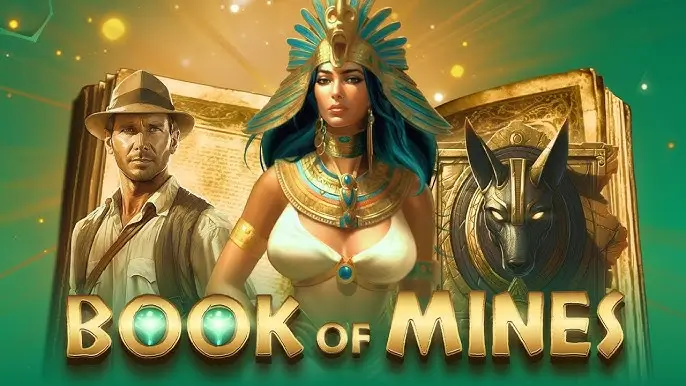
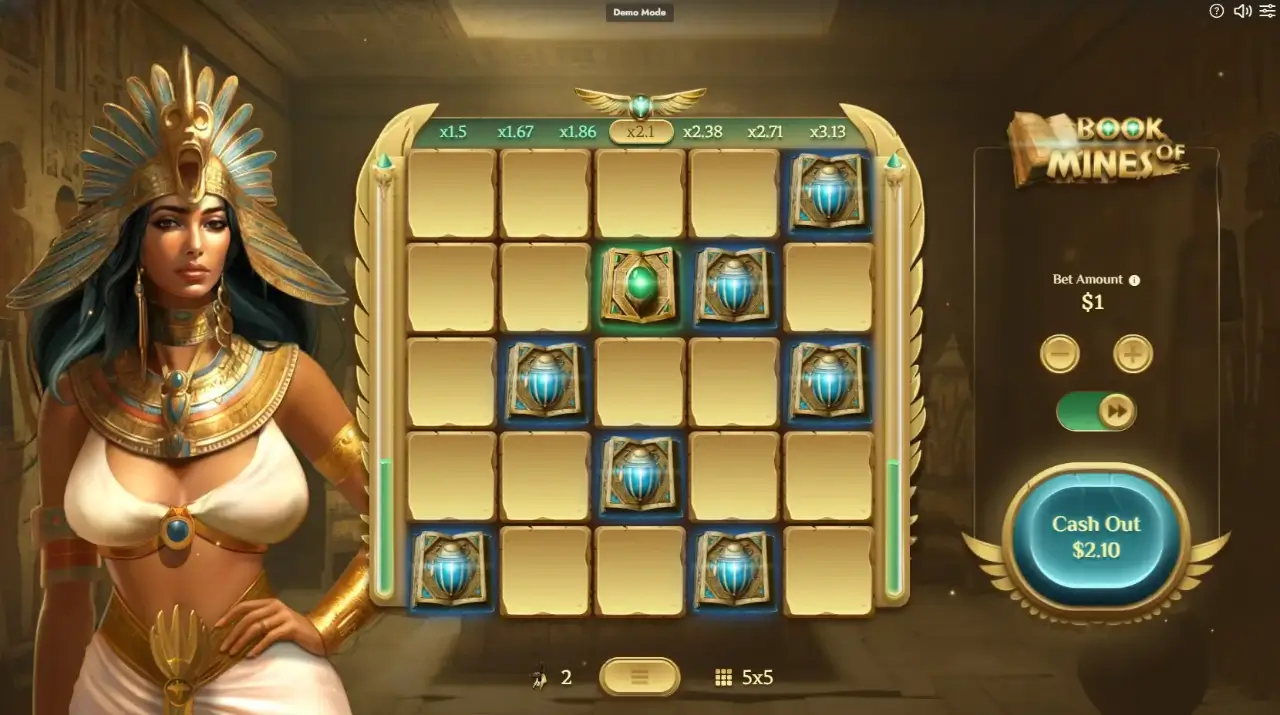
The game is set inside an Egyptian pyramid tomb. The background shows stone walls covered in hieroglyphs, with what appear to be fireflies drifting through the chamber air. On the left side of the screen stands an Egyptian queen character — elaborately dressed, with a headdress and golden jewellery — who occasionally glances toward the player with a faint smile. She does not affect gameplay in any way, but her presence gives the interface a warmth that most mine games simply do not have.
The soundtrack avoids the obvious clichés. There is no dramatic orchestral swell or cartoonish Egyptian motif. Instead the audio maintains a quiet, ambient mystery that sits underneath the gameplay without demanding attention. It is the kind of soundtrack that you notice when it is not there — unobtrusive enough that it never fights with the decision-making, present enough that it contributes to the atmosphere.
The two tile types are visually clean. Safe tiles reveal enchanted treasure books — ornate, glowing, with the kind of illustration detail that suggests an artefact with history. Mines reveal Anubis, the Egyptian deity of death and funeral rites, rendered with enough weight to feel like a genuine consequence rather than a cartoon explosion. The contrast between the two outcomes is sharp enough that even in fast play you always know immediately what happened.
The Egyptian queen character has attracted some attention in reviews — she is visually striking, designed along the lines of a stylised ancient Egyptian noblewoman, and her occasional animations break the monotony of a game that could otherwise feel static between clicks. Some reviewers find her distracting. Whether that is a negative depends on whether you prefer a completely minimal interface or one with a bit of life in it. For a game with no reel animations or feature triggers to provide visual interest, having a character presence that moves occasionally is a reasonable design decision.
Most mine games look like software prototypes with a thin graphical layer over a grid. Book of Mines looks like someone cared about the atmosphere. That distinction matters more than it might seem — when you are making repeated small decisions under pressure across multiple rounds, the environment you are sitting in affects how long you stay engaged and whether the experience feels worth returning to.
Core Mechanics: How the Game Actually Works
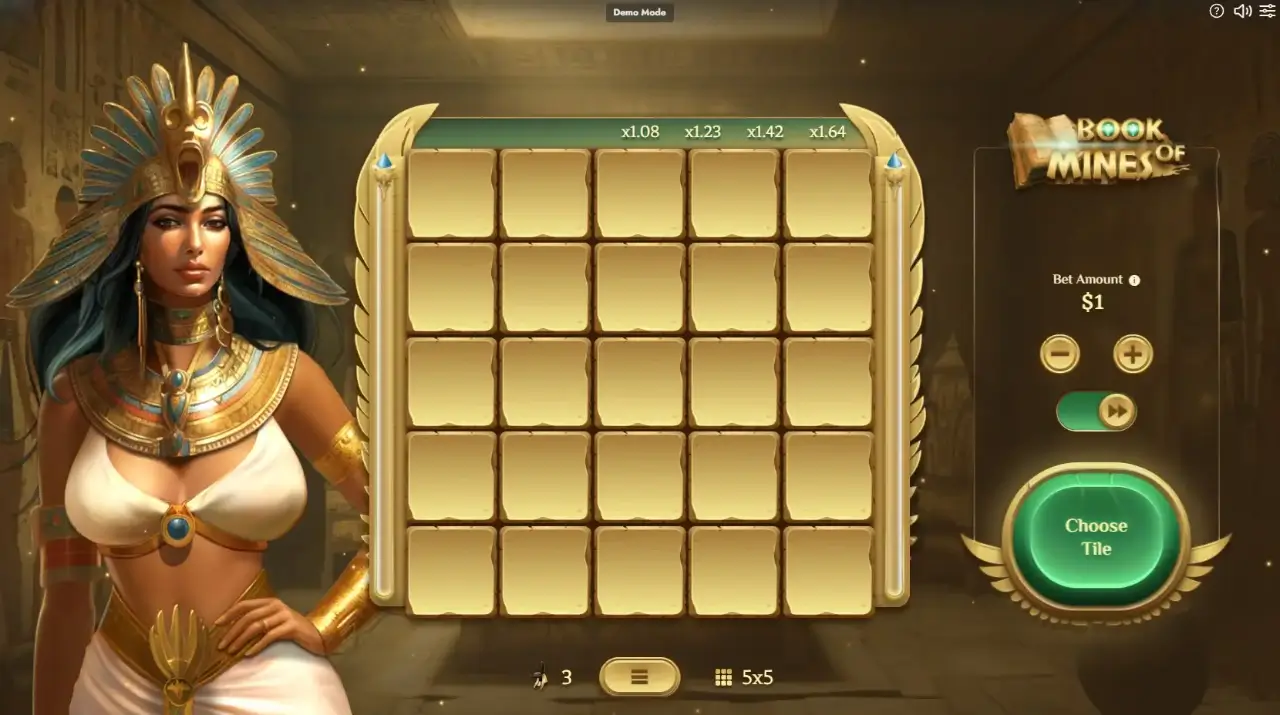
Each round starts with a blank grid of face-down tiles. Before the round begins, you choose two things via the settings menu (accessed through the hamburger icon below the game area):
Grid size: from 3×3 (9 tiles total) up to 9×9 (81 tiles total).
Number of Anubis mines: minimum 1, maximum equal to the total number of tiles minus one. On a 3×3 grid that means between 1 and 8 mines. On a 9×9 grid that means between 1 and 80 mines.
Once the round begins, you click tiles one at a time. Every tile that reveals an enchanted book increases your current prize level. The potential payout for the next pick is displayed above the grid and updates in real time after each safe reveal. If you hit an Anubis tile at any point, the round ends immediately and all accumulated winnings are forfeited. There is no second chance, no respin mechanic, no safety net.
At any point after your first successful reveal, you can click “Cash Out” to collect the current prize and end the round on your own terms.
Turbo mode is available. It speeds up the tile-flip animations without changing anything about the RTP or outcome logic — useful for players who want to move through rounds quickly.
There is no autoplay. Every tile selection is a manual click. This is a deliberate design decision that keeps the player fully present in each decision rather than watching a simulation run on their behalf.
The Multiplier System
The payout for each pick scales based on the number of tiles in the grid and the number of mines you placed. The more mines you set relative to the grid size, the higher the reward for each safe reveal — because the probability of hitting a mine is correspondingly higher.
To give a concrete sense of scale: on a 3×3 grid with 8 mines (the maximum), you have one safe tile and eight dangerous ones. A single successful pick pays 8.55x your stake. On a 9×9 grid with 80 mines, a single successful pick pays 76.95x. These are the maximum mine configurations. Lower mine counts produce lower per-tile values but allow you to safely reveal many more tiles, building a multiplier gradually across a longer round.
The theoretical maximum win is 999,999x your stake. In practice, there is a hard win cap of €10,000 regardless of your bet size. This is a significant caveat: a player betting €100 per round and hitting a genuinely astronomical multiplier sequence will be capped at €10,000, not the mathematical maximum the multiplier might suggest. This cap is worth knowing before you size your stakes.
Volatility: The Part Most Reviews Get Wrong
A number of existing reviews assign a fixed volatility label to Book of Mines — some call it low, some call it high. Both are wrong, because the volatility is entirely a function of the configuration the player selects before each round.
A single mine on a 9×9 grid means 80 safe tiles and only one mine across 81 positions. That configuration behaves like a low-variance game — small, frequent wins as you work through the grid carefully. The multiplier grows slowly but the probability of surviving many picks is high.
Maximum mines on the smallest grid (8 mines on 3×3) means one safe tile in nine. That is extreme variance — the hit rate on a mine is approximately 89% for the first pick, and a successful pick rewards roughly 8.55x. Very few rounds pay out; those that do pay immediately.
The player controls this spectrum entirely. There is no fixed volatility profile the way a slot has a fixed volatility setting coded into the RNG. What you are actually doing when you select grid size and mine count is choosing your own risk-reward curve for the session. This is one of the most genuinely distinctive design features of Book of Mines relative to the broader instant game market, and it is consistently misrepresented in reviews.
RTP: What the 95% Actually Tells You
The certified default RTP for Book of Mines is 95%. This is consistent across the Turbo Games mines series and is in line with industry averages for online slots.
However, 95% is the default figure — the one Turbo Games certifies and publishes. Operators who license and distribute Book of Mines can configure the RTP within a permitted range. The actual RTP active at any given casino may differ from the certified default. Most casinos do not publish the specific RTP variant they are running.
This is not unique to Book of Mines or to Turbo Games. It is standard practice across the iGaming industry. But it is worth understanding: when you see “95% RTP” listed for Book of Mines on a casino’s game info page, you are looking at the certified default, not necessarily the live configuration at that specific platform. If RTP matters to your decision-making, it is worth checking whether the casino you are playing at publishes the specific variant they run.
The 95% figure, where it is active, means that for every €100 wagered across a statistically significant number of rounds, the game returns €95 on average to players in aggregate. Individual sessions can deviate wildly from this in either direction — particularly on high-mine configurations — but the long-term theoretical return is around that figure.
Provably Fair: What It Actually Means
Book of Mines uses a provably fair system. This term appears in most reviews without explanation. Here is what it means in practice.
Before each round begins, the game generates a server seed and a client seed. These seeds determine where the mines are placed on the grid. The server seed is hashed (encrypted) and shown to the player before play begins — meaning the outcome is committed before you start clicking. After the round ends, the server seed is revealed. You can take the revealed seeds and independently calculate whether the mine placement matches what was predetermined.
In plain terms: you do not have to trust that the casino ran the round fairly. You can verify it yourself. The mine layout was fixed before your first click, and the cryptographic proof of that is available to you after the fact.
For players who have historically been sceptical about whether instant games are genuinely random, provably fair is a meaningful guarantee — not just a marketing label. The mathematics underlying it are sound. Turbo Games applies this standard across its entire portfolio, not just Book of Mines.
Strategic Depth: Risk Management Beyond the Obvious
Book of Mines is a game of probability, not skill. No clicking pattern or sequence of tile selections changes the underlying odds. The mines are distributed randomly across the grid at the start of each round, and where you click does not affect where they are — only whether you happen to find one.
What the player does control is the risk profile entering each round and the cash-out decision during it.
Grid and mine selection as pre-round risk management. Choosing a larger grid with fewer mines means lower per-tile payouts but more room to build a multiplier through multiple successful picks. Choosing a smaller grid with many mines means higher per-tile payouts but a much higher probability of hitting a mine early. Neither approach is objectively better — they represent different risk tolerances and different bankroll dynamics.
A player with a limited session budget might find that high-mine configurations burn through funds quickly with few paying rounds. The same player on a large grid with few mines will see more rounds survive to cash-out, though each cash-out will be smaller. Understanding this relationship is the practical foundation of any sensible approach to the game.
The cash-out decision. This is where psychology enters the picture. After each safe reveal, the potential payout displayed above the grid increases. The temptation is to keep clicking, because the numbers are going up and it feels like momentum. That instinct is not logical — every subsequent tile carries the same probability of being a mine as the previous tile, independent of how many safe tiles have already been revealed. Past results do not affect future picks.
The rational cash-out point is personal: it is the multiplier at which the guaranteed payout is worth more to you than the expected value of another pick. That calculation depends on the grid configuration, your current multiplier, and how many mines remain relative to unrevealed tiles. The game displays the potential payout for the next pick, which gives you enough information to make an informed decision rather than a purely emotional one.
One useful habit: decide your target multiplier before you start a round, not during it. Choosing in advance to cash out at 5x, for example, and then sticking to that regardless of how the round is unfolding, removes the moment-to-moment negotiation with yourself that tends to result in staying in one pick too long. It is not a strategy that changes the odds — nothing does — but it is a way of avoiding the decision fatigue that accumulates across a long session.
Session limits. Before starting any session in Book of Mines — or any mine game — it is worth deciding in advance what a reasonable loss limit is and what a satisfying win target looks like. The game’s round-by-round structure and fast pace make it easy to play many more rounds than intended. Setting a session budget before you start is more effective than trying to judge it mid-session, when the desire to recover a loss or extend a winning streak is shaping your decisions.
What the Game Does Not Have
Some players will arrive at Book of Mines expecting a slot with mine-themed aesthetics. It is not that. There are no free spins, no bonus round triggered by a special symbol, no wild substitutions, no scatter pays, no progressive jackpot, no gamble feature, no multiplier trail built into the base game structure. The game does not have autoplay.
These absences are not oversights. They are the design. Book of Mines is built around one mechanic — tile selection under risk — and everything else has been stripped out so that mechanic carries the full experience. Whether that appeals to you depends entirely on whether you enjoy that kind of focused, decision-driven tension.
The lack of an autoplay function is worth addressing specifically, because it polarises opinion. Players who use autoplay to run extended sessions without constant input will find Book of Mines requires more active engagement than they may want. Every tile is a manual click; you cannot set parameters and step away. For some players this is a genuine disadvantage. For others it is the point — the game is asking you to be present for each decision, which is what makes the cash-out choice feel meaningful rather than mechanical.
The absence of a bonus round also means there is no rescue mechanism. In a slot with free spins, a tough base game session can be turned around by a feature trigger. In Book of Mines, the session is made up entirely of individual rounds that each play out on their own terms. A losing run stays a losing run. A good session depends on either getting lucky in rounds where you let the multiplier build before cashing out, or cashing out consistently at modest multipliers and accumulating steady returns. There is no single feature moment waiting to change the narrative.
For players who find traditional slots passive or overcomplicated — too many features competing for attention, outcomes entirely outside their control — Book of Mines offers something more direct. You make choices. Those choices have consequences. The outcome is immediate. That directness is either the game’s main selling point or its main limitation, depending on what you are looking for.
Mobile Performance
The game is fully optimised for mobile and desktop. The touch interface works cleanly for tile selection — tap to reveal, no pinching or scrolling needed. The interface scales appropriately across screen sizes without the grid becoming cramped or the cash-out controls difficult to reach.
The turbo mode option is particularly useful on mobile, where the faster animations help the game feel responsive rather than sluggish between picks.
How Book of Mines Sits Within the Mine Game Category
The mine game category has expanded significantly since Spribe’s Mines became one of the most widely distributed instant games in the industry. Multiple providers now offer mine variants — BGaming, Hacksaw Gaming, and others have their own takes on the format. Most of them operate on a fixed 5×5 grid with variable mine counts.
Book of Mines distinguishes itself on two fronts. First, the grid size variability — from 3×3 to 9×9 — gives it a wider volatility range than fixed-grid competitors. A fixed 5×5 grid limits the minimum mine density and the maximum number of safe tiles you can reveal in a single round. Book of Mines removes that ceiling: on a 9×9 grid with a single mine, you have up to 80 consecutive safe tile opportunities within one round, which opens up multiplier-building sequences simply not possible in a fixed-format mine game. Second, the visual and thematic investment is genuinely higher than the category average. Most mine games are functionally indistinguishable in presentation. Book of Mines is not.
What it shares with the category is the fundamental limitation: there are no features to generate excitement beyond the core pick-and-reveal loop. For some players that is a feature. For others it is the ceiling of what the game can offer.
Practical Summary: Key Facts
- Developer: Turbo Games
- Release date: April 2024
- RTP: 95% (certified default; operator-configured variants may differ)
- Bet range: $0.10 – $100 per round
- Grid sizes: 3×3 to 9×9 (player-selected before each round)
- Mine count: 1 minimum to total tiles minus 1 maximum
- Max win: 999,999x stake; hard win cap of €10,000
- Volatility: fully player-controlled via grid and mine configuration
- Features: turbo mode, cash-out anytime, provably fair
- No autoplay, no free spins, no bonus rounds, no wilds
- Mobile: fully compatible, touch-optimised
Honest Assessment
Book of Mines is a well-executed entry in the mine game category. The Egyptian theme is not just a coat of paint — the visual design is noticeably more considered than most instant games at this level of mechanical simplicity. The grid customisation gives it genuine flexibility that fixed-grid competitors lack. The provably fair system means players can verify outcomes independently, which matters in a category where trust in RNG implementation is not universal.
The limitations are real. There is one mechanic. There are no features. The €10,000 win cap makes high-stake play less interesting than the theoretical max win implies. The 95% default RTP is industry-standard but not exceptional, and the live RTP at a given casino may be different.
For players who enjoy the mine game format — the active decision-making, the cash-out tension, the short round structure — Book of Mines is one of the better-presented options available in early 2026. It plays cleanly, it looks good, and the risk customisation is handled more thoughtfully than most comparable titles.
For players who have not tried a mine game before: the absence of traditional slot features is jarring at first. The rhythm is completely different. But if the idea of controlling your own risk profile rather than watching reels land appeals to you, Book of Mines is a reasonable starting point — more accessible in its presentation than most mine games, and the demo mode means you can test the mechanics without any financial commitment before deciding whether the format suits you.
Book of Mines is a gambling product. Set session budgets before you start. The game’s fast round structure and progressive multiplier display are designed to encourage continued play — knowing this going in does not make you immune to it, but it helps. Play within limits you set for yourself, not ones the session sets for you.