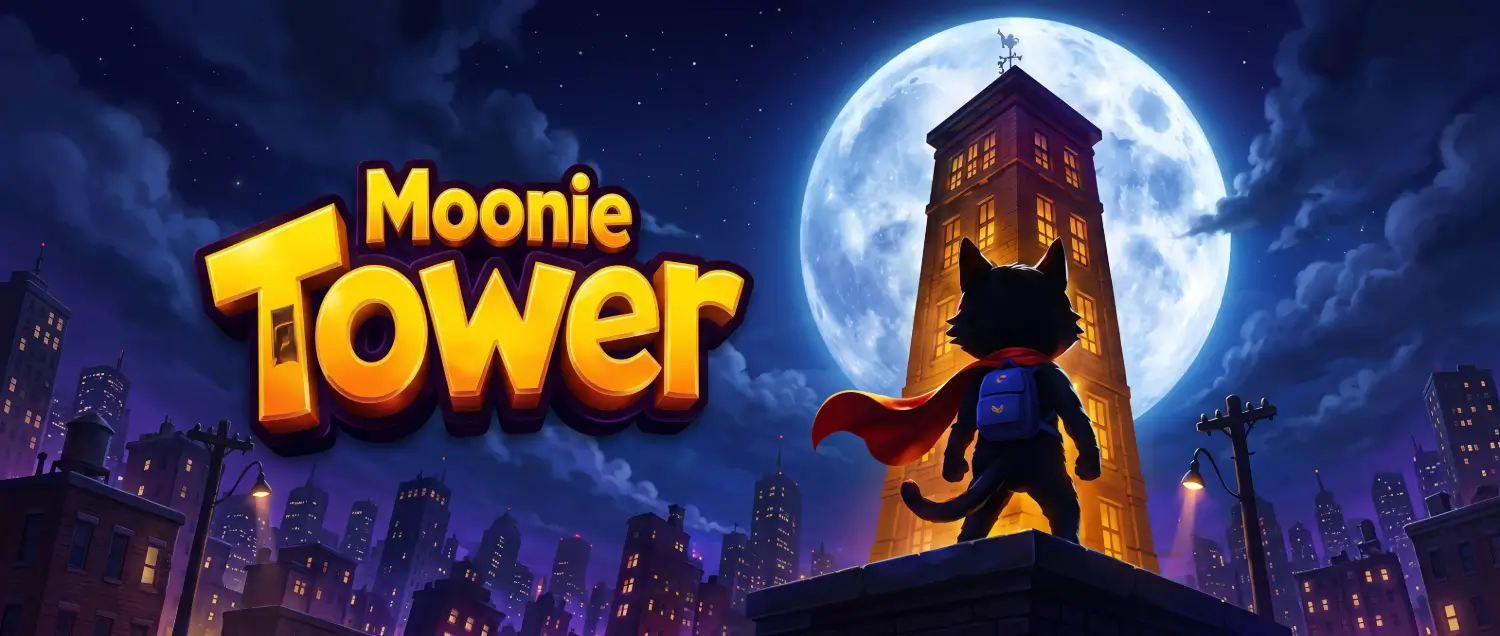
Moonie Tower went live on 10 December 2025, which makes it one of the newer names in Megafair’s instant-game catalogue rather than an established one. That timing matters, because it landed in a category — stepped-risk climb games — that had already been shaped by titles offering four-figure and five-figure multipliers. The question this review keeps circling back to is simple: does a 97% RTP and a 100x ceiling earn a place in a 2026 lobby that already has Mines, Chicken Road, and Tower Rush sitting in it?
Before going further: this is not a slot. There are no reels, no paylines, no bonus round waiting behind a scatter symbol. Moonie Tower is a vertical climb game — a jetpack-wearing cat picks its way upward through a grid of cells, and every correct guess raises the multiplier until either the player cashes out or picks wrong. 97% RTP and 100x max win are the two numbers that frame everything else in this review, and the second one is the more interesting story.
The math model and how it actually plays
Moonie Tower runs at a confirmed 97% RTP, sourced from SlotCatalog’s attribute listing for the title. That figure sits at the healthier end of the instant-game category — Spribe’s Mines runs the same 97%, and Tower Rush from Galaxsys operates in a 96.12%–97% operator-configurable band. Chicken Road from InOut Games claims 98% on its own materials, though several independent review sites list it closer to 96.5%. That’s a genuine spread across the category, and it’s worth remembering that RTP alone doesn’t tell you how a session will feel — it tells you what happens over thousands of rounds, not what happens in the twenty minutes you’ll actually play tonight.
Here’s where Moonie Tower’s story gets less flattering. SlotCatalog does not carry a numeric volatility rating for the title — the field is marked N/A — but the accompanying editorial description characterises the game as high volatility with “a dramatic risk-reward curve.” That’s a documented discrepancy worth stating plainly: the structured data says nothing, the prose says high. I’d side with the prose here, because the mechanic itself all but guarantees it. Every step forward is a binary outcome — safe or bust — and there’s no partial-win cushion sitting between “cashed out” and “lost the round.” That’s the textbook definition of high volatility, rated field or not.
What I can’t give you is a hit-frequency percentage, because neither SlotCatalog nor any other source I could verify publishes one for this specific title. Spribe’s Mines has a public formula tying multiplier directly to grid size and mine count — 0.97 × C(25,s)/C(25-N,s) — because the grid dimensions are published. Moonie Tower’s exact grid size isn’t confirmed anywhere I could find, so I’m not going to reverse-engineer a probability model out of guesswork. What’s confirmed instead is a bet range of 0.50 to 500 units, listed by SlotCatalog without a fixed currency attached — expect the operator you play at to convert that into their own display currency, which is standard for HTML5 instant titles distributed across dozens of markets.
Now the number that actually shapes the verdict: 100x max win. On a $10 stake, that’s a $1,000 ceiling, full stop, no matter how long the climb runs or how the multiplier curve is shaped underneath it. Compare that with Mines by Spribe, where operators typically cap payouts at 10,000x (with a theoretical maximum north of 4.7 million x baked into the underlying math), or Chicken Road, where operator caps commonly sit at $10,000–€20,000 regardless of how the in-round multiplier climbs. Even Tower Rush — a game I’d call a direct structural cousin of Moonie Tower, given its own vertical-building mechanic — carries the same 100x cap, so Moonie Tower isn’t uniquely stingy. It’s just arriving in 2026 with a ceiling that was already looking dated when Tower Rush launched in February 2024.
You might ask: why does a fixed low ceiling matter more in this genre than it would in a slot? Because in a slot, the max win usually sits behind a rare bonus-round alignment that most players will never see, so it functions more as a marketing headline than a practical target. In a stepped-risk climb game, the ceiling is reachable through the same mechanic every single round uses — there’s no separate bonus feature gating it off. That makes the 100x figure a genuinely operative constraint on every session, not a theoretical curiosity. A player grinding Mines toward a four-figure multiplier is playing the same core loop as a player cashing out at 3x — the only difference is nerve and bust luck. Moonie Tower’s players are working within that same loop, just with a lower roof over the whole exercise.
There’s also a release-timing angle worth sitting with. Moonie Tower launched into a market where the two most-cited names in this category — Mines and Chicken Road — had a combined four years of player familiarity and, in Chicken Road’s case, an RTP figure the provider is happy to advertise as industry-leading. Launching a new stepped-risk title in December 2025 without pushing past a ceiling that Tower Rush already carried in February 2024 isn’t a fatal flaw, but it is a missed opportunity. Nothing about the underlying math — a 97% RTP, provably fair verification, HTML5 delivery — required Megafair to cap the game at 100x. That was a design choice, not a mathematical inevitability, and it’s the choice that does the most to hold this title back from genre-leader status.
Feature breakdown
The climb mechanic
The core loop is a guess-and-advance structure. Each round, the cat is presented with cells to pick from; a correct pick advances the climb and increases the multiplier, and a wrong pick ends the round immediately with the stake forfeited. Cash-out is manual and available after any successful step — there’s no forced continuation once you’re in profit. This is the same skeleton as Mines (pick a cell, avoid the bomb, cash out whenever) and Cat Cross, another Megafair title with a near-identical superhero-cat premise built around lane-by-lane jumps instead of cell reveals. If you’ve played either, Moonie Tower will feel immediately familiar — which cuts both ways. It’s easy to pick up, but it isn’t doing anything the category hasn’t already done.
Fair question, though: does the theme actually change how the game plays? Not mechanically, no. The jetpack-cat framing and the vertical “tower” visual are dressing on top of a grid-pick structure that Mines popularised years earlier. What the theme does change is the pacing feel — the visual sense of climbing upward step by step reads as more purposeful than Mines’ flat grid reveal, even though the underlying decision at each step (advance or bank) is identical. That’s not a criticism. Theme-driven pacing is exactly how this category differentiates itself when the math underneath is largely the same 96–98% RTP band across every title.
Safety Teleport Boost
The one feature that gives Moonie Tower some identity of its own is the Safety Teleport Boost, which grants an automatic advance of one stage with guaranteed success — no risk of busting on that particular step. It’s a genuinely useful mechanic for a stepped-risk game, because it lets a player bank one “free” advance during a run without touching the pick-and-pray core loop. What’s missing from every source I checked is the trigger condition: is this something you buy, something that appears randomly, or something tied to a specific difficulty setting? None of that is confirmed, and I’m not going to invent a trigger mechanism just to fill the gap. If you’re evaluating this game for a casino build, that’s a detail worth confirming directly with Megafair before committing to marketing copy that describes how the boost is earned.
What I can say with more confidence is why this kind of feature matters in a genre built entirely around binary outcomes. Every other stepped-risk title in this review — Mines, Chicken Road, Cat Cross — runs purely on the pick-and-survive loop with nothing softening a bad guess. A guaranteed safe advance, even a single one per run, is a genuine structural variation rather than a cosmetic add-on. It’s the kind of feature that would be a footnote in a slot’s feature list, buried under wilds and scatters, but in a genre this stripped-down, one confirmed mechanical difference is doing real work toward making Moonie Tower distinguishable from its own category-mates.
Difficulty settings
Moonie Tower lets players adjust difficulty before a round starts, in line with the rest of its category — Chicken Road offers four fixed presets (Easy, Medium, Hard, Hardcore), and Cat Cross, Megafair’s own sibling title, mirrors that exact structure with 24, 22, 20, and 15 steps respectively across its four levels. Moonie Tower’s own step counts per difficulty tier aren’t published anywhere I could verify, which is a genuine gap. What is consistent across the category, and almost certainly true here too, is the trade-off: fewer steps per difficulty tier means a faster climb to the multiplier ceiling, and a correspondingly higher bust rate per step. Treat any specific step count you see quoted for Moonie Tower’s difficulty tiers as unconfirmed until the operator’s own paytable says otherwise.
You might wonder why this matters if the max win is fixed at 100x regardless of difficulty. It’s about the shape of the climb, not the ceiling. A harder setting with fewer total steps reaches that 100x cap faster — meaning higher multiplier growth per successful step, but a shorter run before either cashing out or busting. An easier setting stretches the same 100x ceiling across more steps, which slows the climb but gives more decision points along the way and, presumably, a gentler bust probability per step. Neither approach changes the RTP, which stays fixed at 97% regardless of the tier selected — that’s standard across this entire category, where difficulty reshapes variance without touching the long-run return.
Autoplay and cash-out timing
Autoplay is available, which matters more in this genre than it does in a slot — a manual-only climb game demands constant attention, and Tower Rush draws real criticism in independent reviews for lacking exactly this feature after fifteen or twenty minutes of clicking. Moonie Tower having autoplay built in from launch is a small but real point in its favour against a genre-mate that shipped without it. The trade-off, as always with automated cash-out settings on a high-volatility climb game, is that a poorly chosen auto-cash-out threshold will either bank profits too early or ride a losing streak on autopilot. Set it conservatively the first few sessions.
Here’s the thing worth remembering with any auto-cash-out tool in this genre: it doesn’t change your odds, it only changes your consistency. Set the auto-cash at, say, 3x and you’ll bank small, frequent wins while giving up any shot at the ceiling. Set it near the 100x cap and you’ll rarely reach it, because the bust probability compounds with every additional step regardless of how the tool is configured. Autoplay is a convenience feature for session management, not an edge — and no combination of settings changes the fact that the house holds a fixed 3% edge on every round, difficulty setting aside.
Where Moonie Tower sits in the 2026 lobby
Megafair doesn’t appear to have released a Power Reels, Megaways, or otherwise upgraded variant of Moonie Tower — I found no evidence of a sequel or enhanced edition anywhere in my research, and I’m stating that plainly rather than implying one might exist. The closest comparison available is Cat Cross, Megafair’s other crash-adjacent title, built on a lane-jump structure rather than a cell-grid but sharing the same 97% RTP and the same four-tier difficulty logic seen elsewhere in the category. Where the two diverge sharply is max win: several low-authority affiliate sites quote Cat Cross’s maximum payout at $2,500,000, a figure that appears nowhere on Megafair’s own product page and that I’m not willing to treat as verified — it’s wildly out of step with everything else in this category, including Moonie Tower’s own 100x cap from the same studio. I’m flagging that conflict rather than picking a side: either Cat Cross genuinely has an outlier ceiling Megafair hasn’t documented officially, or several SEO-farmed review sites are recycling an inflated number nobody has checked. Until Megafair’s own materials confirm one way or the other, don’t take that $2.5 million figure as fact.
Against named competitors outside the Megafair stable, Moonie Tower’s positioning is clearer and less flattering. Mines by Spribe (97% RTP, 10,000x operator-cap max win, released September 2021) offers a fully adjustable risk profile — the player sets mine count from 1 to 24, which changes both the odds and the payout curve directly. Chicken Road by InOut Games (RTP disputed between 96.5% and 98%, max win typically capped between $10,000 and €20,000, released April 2024) trades that granular control for four fixed presets and a considerably higher payout ceiling. Tower Rush by Galaxsys (RTP 96.12%–97% operator-configurable, 100x max win, released February 2024) is the closest structural relative — same vertical build-and-climb premise, same low ceiling — but compensates with three distinct in-round bonus floors (Frozen Floor, Temple Floor, Triple Build) that Moonie Tower doesn’t currently match beyond its single Safety Teleport Boost.
Buy-bonus mechanics don’t exist in this game, and that’s consistent with the entire stepped-risk category — none of Mines, Chicken Road, Cat Cross, or Tower Rush offer a bonus-buy either, because the “bonus” in these games is the entire round, not a feature bolted onto a base game. Progressive jackpots are similarly absent, again in line with category norms; stepped-risk instant games build their appeal around session-length control and instant decisions, not slow-accumulating pools. Neither absence should read as a mark against Moonie Tower specifically — it’s simply not that kind of game.
Worth putting a finer point on the Tower Rush comparison, since it’s the closest structural match here. Both games use a vertical build/climb visual, both cap at 100x, and both run an operator-configurable RTP band that lands close to 97%. Where Tower Rush pulls ahead is feature depth — three named bonus floors that each do something distinct (Frozen Floor locks in a win mid-round, Temple Floor offers a roulette-style multiplier bump up to 7x, Triple Build lets a player stack three risk-free floors at once) against Moonie Tower’s single Safety Teleport Boost. Where Moonie Tower pulls ahead is the autoplay support that Tower Rush lacks. Neither game has solved the low-ceiling problem, and until one of them does, a player chasing a genuinely large multiplier has more reason to look at Mines or Chicken Road than at either tower-climbing title.
It’s also worth being honest about what a 7.0/10 user rating built on a single vote actually tells you: nothing statistically meaningful. SlotCatalog’s own scan data shows Moonie Tower listed across 27 countries with strongest lobby presence in New Zealand, Canada, Australia, and Norway — a reasonable early distribution footprint for a title barely three months old at the time of writing, but not yet the kind of player-review volume that lets anyone draw a confident conclusion about long-term reception. Early distribution and early sentiment are two different signals, and only one of them is currently available here.
So who is this actually for? With a 100x ceiling, Moonie Tower is not a high roller’s game — a $1,000 return on a $10 bet is a solid session, not the kind of number that gets talked about anywhere. It reads as a recreational, short-session title: quick rounds, an easy-to-grasp guess-and-advance loop, a familiar cat-and-danger theme, and a genuinely useful escape hatch in the Safety Teleport Boost. What it isn’t is a genre leader. Arriving in December 2025 with the same 100x cap that Tower Rush shipped with nearly two years earlier, while Mines and Chicken Road were both already operating with ceilings in the thousands, means Moonie Tower is playing catch-up on the one number most experienced players check first.
Verdict
Play it if you want a low-stakes, low-drama stepped-risk game with a straightforward loop and a workable safety mechanic — the 97% RTP is genuinely competitive, and the Safety Teleport Boost is a real point of difference in a crowded category. Skip it if you’re chasing the kind of multiplier that makes a session memorable; 100x is the one number that limits everything else here, and it puts a hard ceiling under a game that would otherwise sit comfortably alongside its peers.
The player profile this suits: casual, mobile-first, short-session players who want quick decisions and don’t mind a modest cap on the upside. The player profile it doesn’t suit: anyone coming from Mines or Chicken Road looking for four- or five-figure multiplier chases — that appetite simply isn’t served here, and no amount of theme or polish changes the arithmetic on a 100x cap. Until Megafair either lifts that ceiling or ships a variant that does, treat Moonie Tower as a secondary title in rotation, not a first pick.
One last honest note before you decide: several of the specifics that would normally round out a review like this — exact step counts per difficulty tier, the trigger condition on the Safety Teleport Boost, a published hit-frequency figure — simply aren’t available yet from Megafair or from any aggregator I could verify. That’s not a reason to distrust the confirmed numbers (97% RTP, 100x max win, 0.50–500 bet range, provably fair verification), but it is a reason to treat this as a young title still building out its public documentation. Check the in-game paytable directly before your first real-money session — it’s the only place those remaining gaps get closed with certainty.