Listen up, gambling enthusiasts and curious newcomers alike. Today we’re diving deep into Punto Banco—the casino classic that James Bond made look sophisticated and high rollers have been riding since the 1950s. After countless hours at both brick-and-mortar tables and digital versions, I’m here to give you the real scoop on this elegant beast of a game.
Spoiler alert: it’s simpler than you think, more thrilling than it should be, and yes, you’ll probably still bet on that tempting Tie despite my warnings. Don’t worry, we’ve all been there.
What Exactly Is This Punto Banco Thing Anyway?
Let me paint you a picture. Imagine a card game so simple that a toddler could learn the rules in five minutes, yet so elegant that casinos dedicate entire VIP rooms to it. That’s Punto Banco, baby—the North American version of baccarat that’s basically taken over the gambling world.
Here’s the beautiful part: you don’t actually play this game. I know, I know—that sounds weird. But stick with me. In Punto Banco, you’re essentially a spectator placing bets on a contest between two hands: the Player (Punto) and the Banker (Banco). The dealer does all the heavy lifting while you sit back, sip your complimentary beverage, and watch the drama unfold.
The objective? Dead simple. Whichever hand gets closest to 9 wins. That’s it. No poker faces, no bluffing, no complicated strategies to memorize. Just pure, unadulterated chance wrapped in a tuxedo.
The Origins Story (Because Every Great Game Has One)
The history of Punto Banco is murkier than a Vegas cocktail at 3 AM. Some historians claim it started with Italian aristocrats in the 15th century, possibly inspired by tarot cards or some ancient game called tarocchini. Others point to French soldiers returning from Italy with a new obsession. Fast forward to the 1940s and 1950s, and the game shows up in Cuba, getting a Caribbean makeover.
The real plot twist? Tommy Renzoni brought Punto Banco to Las Vegas in 1959, and American casinos went absolutely wild for it. Why? Because unlike the European versions (Chemin de Fer and Baccarat Banque) where players had choices to make, Punto Banco was completely mechanical. Fixed rules, house-banked action, and a house edge that made casino managers smile—what’s not to love?
Today, Punto Banco dominates casino floors from Macau to Monte Carlo. It’s the game that separates the casual slot-spinners from the high-stakes drama seekers. And trust me, once you get the rush of watching a natural 9 flip over on your side, you’ll understand the addiction.
Breaking Down the Punto Banco Setup
Alright, let’s talk game design. Punto Banco uses either six or eight standard 52-card decks shuffled together in what we call a “shoe.” No jokers, no wild cards—just honest-to-goodness playing cards doing their thing.
The Card Values (Easier Than Counting Calories)
Here’s where Punto Banco gets beautifully simple:
- Aces = 1 point (not 11, we’re not playing blackjack here)
- 2 through 9 = Face value (a 7 is worth 7, revolutionary stuff)
- 10s, Jacks, Queens, Kings = 0 points (yep, those fancy face cards are worthless)
The twist? We only care about the last digit. Got a 7 and an 8? That’s 15, but we drop the first digit, so it’s 5. See a 9 and a 9? That’s 18, which becomes 8. This modulo-10 arithmetic is the secret sauce that keeps everything between 0 and 9.
The Table Layout
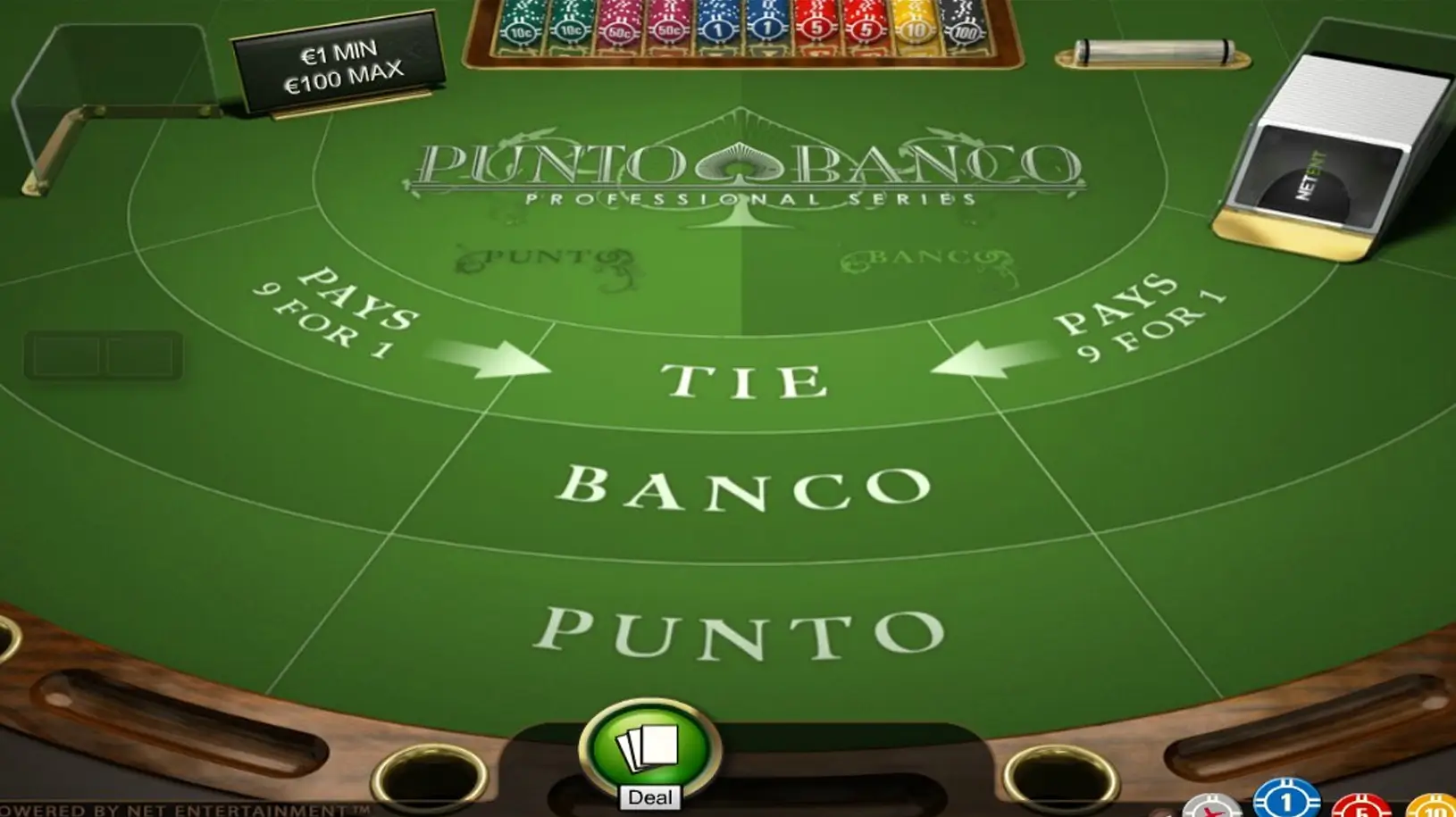
The Punto Banco table looks fancy with its green felt and gold lettering, but don’t let it intimidate you. You’ll typically see three betting areas:
- Player (Punto) – usually labeled in blue
- Banker (Banco) – usually labeled in red
- Tie (Égalité) – that tempting middle ground
Some tables also have spots for Pair bets (more on those money-drainers later). The betting areas are usually numbered for multiple players, but in online versions, you’ve got the whole table to yourself like a boss.
The Dealers (Your New Best Friends)
In live casinos, you’ll have croupiers managing the action with the grace of ballet dancers. They handle the shoe, announce the totals in that slightly bored monotone we all love, collect losing bets with practiced efficiency, and pay out winners while calculating the 5% Banker commission faster than your phone’s calculator.
Online? The RNG software handles everything automatically, though live dealer versions try to recreate that authentic casino atmosphere. Some succeed better than others—we’ll get to that.
How to Actually Play This Game Without Looking Like a Tourist
Let me walk you through a typical round of Punto Banco, because understanding the flow is key to enjoying the ride.
Step 1: Place Your Bets (The Easy Part)
Before any cards hit the felt, you need to pick your horse. You’ve got three main options:
- Bet on Player to win
- Bet on Banker to win
- Bet on a Tie (which I’ll try to talk you out of shortly)
In online versions, you just click your chips on the betting area. In physical casinos, you place your chips in the corresponding spot. Most tables have minimum bets ranging from $5 to $25 for regular tables, though high-limit rooms start at $100 and can go absolutely bonkers from there.
Step 2: The Deal (Where the Magic Happens)
Once betting is closed, the dealer distributes four cards total in this order:
- First card to Player
- First card to Banker
- Second card to Player
- Second card to Banker
Both hands now have two cards each, dealt face-up for all to see. No secrets here, folks.
Step 3: Calculate the Totals (Actually, Just Watch the Dealer Do It)
The dealer adds up each hand using those funky values I mentioned. Remember: we only care about the last digit. A Jack-7 combo? That’s 0+7 = 7. A 9-6 situation? That’s 15, which becomes 5.
Step 4: The Natural Winner (Or Not)
If either hand totals 8 or 9 right off the bat, we call that a “Natural,” and the round ends immediately. Natural 9 beats Natural 8, and both beat everything else. No third card, no drama—just instant resolution.
This is where beginners often get confused: if there’s no Natural, we move to the potentially-complicated-but-actually-not-that-bad third card rules.
Step 5: Third Card Rules (The Part That Seems Scary But Isn’t)
Here’s the beautiful thing about Punto Banco: you don’t need to memorize these rules because they’re automatic. The dealer handles everything based on a fixed tableau. But for the curious among you:
Player’s Third Card Rule:
- 0-5: Player draws a third card
- 6-7: Player stands
- 8-9: Natural, no third card
Banker’s Third Card Rule: This is where it gets spicy. The Banker’s action depends on both their total AND what the Player drew (if anything):
- If Player stood (6-7), Banker draws on 0-5, stands on 6-7
- If Player drew, Banker follows a complex chart based on their total and Player’s third card value
But remember: you don’t need to know this. The dealer follows the tableau automatically. I’ve been playing for years and still don’t have it memorized. Why would I? That’s what the croupiers get paid for.
Step 6: Determine the Winner and Get Paid (The Fun Part)
After all cards are dealt, whoever has the higher total wins. Payouts work like this:
- Player wins: 1:1 (bet $100, win $100)
- Banker wins: 1:1 minus 5% commission (bet $100, win $95)
- Tie: 8:1 or 9:1 depending on the casino (bet $100, win $800-$900)
That 5% commission on Banker bets is how casinos keep their edge when you’re betting on the statistically superior option. Some casinos offer commission-free Banker bets, but they usually short-pay on specific Banker wins (like 6s) to compensate.
The Betting Menu: What’s Worth Your Money?
Let’s talk brass tacks about where to put your hard-earned cash. Not all bets are created equal, and some are straight-up casino traps disguised as opportunities.
Player Win Bet (The Straightforward Option)
House Edge: 1.24%
Payout: 1:1
Betting on Player is the second-best option mathematically. You’ll win roughly 44.62% of the time (excluding ties), and you don’t pay that annoying 5% commission. The simplicity is appealing—what you win is what you get.
From my experience, Player betting is perfect for beginners who find the Banker commission confusing or annoying. You’ll lose slightly more in the long run compared to Banker betting, but we’re talking about a 0.18% difference—basically negligible unless you’re grinding thousands of hands.
My Take: Solid choice, no shame in parking here. I often bounce between Player and Banker based purely on superstition and mood, which is probably not optimal strategy but keeps things entertaining.
Banker Win Bet (The Smart Money)
House Edge: 1.06%
Payout: 0.95:1 (1:1 minus 5% commission)
This is mathematically the best bet on the table, no contest. The Banker wins approximately 45.86% of non-tie hands, giving it a slight statistical edge. Even after the casino takes their 5% cut, you’re still getting the best odds in the house.
The commission can be annoying—winning $100 but only getting $95 feels weird at first. Most casinos track your commissions and collect at the end of your session or when you cash out, though some collect immediately after each win.
Pro Tip: Some casinos offer “EZ Baccarat” or similar variants where Banker bets pay even money with no commission, BUT a Banker win with a three-card 7 pushes instead of paying. These variants actually have a slightly higher house edge (1.02% vs 1.06%), but the psychology of not paying commission appeals to many players.
My Take: This is my default bet about 60% of the time. Yes, it’s “boring” to always bet the mathematically optimal option, but I didn’t become a casino veteran by ignoring math. Save the thrill-seeking for the rides at the casino’s neighboring theme park.
Tie Bet (The Siren Song of Ruin)
House Edge: 14.36%
Payout: 8:1 (sometimes 9:1)
Oh, the Tie bet. This is the casino’s honey trap, the lottery ticket of baccarat, the bet that looks so juicy you can almost taste the payout. With an 8:1 or 9:1 return, a $10 bet could net you $80-$90. Tempting, right?
Wrong. So very wrong.
Ties occur roughly 9.5% of the time. Even with an 8:1 payout, the house edge is a brutal 14.36%. For comparison, slot machines typically range from 2-15% house edge. You’re basically playing slots but with fancier cards.
Some casinos offer 9:1 on Ties, which drops the edge to “only” 4.84%—still nearly five times worse than betting Banker. The math simply doesn’t justify this bet under any circumstances.
My Take: I’ll be honest—I’ve thrown down Tie bets after a few drinks or when I’m feeling particularly reckless. The couple of times they’ve hit felt amazing. The dozens of times they’ve missed felt like flushing money down a very elegant toilet. Learn from my mistakes: just say no to Tie bets. If you absolutely must scratch that lottery-ticket itch, keep it to minimum bets and treat it as pure entertainment expense.
Player Pair Bet (The Side Hustle)
House Edge: ~10.36%
Payout: 11:1
This side bet wagers that the Player’s first two cards will be a pair (two 8s, two Kings, etc.). With a 11:1 payout, a $10 bet returns $110 if you nail it.
Pairs occur roughly 7.47% of the time. The math makes this bet almost as bad as the Tie, though slightly less offensive. It’s essentially a prop bet for when you’re bored and feeling frisky.
My Take: Occasionally fun in tiny doses, terrible as a regular strategy. I’ll sometimes toss a $5 chip on Player Pair if I’ve got a weird feeling, but I never chase it and never make it a significant portion of my bet. Think of it like ordering dessert—occasional indulgence, not a meal plan.
Banker Pair Bet (The Other Side Hustle)
House Edge: ~10.36%
Payout: 11:1
Identical to Player Pair but betting on the Banker’s first two cards being a pair. Same math, same warnings, same occasional entertainment value.
Some casinos offer “Perfect Pair” side bets (same suit and rank) or “Either Pair” (either hand pairs up) with various payouts. All of them carry significant house edges. The casino isn’t offering these bets out of generosity—they’re profit centers.
My Take: If you’re going to mess with Pair bets at all, at least keep them small and infrequent. They’re the appetizers of bad bets—not quite as terrible as the Tie entrée, but still not great for your bankroll’s health.
The Scoreboard Features (Or: How Gamblers Invent Patterns in Pure Randomness)
One of the most fascinating aspects of Punto Banco culture is the elaborate scorekeeping systems that casinos provide. These tracking tools create the illusion that past results somehow influence future outcomes—spoiler alert: they don’t—but they’re fun as hell to follow.
Bead Plate (The Basic Tracker)
The Bead Plate is your starter scoreboard, a grid that records results in order from top to bottom, left to right. Red circles indicate Banker wins, blue circles show Player wins, and green dots mark Ties. Simple, visual, and utterly useless for prediction.
But here’s the thing: tracking results scratches an itch in the gambler’s brain. We’re pattern-seeking creatures. The Bead Plate gives you something to stare at between hands, a sense that you’re “studying” the game.
My Experience: I always glance at the Bead Plate, not because it influences my bets (it shouldn’t), but because it’s tradition. It’s like checking your horoscope—you know it doesn’t mean anything, but you do it anyway.
Big Road (The Main Event)
The Big Road is the most popular tracking system, displayed on electronic scoreboards at virtually every Punto Banco table. Instead of simple chronological order, it creates vertical columns that represent “runs” of the same outcome.
When Banker or Player keeps winning, the Big Road extends downward. When the result switches, it starts a new column. The result is this fascinating visual pattern that looks like it should mean something.
Serious baccarat players study the Big Road religiously, looking for “shoes” (sessions) that are “choppy” (alternating results) versus “streaky” (long runs of the same outcome). They’ll adjust their betting based on these perceived patterns.
The Math Says: Every hand is independent. Past results have zero influence on future outcomes. The shoe doesn’t “remember” that Banker has won six times in a row.
The Gambler in Me Says: But that seven-Banker streak looks SO ready to break! And yet, I’ve also seen ten-Banker runs that made believers out of skeptics. The Big Road makes the game more engaging, even if it’s essentially tea-leaf reading with playing cards.
Big Eye Boy, Small Road, and Cockroach Pig (The Advanced Tea Leaves)
These derived roads are where Punto Banco tracking enters mysticism territory. They’re secondary charts that attempt to identify patterns in the Big Road itself—meta-patterns, if you will.
Big Eye Boy starts recording from the hand after the first entry in the second column of the Big Road. It tracks whether the pattern is “choppy” or “streaky” using red and blue marks (not representing Banker/Player, but pattern characteristics).
Small Road begins from the hand after the first entry in the third column, skipping a column compared to Big Eye Boy.
Cockroach Pig (yes, that’s really the name) starts from the hand after the first entry in the fourth column.
All three use complex rules to determine entries, comparing the current column to earlier columns in the Big Road to identify “pattern disruptions.”
My Take: I’ve met players who swear by these derived roads, claiming they provide “early warning signals” of pattern changes. I’ve studied them extensively, even tried following their “predictions” for multiple sessions. My conclusion? They’re elaborate entertainment that makes you feel smart but doesn’t actually improve your edge.
The math is clear: these tracking systems analyze past independent events to predict future independent events. It’s like flipping a coin ten times, getting seven heads, and concluding the coin “wants” to show more heads. The coin doesn’t want anything—it’s a coin.
That Said: These scoreboards are part of Punto Banco culture. They create a shared language among players at the table. They make the game more social and engaging. So by all means, use them! Just don’t confuse correlation hunting with actual strategy.
Taking Punto Banco Mobile: My Phone Gambling Adventures
Let me tell you about playing Punto Banco on my phone while waiting for a dentist appointment—because apparently, my relationship with gambling has reached “any time, anywhere” status.
The Good: Convenience is King
Mobile Punto Banco is absurdly convenient. I’ve played while:
- Sitting on the toilet (let’s be honest, we all do it)
- Waiting for my Uber Eats delivery
- Pretending to listen during video calls (don’t judge)
- Lying in bed at 2 AM with insomnia
The interface on most casino apps is slick. Big, tappable betting areas make it hard to accidentally place the wrong bet. The speed is adjustable—want to crank through hands at warp speed? Go for it. Prefer a leisurely pace? Slow it down.
The Graphics: Hit or Miss
I’ve tested probably 15+ different mobile Punto Banco apps, and the quality varies wildly. The best ones have:
- Crisp card graphics that don’t look like 1990s ClipArt
- Smooth animations that don’t lag
- Clear betting areas with obvious chip denominations
- Pleasant sound effects (optional, since I mostly play muted in public)
The worst ones feel like they were designed by someone who’s never actually seen a casino. Janky animations, confusing interfaces, and color schemes that hurt my eyes.
Standout Example: I tested one app where the Banker/Player labels were nearly identical shades of red. I placed three bets on the wrong side before I realized what was happening. Not ideal when you’re trying to implement “optimal strategy.”
The Live Dealer Mobile Experience
Some apps offer live dealer Punto Banco streamed from actual studios or real casinos. These attempt to recreate the authentic experience, complete with attractive dealers flipping cards and announcing results.
Pros:
- More engaging than RNG-based games
- The dealer banter adds personality
- You can chat with other players
- Feels more “real” than just watching animations
Cons:
- Slower gameplay (you’re tied to the dealer’s pace)
- Requires stable internet connection
- Higher minimum bets usually
- The stream quality can be terrible on weak connections
I’ve played live dealer mobile Punto Banco from coffee shops, airports, and once from a moving train (the stream kept buffering—not recommended). When the connection is solid, it’s genuinely immersive. When it’s spotty, it’s frustrating as hell watching the spinner instead of cards.
The Portrait vs. Landscape Debate
Most Punto Banco apps work in both orientations, but they’re usually optimized for one or the other. Portrait mode works great for quick sessions and one-handed play (important when you’re holding a coffee in the other hand). Landscape mode typically shows more of the table, scoreboard history, and statistics.
My Preference: Portrait for casual play, landscape for longer sessions when I’m actually paying attention. Though let’s be real—I’m usually in portrait mode because I’m playing while doing something else I probably shouldn’t be.
Battery Drain: The Hidden Cost
Here’s something nobody warns you about: casino apps are battery vampires. The graphics processing, constant server communication, and (especially) live dealer video streams will murder your phone’s battery.
I’ve started carrying a portable charger specifically for extended mobile gambling sessions. Nothing kills your momentum like your phone dying at 5% when you’re up $80 and contemplating whether to press your luck.
Mobile Betting Limits
Most mobile apps offer a wide range of betting limits to accommodate different bankrolls. I’ve found minimums from $0.10 to $5 per hand, with maximums ranging from $100 to $1,000 for regular accounts.
The lower minimums are perfect for practicing or playing on a budget. I regularly play $0.50 hands just to pass time, treating it as entertainment rather than serious gambling. At those stakes, even a bad session won’t break the bank.
The Temptation Factor
Real talk: mobile Punto Banco makes it dangerously easy to play impulsively. There’s no drive to the casino, no getting dressed up, no conscious decision to gamble—just your phone and three taps to start betting.
I’ve definitely had moments where I’ve thought “I’ll just play a few hands” at 11 PM, looked up, and realized it’s 2 AM and I’ve gone through way more money than intended. The convenience cuts both ways.
My Advice: Set hard limits before you start. Decide your loss limit and stick to it religiously. Use the app’s responsible gambling tools—deposit limits, time limits, reality checks. They exist for a reason, and that reason is people like us who lose track of time and money when we’re in the zone.
Playing Punto Banco for Free: The Training Wheels Experience
Most online casinos offer demo or practice modes where you can play Punto Banco with pretend money. I’ve spent more time than I care to admit grinding free-play games, and here’s what I learned.
The Benefits of Play Money
Zero Risk: You can’t lose actual money, which removes the anxiety and lets you focus on understanding the game flow. Perfect for beginners who want to build confidence before betting real cash.
Unlimited Bankroll: Running out of play money? Just refresh the page. This lets you test different betting patterns without consequence. Want to see what happens if you bet on Tie for 100 straight hands? Go nuts! (Spoiler: you’ll lose play money spectacularly, which hopefully convinces you not to do it with real money.)
Speed Learning: You can play hundreds of hands per hour in demo mode, rapidly familiarizing yourself with card values, third-card scenarios, and payout structures.
Where Demo Mode Falls Short
No Real Consequences = No Real Learning: Here’s the brutal truth: playing with fake money doesn’t replicate the psychological experience of real gambling. It’s the difference between watching someone else ride a roller coaster and actually riding it yourself.
Without actual money on the line, you don’t experience:
- The pit-in-stomach feeling when you’re down
- The temptation to chase losses
- The thrill of a big win
- The discipline required for bankroll management
Bad Habits Form Easily: I watched myself develop terrible habits in play-money mode. Betting on Tie constantly because “why not?” Doubling my bet after every loss (classic Martingale system). Going all-in on hunches. None of these strategies work in real play, but play money makes them seem consequence-free.
When I switched to real money after weeks of demo play, I found myself attempting the same reckless strategies—except now they actually hurt.
You’ll Eventually Get Bored: Playing for fake chips gets stale fast. Without real stakes, even the most elaborate graphics and features can’t maintain engagement. I found myself clicking through hands robotically, barely paying attention, which defeats the purpose of practice.
My Recommended Approach
Use demo mode for:
- Learning the absolute basics (card values, betting areas, game flow)
- Testing out new casinos or apps before depositing
- Understanding the interface and features
- Killing time without financial risk
Then transition to real money with:
- Minimum bet sizes to start ($1-$5 per hand)
- Strict loss limits ($20-$50 max per session)
- An understanding that the psychological experience will feel completely different
I genuinely believe there’s value in free-play mode for absolute beginners, but it’s a stepping stone, not a destination. Spending months playing with fake money won’t make you a better real-money player—it’ll just make you comfortable with a game that has no stakes.
Hot Take: If you find yourself playing free Punto Banco for hours and hours, ask yourself why. If it’s genuinely entertaining without the money element, great—you’ve found free entertainment. But if you’re chasing the gambling thrill without wanting to risk money, you might be better off finding a different hobby. The “thrill” of gambling is inextricably linked to risk, and fake money provides neither.
The Unvarnished Truth: Punto Banco Pros and Cons
Let me break down the reality of this game without the marketing spin or gambler’s false optimism.
The Pros (Why I Keep Coming Back)
Ridiculously Simple Rules: You can teach someone Punto Banco in literally five minutes. “Bet on who gets closest to 9” is easier to explain than most board games. This accessibility makes it perfect for casual gamblers who want action without homework.
Low House Edge: A 1.06% edge on Banker bets is legitimately good for casino games. Compare that to American Roulette (5.26%), Caribbean Stud (5.22%), or the worst slot machines (10-15%). Punto Banco gives you more play time per dollar.
Fast-Paced Action: Hands resolve quickly—typically 30-60 seconds from bet to payout. If you like constant action rather than waiting around, Punto Banco delivers. I’ve played 60+ hands per hour at efficient tables.
No Skill-Based Humiliation: Unlike poker where experienced players will read you like a book, or blackjack where counting cards requires math skills I don’t possess, Punto Banco is pure chance. Nobody’s going to outplay you because there’s no playing—just betting.
Elegant Atmosphere: There’s something undeniably classy about Punto Banco. The terminology, the rituals, the hushed intensity at high-stakes tables—it makes you feel sophisticated even if you’re betting $5 minimums.
Great for Bankroll Management: The straightforward payouts and bet options make it easy to track your spending. You know exactly what you’re risking and what you might win. No complicated side bets or confusing payout tables (unless you venture into the Pair bets, which I’ve warned you about).
The Cons (Why My Accountant Wishes I’d Stop)
Zero Player Agency: Some people find this relaxing; I sometimes find it frustrating. You literally cannot influence the outcome through skill, strategy, or decision-making. You place a bet and watch—that’s the entire game loop.
House Always Has the Edge: This isn’t news, but it bears repeating: no betting system, pattern recognition, or “strategy” can overcome the mathematical house advantage. Long-term, the casino wins. Period. Anyone telling you otherwise is selling something.
The Grind is Real: Punto Banco can become monotonous. Bet, watch, win or lose, repeat. Without the social element of a live table, it’s basically a fancy coin flip simulator. I’ve caught myself zoning out during online sessions, clicking automatically without engagement.
Temptation of Bad Bets: The Tie and Pair bets sit right there on the table, looking juicy with their big payouts. Resisting them requires discipline, especially after you’ve seen someone else hit a Tie for an 8:1 windfall.
Bankroll Evaporates Quickly: While the house edge is low, variance can be brutal. I’ve had sessions where I’ve lost 10 straight hands despite betting “optimally.” Streaks happen in both directions, and the bad ones hurt.
Commission Tracking Hassle: That 5% commission on Banker wins is mathematically justified but psychologically annoying. Some casinos track commissions with lammer buttons (markers), and settling up at the end can be confusing for newcomers. Even experienced players sometimes dispute the final tally.
Scoreboard Superstition: Those elaborate tracking systems I discussed earlier? They encourage magical thinking and pattern-chasing behavior that has no basis in reality. I’ve watched players make increasingly desperate bets based on “what the shoe wants” or “breaking the pattern.” The shoe wants nothing—it’s a plastic container.
Minimum Bets Can Be Steep: While online casinos offer low minimums, brick-and-mortar Punto Banco tables often start at $25-$100, with high-limit rooms requiring $500+ minimums. This isn’t a game for casual $5 bettors in many physical casinos.
The Verdict (My Honest Assessment)
Punto Banco occupies a weird space in the casino ecosystem. It’s mechanically simple yet culturally complex, mathematically fair(ish) yet ultimately unbeatable, elegant yet sometimes mind-numbingly boring.
I enjoy it in moderation—a quick session here and there, maybe 30 minutes to an hour tops. It scratches the gambling itch without requiring deep concentration or emotional investment. When I want to feel like James Bond on a budget, Punto Banco delivers.
But it’s not a game I can grind for hours like poker or blackjack. The lack of player agency eventually becomes tedious. And unlike skill-based games where you can improve your results through practice, Punto Banco offers no such progression. Your thousandth hand has the same odds as your first.
Bottom Line: If you want simple, fast-paced gambling with better-than-average odds, Punto Banco is excellent. If you need player choice, skill development, or complex strategy to stay engaged, you’ll probably get bored. Know thyself.
Frequently Asked Questions (Because You’re Still Confused)
Q: Can I actually win money playing Punto Banco?
A: Short-term? Absolutely. I’ve had sessions where I’ve walked away up $200-$300. Long-term? The math says no. The house edge is small but persistent. Think of it like this: you can win battles, but the casino wins the war. Play for entertainment, and any winnings are a pleasant bonus—not a reliable income stream.
Q: Is card counting effective in Punto Banco?
A: No. Researchers like Edward Thorp and Peter Griffin have mathematically proven that card counting in baccarat provides minimal advantage—we’re talking cents per hour even at high stakes. The fixed drawing rules and the modulo-10 scoring system make tracking specific cards nearly worthless. Save your brain cells.
Q: Should I always bet on Banker?
A: Mathematically? Yes, Banker has the lowest house edge at 1.06%. Realistically? Most players bounce between Banker and Player based on feel, superstition, or just wanting variety. The difference is only 0.18%, so you’re not destroying your bankroll by occasionally betting Player. Just avoid the Tie.
Q: What’s the deal with that 5% commission?
A: The Banker bet wins slightly more often than Player due to the third-card rules (45.86% vs. 44.62%, excluding ties). Without the commission, players would have an actual advantage over the house—can’t have that! The 5% take ensures the casino maintains its edge while still offering the best bet on the table.
Q: How much money should I bring to a Punto Banco session?
A: A common rule is 100-200 times your average bet. Planning to bet $10 per hand? Bring $1,000-$2,000. This bankroll gives you enough cushion to weather the inevitable losing streaks without going broke. For casual play, I recommend starting with 50 times your bet size and strictly walking away if you lose it all.
Q: Are online Punto Banco games rigged?
A: Legitimate, licensed online casinos use certified Random Number Generators that are regularly audited by third parties. They don’t need to rig the games—the house edge already guarantees profit. That said, stick to reputable casinos with proper licensing (Malta, UK, Curacao, etc.). If a casino seems sketchy, trust your gut and avoid it.
Q: What’s the difference between Punto Banco and regular baccarat?
A: Punto Banco is a specific variant of baccarat with fixed rules and no player choices. Other variants like Chemin de Fer and Baccarat Banque give players decisions about drawing cards and taking turns as the banker. Punto Banco is purely bet-and-watch, which is why it dominates North American casinos.
Q: Can I play Punto Banco professionally?
A: Not really. Since it’s a pure chance game with fixed house edge, there’s no way to gain a long-term advantage. Unlike poker (skill-based) or blackjack (countable), Punto Banco offers no avenue for professional exploitation. Some high rollers grind it in pursuit of comps and rewards, but they’re not “beating” the game—they’re just recycling money for points.
Q: What’s the best betting system for Punto Banco?
A: The brutal truth? None of them work. Martingale, Fibonacci, D’Alembert, Labouchere—they’re all progressions that look good on paper but crumble against table limits and finite bankrolls. I’ve tested them all (for science!), and while they can produce short-term wins, they eventually hit a streak that wipes you out. The only “system” that works is betting small, setting loss limits, and accepting that the house edge is unbeatable.
Q: Why do people track patterns if they’re meaningless?
A: Because humans are pattern-seeking creatures, and casinos know it. The scoreboards create the illusion of control and make the game more engaging. Even knowing they’re statistically useless, I still catch myself thinking “Banker is due” after a long Player run. It’s entertainment theater, not mathematics. Enjoy the ritual, but don’t let it dictate your betting.
Q: Is Punto Banco a good game for beginners?
A: Absolutely. The rules are simple, the pace is fast enough to stay interesting but not overwhelming, and you can’t make “wrong” decisions since there are no decisions to make. Just avoid the Tie bet, stick to Banker or Player, and you’ll do fine. It’s much more beginner-friendly than poker, craps, or even blackjack.
Q: How long does a typical Punto Banco shoe last?
A: A six-deck shoe contains 312 cards, and roughly 70-80 hands are dealt before reshuffling (some cards are burned, and shoes end before completion). At a brisk table, that’s about an hour. Online, you can rip through hands much faster—sometimes 60+ per hour if you’re clicking aggressively.
Q: Should I play at a live table or online?
A: Depends on what you value. Live tables offer social interaction, authentic atmosphere, and the full casino experience—but require higher bankrolls and involve travel. Online offers convenience, low minimums, faster gameplay, and play-from-anywhere flexibility—but lacks the social element. I do both depending on my mood and location. Neither is objectively “better.”
Q: What’s your win rate in Punto Banco?
A: Over hundreds of sessions? I’m down overall, like everyone who plays long enough. I’ve had profitable months and terrible months. My biggest single session win was about $800 (betting $25-$50 per hand during a lucky streak). My worst single session loss was around $600 (chasing losses with increasing bet sizes—don’t do this). The house edge is small, but it grinds relentlessly. I play for entertainment, not income.
Q: Are there any legitimate strategies to improve my odds?
A: Only one: always bet Banker. That’s it. That’s the entire strategic depth of Punto Banco. You cannot overcome the house edge, but you can minimize it by making the mathematically optimal bet. Everything else—pattern tracking, betting systems, lucky rituals—is superstition masquerading as strategy. Accept the game for what it is: elegant chance with a small house edge.
Q: Why does Punto Banco have such a devoted following among high rollers?
A: Several reasons. First, the low house edge means their massive bankrolls last longer than with other games. Second, the prestige and exclusivity of high-limit rooms appeals to wealthy players. Third, the fast pace lets them churn through huge amounts of action quickly, which matters for casino comps and reward programs. Fourth, the simplicity means they can drink, socialize, and still play optimally—try doing that at a poker table.
Q: What should I do if I hit a massive winning streak?
A: Set aside your initial bankroll plus a guaranteed profit amount, then play only with “house money.” Better yet, walk away. I know that’s boring advice, but winning streaks end—that’s why they’re called streaks. I’ve turned $100 into $600 and kept playing until I left with $150, thinking the streak would continue. It didn’t. The house edge doesn’t care about your current run—every hand is independent.
Q: Is there a “best time” to play Punto Banco?
A: No. This isn’t progressive slots where the jackpot accumulates. Every hand has identical odds regardless of time of day, day of week, or phase of the moon. Some players prefer crowded tables for the social atmosphere, others like quiet tables for faster play. Online? Literally doesn’t matter at all. The RNG doesn’t know or care what time it is.
Final Thoughts: Should You Play Punto Banco?
After years of grinding Punto Banco sessions across multiple continents, countless online casinos, and more mobile apps than I care to admit, here’s my ultimate take:
Punto Banco is a perfectly fine way to gamble if you accept it for what it is: a simple, elegant game of pure chance with a relatively low house edge. It won’t make you rich, you can’t “beat” it through skill, and long-term profit is mathematically impossible. But for 30-60 minutes of entertainment, with the possibility of walking away up a few bucks? It’s a solid choice.
The key is managing expectations. You’re not playing to win—you’re paying for entertainment, and occasionally the entertainment pays you back. Approach it like buying a movie ticket: you’re spending money for an experience. Sometimes the movie sucks, sometimes it’s great, but you knew the ticket price going in.
My personal rules that keep Punto Banco fun rather than destructive:
- Never bet more than 1-2% of my total bankroll per hand. This keeps variance from destroying me during bad runs.
- Always set a loss limit before starting and stick to it religiously. Mine is usually $50-$100 for casual sessions.
- Bet Banker 80%+ of the time. Save the Player bets for when I want variety, never touch Tie bets except rare $5 lottery tickets.
- Ignore the scoreboards for betting decisions. I’ll glance at them for entertainment, but they don’t influence my strategy.
- Walk away after big wins. This is the hardest rule to follow, but also the most important. The rush of winning can be more dangerous than the despair of losing.
- Never chase losses. This is how recreational gambling becomes problem gambling. Down $100? That’s the session. Try again another day.
- Treat online/mobile play with extra caution. The convenience makes it dangerously easy to play impulsively. I only play when I’ve consciously decided to gamble, not as a boredom cure.
Who should play Punto Banco?
- Casual gamblers wanting simple, fast-paced action
- People who find poker/blackjack too mentally demanding
- Anyone who values low house edge over player agency
- Folks who enjoy the ritual and atmosphere of casino gaming
- Players who can accept losing as the price of entertainment
Who should avoid Punto Banco?
- Anyone who needs skill-based games to stay engaged
- People who struggle with impulse control around gambling
- Those seeking “systems” to beat the house (they don’t exist)
- Anyone who can’t afford to lose their betting bankroll
- Players who get frustrated by variance and long losing streaks
The bottom line: Punto Banco is what it is—an elegant coin flip with slightly better odds than an actual coin flip. It’s not going to replace your day job, fund your retirement, or consistently win you money. But for some low-stakes entertainment with the possibility of a lucky session? You could do a lot worse.
Now if you’ll excuse me, I have a $0.50/hand mobile session calling my name. Probably going to bet Banker for 30 minutes, maybe hit a small win, possibly lose $15, and move on with my day. That’s Punto Banco in a nutshell—small stakes, simple pleasures, and acceptance that the house always has the edge.
Just please, for the love of all that’s holy, don’t bet on Tie.
Remember: Gambling should be entertainment, not income. Never bet more than you can afford to lose. If gambling stops being fun, stop gambling. Most jurisdictions offer resources for problem gambling support. Be smart, set limits, and may the cards be ever in your favor (but probably not, because math).