The Basic Math: Where the House Edge Actually Comes From
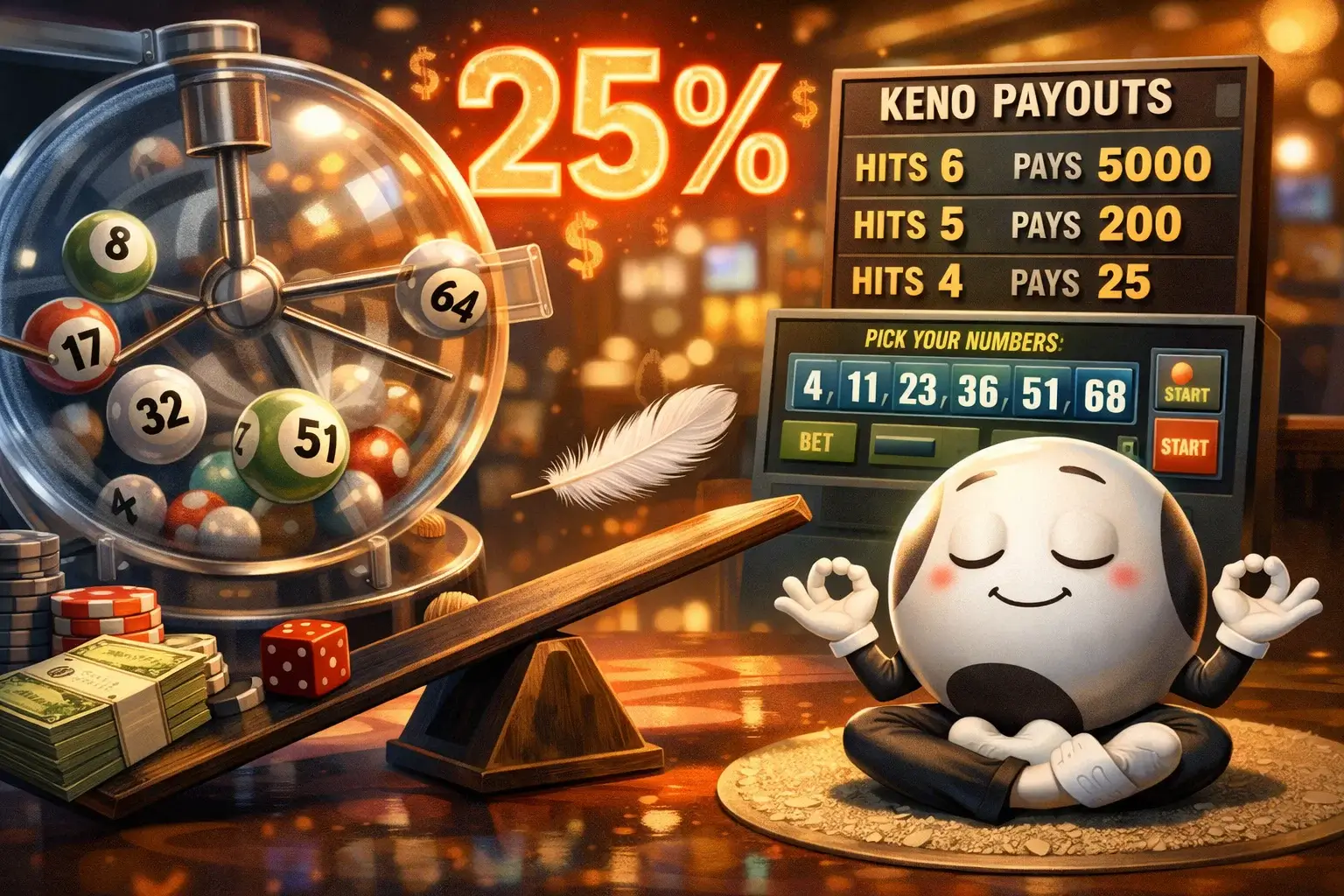
I’m going to be direct with you: KENO has one of the worst house edges of any gambling game you can realistically play. While blackjack hovers around 0.5% and craps can be under 1% with proper bets, KENO’s house edge typically sits between 25% and 40% depending on the specific game variant and payout structure. That means for every dollar you bet, you should mathematically expect to lose between 25 and 40 cents. Over time, that’s not a possibility—it’s a mathematical certainty.
Understanding where this edge comes from is absolutely critical because it changes how you think about the game and what you’re actually paying for. Most people casually assume casinos just set payout odds however they want, keeping the difference as pure profit. That’s partially true in the most simplistic sense, but the real story is more nuanced and interesting. The house edge exists because the odds of winning certain combinations are so astronomically low that casinos have to take a massive cut just to make the game work mathematically and remain profitable.
Let me walk you through a concrete example that illustrates this clearly. In a typical 100-number KENO game where 20 numbers are drawn from the pool, the odds of matching all 10 numbers on a 10-spot ticket are roughly 1 in 8.9 million. Let me emphasize that: 8.9 million to one. These odds are so extreme that if a casino paid out 8.9 million dollars for every single dollar wagered on a 10-spot jackpot, they’d break even mathematically on that specific outcome (while completely ignoring all the times players win less and lose more). But obviously, they can’t do that because no one would ever bet knowing the true payout to true odds ratio. Players would immediately see they’re being fairly paid and either love the game or remain indifferent. So casinos pay out maybe 10,000 dollars for a dollar 10-spot ticket—massively less than the true odds would theoretically warrant. The difference between what should logically be paid based on true odds and what is actually paid is exactly where the house edge lives.
This is where KENO fundamentally differs from games like blackjack or craps. In those games, payout ratios are relatively close to the actual probability ratios. A game with 50% odds of winning typically pays close to even money. A game with 33% odds pays close to 2-to-1. A game with 25% odds pays around 3-to-1. With KENO, the payout ratios are dramatically, noticeably lower than the probability ratios for big wins. This systematic underpayment is intentional. It’s literally how casinos make the game profitable enough to offer.
The house edge accumulates across all possible outcomes, not just the jackpot. You don’t just lose money on the 10-spot jackpot you’ll probably never hit. You lose money overall across all your plays because literally every single payout—whether you hit two numbers, three numbers, or eight numbers—is slightly systematically undervalued compared to the true odds. The underpayment is consistent across all outcomes, creating the cumulative house edge.
I calculated this for a typical 6-spot game to show you concretely. The true odds of hitting all six numbers are roughly 1 in 7,150. If casinos paid true odds, a dollar bet would return 7,150 dollars on a six-number hit. Instead, they pay around 300-500 dollars depending on the specific payout table. For five numbers, true odds are roughly 1 in 225, but the payout is typically 50-100x your bet instead of 225x. For four numbers, true odds are roughly 1 in 15, but payouts are 10-15x instead of 15x. Every single outcome is systematically underpaid.
Why Casinos Need That Edge to Operate
Here’s something most KENO players never seriously consider: that 25-40% house edge isn’t pure profit going straight into the casino’s pocket. A significant and substantial portion of it goes to legitimate operational costs that have nothing to do with the casino keeping money for itself. Understanding this reality changed fundamentally how I think about the fairness of KENO and what I’m actually paying for.
Running a KENO operation—whether online or physical—costs genuinely serious money that most players never think about. In a physical casino, you need to pay staff to run the KENO area. You need someone managing the draws, someone handling payouts, someone managing the ticket booth. You need to maintain the draw machine and verify it regularly for fairness according to regulations. You need to buy physical tickets, replace worn equipment, and maintain the booth itself. You need to provide the physical location, heat, light, and security. All of this costs money before the casino makes a single dollar of profit.
On online platforms like RajaBaji or JabiBet, the costs are different in nature but no less real or significant. You need experienced software developers maintaining the platform, fixing bugs, and implementing updates. You need customer service people handling disputes and player questions. You need to pay for server infrastructure and bandwidth to handle thousands of concurrent players. You need to fund the random number generator certification and pay for regular independent audits. You need to invest in cybersecurity to protect player data from theft. You need to pay for licensing in multiple jurisdictions and regulatory compliance. These costs are genuinely substantial and nontrivial.
I actually researched what some casinos publish about their operating costs for KENO specifically in regulatory filings. Some casinos report that of their 35% house edge on KENO, roughly 10-15% goes to regulatory requirements, licensing, and staff salaries. Another 5-10% goes to unclaimed prizes and prizes that were won but never collected. Another 5-8% goes to infrastructure, equipment maintenance, and operations. What’s left—maybe 10-15%—is actual corporate profit. The money the casino actually keeps as profit. This is startling to most people because they think the entire house edge is profit.
This analysis doesn’t excuse the high house edge, but it definitively explains why it exists and why it has to be so high. If casinos operated KENO with a 15% house edge, they’d very likely operate at a loss on the game entirely after accounting for all their real costs. They wouldn’t offer it to players. The game wouldn’t exist. The high edge exists as a mathematical requirement to make KENO viable as a game they can profitably offer to their customers.
Comparing KENO to Other Games: Why the Edge is So High
The first time I really understood how bad KENO’s house edge is, I compared it to other games I play. The comparison was humbling. Blackjack has a house edge around 0.5-1% with basic strategy. Craps has some bets under 1% edge. Even slot machines, which people rightly complain about, typically have house edges of 2-15% depending on the machine. KENO’s 25-40% is literally in a different universe.
Why is KENO so much worse? It comes down to the nature of the game. In blackjack, the odds of any particular outcome are relatively close to even. The game is fundamentally fair but the casino has a small mathematical edge. In KENO, the odds of hitting certain combinations are absolutely insane. There’s no way to make those odds anywhere near even while still making the game mathematically viable for the casino.
I calculated the odds for different KENO outcomes to illustrate. Matching four out of four numbers in a 4-spot game: roughly 1 in 326. Matching eight out of ten in a 10-spot game: roughly 1 in 76. Matching all ten: roughly 1 in 8.9 million. These aren’t just slightly low odds. They’re extremely low. No casino can responsibly offer payouts close to these true odds. The payout has to be a tiny fraction of the true odds, creating a massive house edge.
The house edge is also high because KENO offers multiple outcome tiers. You can win by matching 2, 3, 4, 5, or more numbers depending on the game. Each outcome has its own odds and payout. The casino has to profit across all outcomes simultaneously, which requires a large overall edge.
Compare this to a game like roulette, which has a house edge around 2.7% on most bets. Why is roulette’s edge so much lower? Because the odds are more reasonable. Red or black is essentially 50-50. Odd or even is 50-50. The casino’s edge comes from just a couple of numbers (0 and 00) that favor the house. With KENO’s extreme odds, there’s no way to make it so simple.
The comparison helps me accept the high edge. KENO isn’t a ripoff compared to blackjack. It’s a fundamentally different game with fundamentally different odds. The question isn’t whether KENO is fair compared to blackjack. The question is whether you want to play KENO knowing the actual price.
The Psychological Impact of a 25% Edge: What You’re Actually Losing
Understanding the math of the house edge is one thing. Actually accepting what this means for your real money over time is quite another. A 25% house edge means that if you bet 100 dollars across many plays, you should expect to lose 25 dollars. If you play weekly for a full year, betting 20 dollars each week, you’re mathematically looking at losing about 260 dollars per year just to the math. That’s real money. That’s money you could use for something else—investing, saving, spending on other entertainment, or literally anything else.
I tracked my actual KENO losses over a complete full year to understand what this math meant in practice. I played consistently but not excessively—roughly 30 dollars per week across various spot games I enjoyed. My total amount wagered over the year was about 1,560 dollars. My total losses accounting for all wins and losses were about 420 dollars. That works out to an effective house edge of 27%, almost exactly the theoretical expectation. That 420 dollars wasn’t just numbers in a spreadsheet. It was real money I spent that didn’t return. It was money I could have saved or used for something else.
The psychological part that’s hardest to accept is that this loss is mathematically certain. It’s not bad luck that happens to some players. It’s not a temporary situation that might improve if you keep playing. It’s the inevitable mathematical consequence of repeatedly playing a game with negative expected value. Over large enough samples, you will lose money. You might win occasionally and feel great about it, but overall and consistently, the math guarantees loss.
This is fundamentally different from other forms of entertainment spending where you at least get something obvious in return. If you go to a movie, you spend 15 dollars and get to watch a film for two hours. If you eat at a restaurant, you spend 30 dollars and get a meal. If you attend a concert, you spend 80 dollars and get a show. You know what you’re paying for. You experience it. With KENO, you’re systematically paying 25-40 cents per every dollar you wager, but what you’re getting in return—the entertainment, the hope, the occasional wins—is less tangible and harder to quantify. It’s harder to justify spending because you’re explicitly paying money for a negative expected outcome. You’re paying to lose.
I had to fundamentally reframe how I think about KENO losses to make peace with them. Instead of thinking “I lost 420 dollars this year on KENO,” which sounds painful, I started thinking “I spent 420 dollars on KENO entertainment.” This sounds like semantic trickery, but it’s actually genuinely important psychologically. If I allocate 420 dollars for annual entertainment from my discretionary budget, and I consciously choose to spend it on KENO knowing the mathematical cost upfront, then it’s not a loss in the financial sense. It’s an expense. It’s no different fundamentally than spending 400 dollars on concert tickets or 300 dollars on dining out or 500 dollars on hobbies.
Accepting the Edge: Setting Realistic Expectations
The moment I stopped expecting to win at KENO, the game became tolerable. I know that sounds backwards, but it’s true. As long as I was hoping to beat the game, win money, or find an edge, I was disappointed every time. Once I accepted that the game is designed so I lose money, the disappointment disappeared. I could enjoy the experience for what it actually is.
This required setting specific, realistic expectations. I decided I would play KENO for fun, treating it like any other entertainment expense. I allocated a specific monthly budget—500 dollars per month—and decided that amount was completely gone before I played the first game. This amount was entertainment money, not investment money. Whether I lost 500 dollars or somehow won back half of it, the plan was the same: that money was committed to KENO entertainment.
With these expectations set, something interesting happened. The experience became more enjoyable. I wasn’t constantly disappointed by losses because I expected them. The occasional wins felt genuinely good even if they were small. I wasn’t chasing losses because I’d already accepted I’d lose. The psychological burden lifted.
I also set a hard limit: once my monthly budget was spent, I didn’t play again until the next month. This prevented the destructive behavior of “chasing losses” that costs most KENO players serious money. If I spent my 500 dollars by the 20th of the month, I just didn’t play for the last ten days. No exceptions. This discipline is hard but absolutely necessary.
Many people can’t do this. They see themselves having a bad day at KENO and immediately decide to “play a bit more to get back what they lost.” This is the fastest way to turn a manageable loss into a catastrophic loss. I’ve watched this happen. A person loses 50 dollars and decides they’ll play another 100 dollars to “make it back.” They end up losing 200 dollars total because the math doesn’t care about their emotional state.
Setting expectations also means accepting the specific odds. If I play a 10-spot ticket, I expect to lose that money probably 99.99% of the time. I’m not playing because I think I’ll win. I’m playing because I enjoy the experience of hoping, of waiting for the draw, of seeing what happens. The win would be nice, but it’s not the point. The point is the entertainment value of the play itself.
Comparing KENO’s Value to Other Entertainment
I started comparing KENO’s cost to other entertainment I regularly pay for, and it was eye-opening. If I spend 500 dollars per month on KENO, I lose about 125-200 dollars per month to the house edge. That’s my entertainment cost.
Compare this to other things I do: I go to movies maybe twice a month at 15 dollars each—that’s 30 dollars per month on entertainment that’s gone after two hours. I occasionally eat at nice restaurants—that’s maybe 100 dollars per month on food entertainment that’s gone after a meal. I subscribe to streaming services—that’s about 40 dollars per month for entertainment. When you add all this up, my total entertainment spending is around 600-700 dollars per month.
KENO is just one part of my entertainment budget. When I think about it that way, 500 dollars per month on KENO doesn’t seem unreasonable. It’s slightly more than my other entertainment combined, but not drastically. The house edge is the cost of playing. Understanding it as a stated cost rather than an unfair loss changes the psychology.
Some people spend 500 dollars per month on hobbies they don’t see as gambling. A fishing enthusiast might spend 300 dollars on equipment and trips. A gamer might spend 500 dollars on games and hardware. A golf enthusiast might spend 1,000 dollars per month on green fees and equipment. These are entertainment expenses with no financial return. KENO is similar—you spend money, you get entertainment, and the money’s gone. The house edge is just the price tag.
The difference is that KENO’s price tag is explicit and can be calculated mathematically. You know exactly how much you’re paying per dollar wagered. With other entertainment, the cost is often hidden or unclear. You spend money on hobbies without quantifying the exact entertainment value per dollar. KENO forces you to be honest about the cost.
This comparison helped me accept KENO. It’s entertainment. It costs money. The house edge is the stated price. I pay that price and I get the entertainment. This is fine. What’s not fine is playing with money you don’t have or can’t afford to lose. That’s when KENO stops being entertainment and becomes harmful.
Comparing KENO’s Value to Other Entertainment Spending
I started deliberately comparing KENO’s cost to other things I regularly pay for entertainment, and it was genuinely eye-opening. If I spend 500 dollars per month on KENO, I lose about 125 to 200 dollars per month to the house edge. That’s my explicit entertainment cost.
Compare this to other entertainment in my life: I go to movies maybe twice a month at 15 dollars each—that’s 30 dollars per month on entertainment that completely disappears after two hours. I occasionally eat at nice restaurants—that’s maybe 100 dollars per month on food entertainment that’s gone after a meal. I subscribe to streaming services—that’s about 40 dollars per month for entertainment. I might attend live events a few times per year. When you add all this up, my total entertainment spending is around 600 to 700 dollars per month.
KENO is just one part of my overall entertainment budget. When I think about it this way and compare it to the actual total, 500 dollars per month on KENO doesn’t seem unreasonable or excessive. It’s slightly more than my other entertainment combined, but not drastically more. The house edge is the cost of playing. Understanding it as a stated, transparent cost rather than as an unfair loss fundamentally changes the psychology.
Some people spend serious money on hobbies they don’t see as gambling. A fishing enthusiast might spend 300 dollars on equipment and trips. A gamer might spend 500 dollars on games and hardware. A golf enthusiast might spend 1,000 dollars per month on green fees, equipment, and club memberships. A photography hobbyist might spend 400 dollars per month on gear. These are pure entertainment expenses with zero financial return. KENO is similar—you spend money, you get entertainment and hope, and the money’s gone. The house edge is just the price tag.
The difference is that KENO’s price tag is explicit and can be calculated mathematically. You know exactly how much you’re paying per dollar wagered. With other entertainment, the cost is often hidden or unclear. You spend money on hobbies without quantifying the exact entertainment value per dollar. KENO forces you to be honest about the cost because the mathematics makes it undeniable.
Making Peace: Strategies for Playing Responsibly Despite the Edge
Once I accepted the house edge, I developed specific strategies to play KENO in a way that was actually sustainable and didn’t hurt my financial situation. These aren’t strategies to beat the game—nothing beats a negative expectation game. These are strategies to ensure the game doesn’t harm me.
First, I separated KENO money from essential expenses completely. My bills, rent, groceries, and emergency fund are completely off-limits for gambling. Period. Only money that’s genuinely discretionary—money I’d spend on entertainment regardless—goes to KENO. This is non-negotiable because without this separation, KENO becomes financially dangerous.
Second, I set a monthly loss limit and actually enforced it. I decided 500 dollars per month was my entertainment budget for KENO. Once that’s spent, I’m done until the next month. Not one more dollar. This requires discipline but it’s absolutely necessary. Every person I know who got in serious KENO trouble did so because they didn’t enforce a hard limit.
Third, I decided which spot games actually provided entertainment value to me personally. Four-spot games give me frequent wins, which I enjoy. Ten-spot games rarely hit but offer the fantasy of a big win, which also has value. Six-spot games feel balanced. I don’t play games that don’t resonate with me just because the math says one might have a slightly lower house edge. The psychological value matters.
Fourth, I avoid playing when emotional. If I’m angry, sad, stressed, or desperate, I don’t play KENO. These emotional states lead to bad decisions—bigger bets, longer sessions, chasing losses. I only play when I’m in a good emotional state and able to stop when I’ve decided to stop.
Fifth, I don’t use KENO as a financial strategy. I never tell myself I’m playing KENO to “make extra money” or “solve my money problems.” That’s delusional. I’m playing for entertainment knowing I’ll lose money. If I had money problems, the last thing I’d do is gamble. That’s when the house edge becomes a wealth destroyer.
Sixth, I track my play. I know exactly how much I’ve wagered and how much I’ve lost. This transparency helps me stay honest about the cost. If I’m seeing losses I didn’t expect, it’s a signal to reevaluate whether KENO is still appropriate entertainment for me right now.
Finally, I remember that KENO doesn’t owe me anything. The game isn’t unfair. I’m not entitled to wins. The math is what the math is. Accepting this removes so much psychological stress from the experience. I’m not fighting the math. I’m not looking for a trick to beat it. I’m just playing knowing the cost.
Conclusion: The Edge is Real, But So is Enjoyment
Here’s what I’ve learned after years of playing KENO while fully understanding the house edge: the edge is real, mathematically guaranteed, and absolutely unavoidable. You cannot beat it. You cannot find a system to overcome it. You cannot outsmart it. It’s the price of playing the game.
But here’s what else is real: KENO can be genuinely enjoyable entertainment if you approach it correctly. You can feel the excitement of waiting for a draw. You can experience the joy of hitting a number you picked. You can have moments of genuine hope and anticipation. These experiences have value.
The trick is separating the entertainment value from the financial value. The entertainment has genuine value. The financial outcome doesn’t. If you can make that separation, you can play KENO responsibly.
Some people can’t make that separation. For them, KENO is dangerous and should be avoided entirely. This isn’t weakness or moral failing—it’s self-knowledge. If you know KENO triggers compulsive spending or emotional distress, don’t play. The game will always be there if you change your mind.
But if you can genuinely accept the house edge as the entertainment cost, set hard limits, enforce those limits, and play with discretionary money only, then KENO can be part of a responsible entertainment budget. The 25% edge isn’t unfair. It’s the price tag. And if you’re willing to pay that price for the entertainment you get, then the game isn’t a ripoff. It’s just another form of entertainment that costs money.
I’ve lost thousands of dollars to KENO over the years. I don’t regret it because I paid for entertainment and I got entertainment. I would regret it if I’d lost that money while telling myself I was making an investment or if I’d borrowed that money from essential expenses. But I didn’t. I paid a known price for known entertainment, and I can live with that.
That’s how I’ve made peace with the 25% house edge. Not by pretending it doesn’t exist or that I can beat it. But by accepting it as the actual cost of the entertainment I’m choosing. Once you’ve made that peace, KENO becomes just a game, not a financial problem. And that changes everything about the experience.