I’ve been doing this for about three years now, and I’m going to be straight with you: most people have no idea that they can actually track which scratch cards still have big prizes left. They just walk into a convenience store, grab whatever looks good, and hope for the best. But there’s actually a system to this. It’s not perfect, and it won’t make you rich, but it can definitely improve your odds.
When I first started looking into this, I was trying to solve a simple problem: I’d noticed I was losing money on scratch cards faster than the math suggested I should be. Not dramatically faster, but consistently. I’d buy five cards, maybe win $3 back. Buy another five, win $2. It made me curious about whether there was actually any way to tilt the game slightly in my favor.
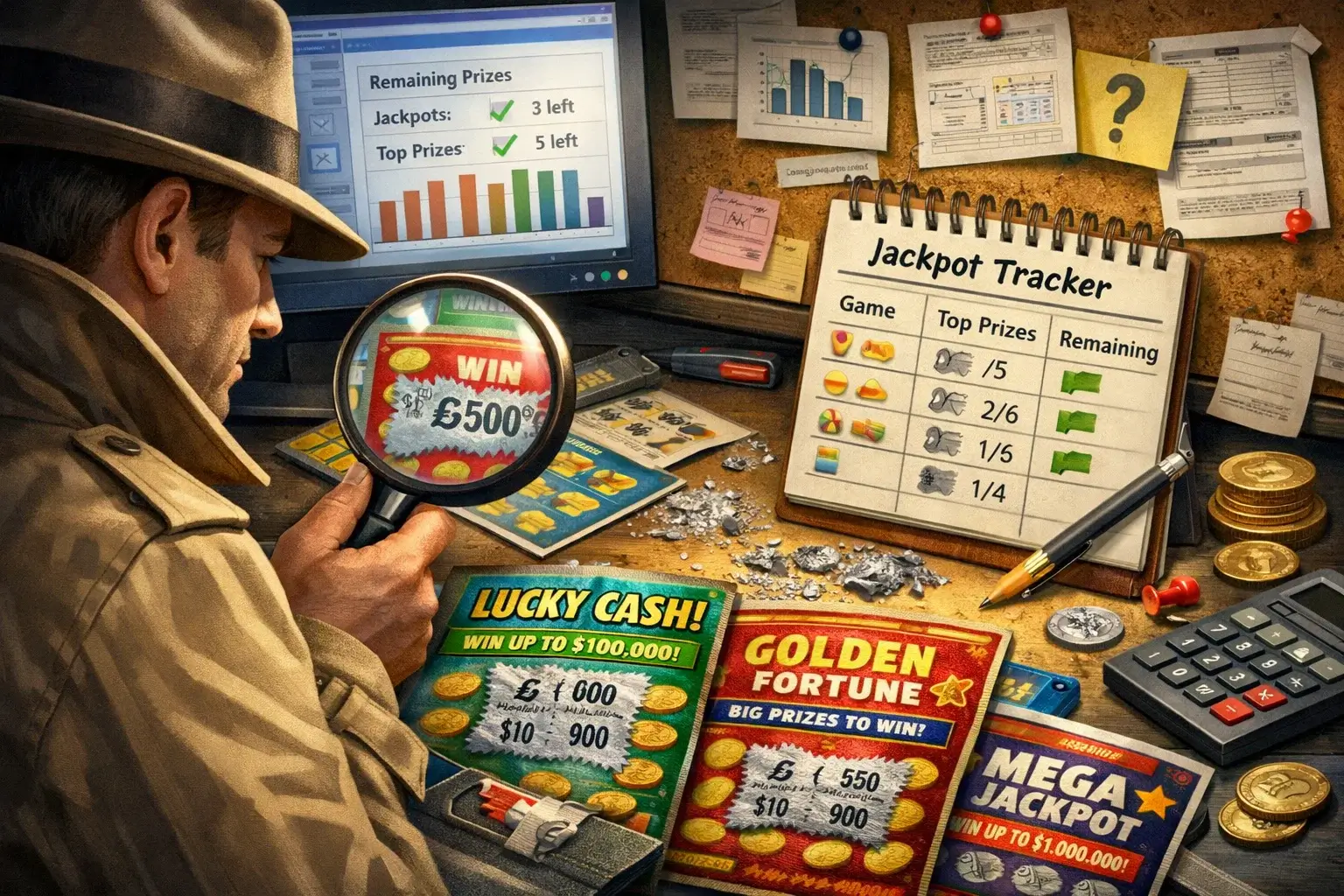
I started researching lottery odds, prize structures, and how games work. And that’s when I stumbled onto something most people don’t know exists: publicly available data about remaining prizes in active games. It completely changed how I approached scratch cards.
The lottery commissions don’t exactly advertise this information. It’s not like they’re hiding it either. It’s just… tucked away where nobody looks. And the people who do look? They’re not talking about it much. The information is there because lotteries are required by law to be transparent about their games. But they don’t exactly put up billboards saying “Hey, you can check our prize data before you buy!”
So I’m going to walk you through exactly what I’ve learned. Not because I’ve figured out some magic system that beats the lottery. I haven’t. The math is what it is. But because if you’re going to play anyway, which statistically a lot of you will, you might as well have better information than just walking in and grabbing whatever catches your eye.
Every State Lottery Has a Prize Tracker—You Just Need to Know Where to Look
Here’s the thing that surprised me most when I started researching this: every single state lottery commission publishes data about remaining prizes. It’s on their official websites. It’s regularly updated. And most people don’t even know it exists.
Every state’s lottery website has a section, usually under something like “Scratch-Off Games” or “Instant Games,” where they list all the active scratch card games. Each game listing includes basic information: the ticket price, the game number, the overall odds of winning, and most importantly, the breakdown of prizes still in circulation.
The format varies by state. Some do it really clearly with a chart showing how many $1 prizes remain, how many $5 prizes, how many $50 prizes, and so on. Other states make it more complicated. But the information is definitely there.
When I first found this, I couldn’t believe it. I spent like twenty minutes just scrolling through New York’s lottery website looking at different scratch games. They’ve got dozens of active games at any given time. Each one has its own odds and prize structure. You can see exactly how many tickets are left to be sold and approximately how many winning tickets are still out there.
The tricky part is that the data isn’t real-time. It’s updated periodically, usually weekly or sometimes a couple times a week depending on the state. So when you’re looking at the numbers, they’re maybe two or three days old. That’s important because it means the information is directional rather than precise. You’re getting a general sense of the game’s status, not an exact snapshot.
Some states are way better about updating this than others. New York, California, and Texas tend to have really frequent updates. Smaller states might only update their games weekly. This matters if you’re trying to time when you buy.
Why Remaining Prize Data Actually Matters (And How to Use It)
So the first question people ask me is: why does this matter? If I know there are still five $50,000 prizes left in a game with 50 million tickets in circulation, how does that help me?
Fair question. And the answer is nuanced.
First, let’s think about it mathematically. If a game has sold half the tickets but still has 80% of the prizes left, that’s a good sign. It means winners are coming out slower than expected. That can happen for a few reasons. Maybe the game isn’t selling as well as the lottery hoped. Maybe people are holding onto winning tickets without claiming them. Either way, it suggests prizes are relatively abundant.
Conversely, if a game has sold 80% of tickets but only has 40% of prizes remaining, that means prizes are drying up fast. Winners are being claimed quickly. This suggests the remaining prizes are probably going to be harder to find.
I’ve tracked this pattern across multiple games, and there’s definitely a correlation. Games where prizes remain abundant relative to ticket sales tend to have more frequent small winners. Games where prizes are scarce relative to sales tend to have longer droughts between wins.
Now, none of this guarantees you’ll win anything. The odds are still heavily against you no matter what. But if you’re going to play anyway, you might as well play games where the odds are slightly less terrible.
Here’s what I actually do: I look for games that have recently launched. New games always have more prizes remaining relative to tickets sold. They literally just started printing and distributing them. The prizes are fresher, so to speak. Games that have been on sale for six months or a year? Those are picked over. More of the tickets have been bought. More of the prizes have been claimed.
I also look for games that aren’t selling well. You can tell because the lottery will sometimes announce promotions for them. “This game has been out for three months and still has huge prizes remaining! Come try your luck!” When you see that kind of messaging, it’s because the game hasn’t been flying off shelves. And that means prizes are more abundant.
The tricky part is actually using this information to improve your results. Let me give you a concrete example. I’m looking at data from a recent game launch in New York. Game number 4587, $5 ticket price. It just launched three weeks ago. They printed 40 million tickets total.
According to the prize data, there are about 35 million tickets still in circulation. That means only about 5 million tickets have been bought and scratched. Of the prizes, they’ve claimed about 18% of all prizes so far. Which means 82% of prizes are still available.
Compare that to another game that’s been running for nine months. Same price point, similar game setup. About 85% of the 40 million tickets have been sold. But they’ve only claimed about 60% of prizes. That’s actually better distribution than the new game, statistically speaking. But the new game means I’m playing in a fresher cycle.
Now let me compare these to a game that’s near the end of its run. It’s been out for fourteen months. Almost all 40 million tickets are claimed or out of circulation. They’ve announced the grand prize winners already. Smaller prizes still remain, but they’re sparse. The lottery is basically milking the last bit of revenue before they retire this game.
Mathematically, if you’re just looking at probability, your odds aren’t dramatically different between these games. But psychologically and strategically, they are. The fresher games give you slightly more hope of hitting something decent.
This is where expected value calculations come in. If a game has a 45% payout rate and you’re buying from a game where prizes are abundant, your expected value is slightly better than if you’re buying from a game where prizes are scarce. Not by much—maybe a 1-2% improvement. But it compounds if you’re doing this regularly.
The tricky part is actually using this information to improve your results in meaningful ways. Yes, if you’re buying tickets from a game with better prize distribution, your expected value is slightly less terrible. But we’re talking about maybe the difference between losing 40% of your money and losing 38%. It’s not huge. It’s not going to change your life.
But here’s what it does do: it gives you agency. Instead of randomly picking any scratch card, you’re making an informed decision. You’re at least trying to tilt the odds slightly in your favor. And psychologically, that matters. It’s the difference between blind gambling and strategic play.
The Retailers Know Which Games Are Hot—And They’re Using That Information
Something I didn’t understand when I started this was that individual retailers have their own stake in which games sell. Every ticket sold at their store generates a small commission for them. So retailers are actually paying attention to which games are moving quickly and which ones are sitting on the shelf.
I’ve talked to several convenience store owners, and they all told me the same thing: they know which scratch games are in their store and how they’re performing. They’ve got data from their lottery terminals about what’s selling. Some of them even make decisions about which games to stock more heavily based on demand.
What this means is that if a game is nearly played out in one location, they might not restock it. So the remaining tickets for that game might be concentrated in stores that have lower foot traffic or didn’t stock it heavily. Meanwhile, hot games that are still selling well get regular restocks.
This is why some people say that finding winners at certain retailers is easier than others. It’s not that the lottery is doing anything special at particular stores. It’s that the distribution of remaining tickets is uneven based on local demand.
I’ve tested this theory. I found a game that was supposedly nearly finished—most prizes claimed, only about 20% of tickets left to be sold. But when I went to different stores, some of them still had stacks of that game on the shelf. The reason? Those stores hadn’t moved as many tickets as others. So they had later-serial-number tickets, which according to some lottery insiders, might have different prize distributions since they were printed later in the run.
Now, I want to be careful here. The lottery doesn’t explicitly state that ticket serial numbers matter. They claim all tickets in a game have the same probability of winning. But the reality is that tickets are printed in batches and distributed over time. So there could be subtle patterns in which batches get what prizes.
The big retailers—Walmart, 7-Eleven, CVS—get regular restocks from lottery distributors. Independent convenience stores might get stocked less frequently or in smaller quantities. This can actually work in your favor if you’re hunting for remaining prizes in a game. The independent stores might have older stock that’s been sitting around, which could mean different distribution patterns than what you’d find at chain stores.
Serial Numbers, Batch Codes, and Other Secrets People Claim Work
I spend a lot of time on lottery forums and Reddit threads, and people are constantly talking about secret methods for picking winning scratch cards. Serial numbers. Batch codes. The color of the ink. Certain store locations. Special numbering patterns that supposedly indicate winners. Some people claim they’ve cracked the code and figured out which tickets will win.
Here’s my honest take: most of it is probably nonsense. But not all of it.
The serial numbers thing I mentioned is real in the sense that tickets are printed sequentially and distributed over time. The lottery doesn’t print all tickets at once and release them simultaneously. They print in batches. First batch gets serial numbers starting at 000001. Next batch gets the next sequence. This happens throughout the game’s lifetime.
But whether that actually affects your odds of finding a winner? I’m skeptical. The lottery has no reason to cluster prizes by serial number. That would be stupid from their perspective. They want the distribution to be random so nobody can exploit it. It would be a massive scandal if someone figured out that serial numbers 5000000-6000000 had more winners than other ranges.
That said, I have noticed that sometimes, if you find a winner at a particular retailer with a certain serial number range, you’ll find winners in the same range at that store. But I don’t know if that’s a real pattern or just confirmation bias on my part. My brain is probably making connections that aren’t actually there because I’m looking for patterns.
The batch codes are legit from a security perspective. Scratch cards have security features, and batch codes are part of that system. They help the lottery and retailers verify that tickets are legitimate and haven’t been counterfeited. But lottery officials have been pretty clear that batch codes don’t correlate with whether a ticket is a winner or not. They’re just for security and tracking purposes.
Then there’s the visual inspection thing. People claim you can tell if a ticket is a winner by how it feels, how the scratch material looks, the way the numbers are arranged underneath, etc. I’ve tried this extensively, and I’m convinced it’s just luck when it works. The scratch material is designed to be opaque and impossible to see through. You can’t see the numbers underneath no matter how hard you look or how you angle it in the light. The scratch material is specifically engineered to prevent that. And even if you could somehow see through it, the numbers are randomly arranged, so there’s no pattern to spot.
What I do think is real is the idea that some retailers have better-luck reputations than others. Not because they’re doing anything special or because they’ve got some special batch of tickets. It’s just because of how tickets are distributed and how many people buy there. A busy 7-Eleven in Manhattan is going to have more winners claimed there than a small convenience store in rural Montana. Just because more tickets are being sold there, period.
The practical takeaway: don’t waste time trying to spot winning tickets through some secret visual method or special numbering trick. You can’t. It’s impossible. But do pay attention to remaining prize data and game age, because that information is real and publicly available.
The Real Strategy: Timing, Game Selection, and Bankroll Management
After doing this for a few years, here’s what actually works: timing and discipline.
Timing means knowing when to play which games. New game launches are the best time to buy because you’re fresh in the prize cycle. Games that have been out for a while and have promotions running to boost sales are often good bets too, because that means prizes are still abundant relative to tickets sold.
The worst time to buy from any game is near the end of its run when the lottery announces that the grand prize has already been won and only smaller prizes remain. At that point, you’re basically guaranteed not to win anything big, and the smaller wins are scattered through millions of remaining tickets.
Game selection means looking at the actual odds. Yes, every ticket in a game has the same mathematical odds of winning. But the odds vary between games. A $1 game might have odds of 1 in 4 for any win. A $20 game might have odds of 1 in 3. The $1 game has better odds in absolute terms, but worse expected value because the prizes are smaller.
I’ve found that $2 and $5 games tend to offer the best combination of odds and prize distribution for what I’m doing. They’re not too expensive per ticket, the odds aren’t terrible, and there’s usually decent prize distribution spread.
Bankroll management is critical. This is the part that separates people who occasionally scratch a card for fun from people who end up losing serious money. You set a budget. You stick to it. When the budget is gone, you stop.
I budget about $50 per month for scratch cards. That’s my entertainment budget. If I win anything, great. Usually I don’t. But I know going in that I’m probably going to lose that fifty bucks, and I’m okay with that as the cost of the small dopamine hits I get from scratching.
The problem is most people don’t have a budget. They buy a few cards, lose money, and then buy more trying to win it back. That’s when the math becomes really brutal. That’s how people lose hundreds of dollars.
There’s a famous strategy called the “Lottery Retailer Database” approach where some people literally buy every ticket from games with specific characteristics, track which ones win, and try to identify patterns. The idea is that if you buy enough tickets from a game, you’ll eventually hit enough winners to offset your costs.
In theory, this could work if you found a game with better-than-average odds and enough capital to weather the variance. But in practice, it doesn’t. The payout percentage is fixed by the lottery. No matter how many tickets you buy or how smart you are about selection, you’ll still lose money in aggregate. You just might lose slightly less if you’re strategic.
Websites and Apps That Track This Data for You
The good news is you don’t have to manually check every state lottery website. There are actually some decent tools available that aggregate this information.
LottoSmile and LotteryCritic are two websites that track remaining prizes across multiple states. They’re not perfect—they rely on data from official lottery sources, so they’re only as current as those sources. But they make it easier to compare games across different states without having to visit each lottery commission website individually.
Some states have their own official apps now. New York’s is pretty good. California’s is okay. Texas has one that’s decent. You can download them and check remaining prizes right from your phone before you go to the store.
There are also some third-party apps that attempt to track this stuff, but I’m always skeptical of third-party lottery apps because of security concerns. The official state apps are safer. Stick with those when they’re available.
The reality is that most people won’t bother checking this data before they buy. They just don’t care enough. And that’s fine. But if you’re going to buy scratch cards anyway, spending five minutes checking the remaining prizes is worth it. It’s not going to make you rich, but it might marginally improve your odds.
I’ve also connected with some online communities of people who obsess over this stuff. There are Discord servers and Reddit communities dedicated to tracking scratch card games across different states, sharing information about which games have good remaining prize distribution, which retailers are getting hot restocks, etc.
Some of these communities are genuinely informative. Others are just echo chambers of people convincing each other that they’ve figured out some secret to beating the system. You have to use judgment about which information is actually useful and which is just noise.
The Uncomfortable Truth: Better Odds Still Aren’t Good Odds
I need to be honest about something. Even if you do all this—check the remaining prize data, wait for new game launches, select games strategically, manage your bankroll carefully—you’re still going to lose money over time.
The math doesn’t change. If a game has a 40% payout percentage, that’s what it is. Period. You can’t change that by being smarter about which ticket you pick. You can’t change it by checking serial numbers or batch codes or any of that stuff.
What you can do is maybe shift the odds slightly in your favor. Maybe instead of losing 40% of your money, you lose 38%. Maybe instead of a 1 in 50 million chance of winning the big prize, you have a 1 in 45 million chance because you’re playing games with slightly better prize distribution.
These are marginal improvements. They’re not meaningful in practical terms. But psychologically, they matter. They give you the sense that you’re not just blindly throwing money at the lottery. You’re making informed decisions.
The real truth is that if you want to improve your financial situation, scratch cards are the worst possible investment. The expected value is terrible. The house edge is massive. There are literally thousands of better things you could do with that money.
But if you’re going to play anyway—and many people will—at least play strategically. At least check the remaining prizes. At least manage your bankroll. At least understand the math.
Because the lottery is counting on people not doing any of this. The lottery is counting on people walking in, grabbing a random ticket, and walking out. The lottery is counting on the occasional winner creating this illusion that prizes are abundant and winnable.
If you know the real odds and you’re still buying scratchers, that’s your choice. That’s entertainment. But make that choice with your eyes open. Don’t fool yourself into thinking you’ve found some secret system that beats the odds. That system doesn’t exist.
What exists is better information, better timing, and better discipline. Use those things if you’re going to play. But understand that they’re marginal improvements, not game-changers.
The lottery will still win. The math makes sure of that. But at least you won’t be losing quite as badly as someone who’s just picking random tickets and hoping for the best.