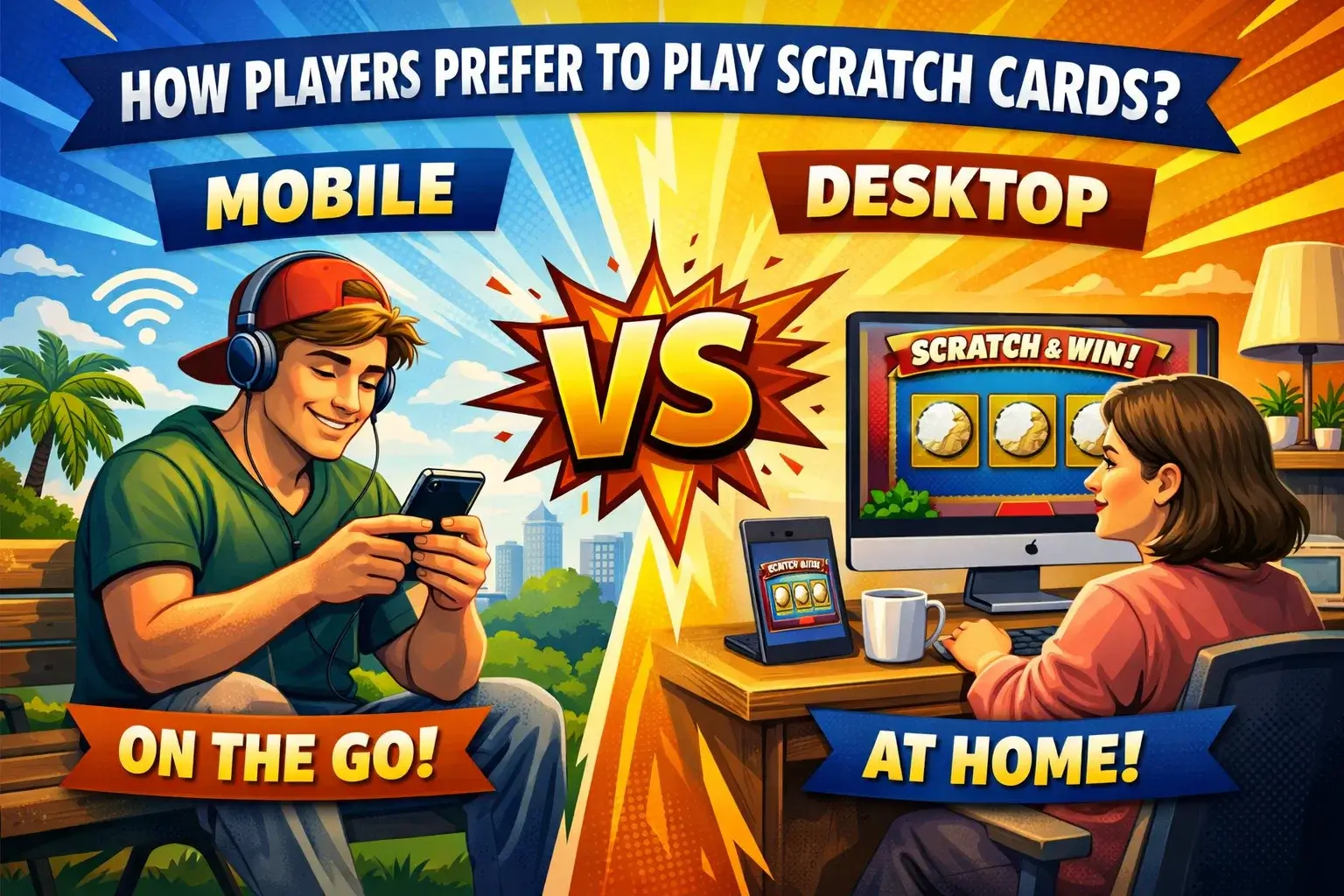
The digital scratch card market has bifurcated into two distinct experiences: mobile gaming optimized for touchscreens and portability, and desktop play offering larger displays and mouse precision. Player preferences between these platforms reveal fundamental differences in how, when, and why people engage with instant-win games. Understanding these preferences requires examining technical capabilities, behavioral patterns, demographic factors, and the psychological experience each platform delivers.
The Touch Revolution: Why Scratching Works Better on Smartphones
Mobile devices transformed scratch card gaming from a mouse-clicking exercise into something that genuinely replicates the tactile satisfaction of physical card scratching. The touchscreen interface solved the fundamental problem that plagued early desktop scratch cards: the disconnect between action and outcome when clicking with a mouse.
Swiping your finger across a smartphone screen to reveal symbols engages sensorimotor systems in ways that mirror physical scratching. The direct manipulation—your finger touching the exact spot being revealed—creates what interface designers call “direct engagement.” This contrasts sharply with mouse-based interfaces where your hand moves a cursor indirectly, creating cognitive distance between action and result. Usability studies consistently show that users rate touchscreen scratch card experiences as more satisfying and engaging than identical games played with mouse controls.
Haptic feedback amplifies this engagement significantly. Modern smartphones incorporate sophisticated vibration motors that provide subtle tactile responses when revealing winning combinations. These vibrations create multisensory experiences combining visual, auditory, and tactile feedback. Research on mobile gaming demonstrates that haptic feedback increases reported enjoyment by 25-30% and extends average session lengths by similar margins. Players describe feeling more “connected” to games with well-implemented haptic responses.
The gesture-based interaction enables natural scratching motions impossible with mouse interfaces. Players can scratch diagonally, in circular patterns, or use multiple fingers simultaneously—movements that feel intuitive and personally expressive. Desktop interfaces constrain interaction to cursor movements and clicks, reducing the personal, physical connection to gameplay. This gestural freedom contributes to mobile scratch cards feeling more like “real” scratch cards than desktop versions, despite being equally digital.
Mobile optimization requires specific technical considerations that paradoxically enhance the experience. Screen size limitations force designers to focus on essential elements, eliminating visual clutter that desktop versions sometimes accumulate. The constraint of designing for 5-7 inch displays creates cleaner, more focused interfaces where symbols, win animations, and critical information receive proper emphasis. Many players report that mobile versions feel “cleaner” and easier to follow than desktop alternatives, despite larger desktop screens theoretically offering advantages.
Touch target sizing follows strict mobile design principles that improve usability. Apple’s Human Interface Guidelines recommend minimum touch targets of 44×44 pixels, while Material Design suggests 48×48 density-independent pixels. These requirements ensure that scratching gestures register accurately without frustrating mis-touches. Desktop designs lack equivalent constraints, sometimes resulting in awkwardly sized interactive elements that feel wrong at standard monitor distances.
The portrait orientation of smartphones creates naturally card-shaped playing fields. Physical scratch cards are typically rectangular in portrait orientation, and mobile devices match this format perfectly. Desktop monitors in landscape orientation require either letterboxing (wasting screen space) or artificially widening card designs that feel unnatural. This orientation match makes mobile scratch cards feel more authentic to players familiar with physical versions.
Mobile devices enable location-based features impossible on desktop systems. GPS integration allows operators to offer location-specific scratch cards—regional games available only in certain areas, tourist-destination themed cards, or special editions tied to local events. Proximity marketing can trigger notifications when players enter retail locations or entertainment venues. These location-aware features create personalized experiences that desktop gaming cannot replicate.
The camera integration on mobile devices opens innovative authentication and bonus features. Some platforms use camera-based age verification, allowing instant identity confirmation without uploading documents. AR (augmented reality) scratch cards project virtual cards onto real-world surfaces viewed through the camera, creating hybrid experiences. QR code scanning enables instant bonus code redemption and cross-platform promotions. Desktop users without webcams cannot access these features, creating mobile-exclusive functionality.
Mobile-first design philosophy now dominates scratch card development. Studios design for mobile experiences first, then adapt for desktop rather than the reverse. This approach ensures that core gameplay optimizes for touch interfaces where most players actually engage. Desktop versions become “also available” alternatives rather than primary platforms, reflected in development resource allocation and feature prioritization.
Push notification systems create ongoing engagement impossible with desktop platforms. Mobile players receive alerts about new game releases, special promotions, jackpot milestones, and personalized offers based on playing history. These notifications re-engage players throughout the day, creating multiple engagement touchpoints. Desktop users must actively visit websites to discover new content, resulting in lower engagement frequency and reduced lifetime value.
The always-available nature of smartphones fundamentally changes scratch card accessibility. Your mobile device accompanies you everywhere—commutes, waiting rooms, lunch breaks, home relaxation. This constant availability transforms scratch cards from destination entertainment (requiring computer access) into ambient entertainment filling life’s small gaps. Desktop gaming requires sitting at a computer, inherently limiting when and where play occurs.
Desktop Advantages: When Bigger Screens and Precision Matter
Despite mobile dominance in overall player numbers, desktop platforms retain advantages for specific player segments and gaming scenarios. Understanding when and why players choose desktop over mobile reveals that platform preference involves more than simple accessibility.
Screen real estate enables simultaneous multi-card play impossible on mobile devices. Serious scratch card players often play multiple cards concurrently, monitoring several reveal sequences simultaneously. Desktop monitors ranging from 24-32 inches accommodate multiple card windows side-by-side, while mobile screens barely fit single cards comfortably. High-volume players consistently prefer desktop for this parallel playing capability, which can increase cards played per hour by 200-300%.
Visual detail and animation quality benefit from larger displays and more powerful processors. Desktop GPUs render complex particle effects, 3D animations, and high-resolution graphics that mobile devices struggle to match. While casual players may not notice these differences, enthusiasts appreciate the enhanced visual experience. Premium scratch card titles designed to showcase graphical capabilities target desktop players willing to sacrifice portability for superior presentation.
Keyboard and mouse input provides precision advantages for certain game mechanics. Some scratch card variants incorporate skill-based bonus rounds, puzzle elements, or timing challenges where precise cursor control matters. Desktop peripherals offer accuracy and speed advantages over finger-based touch controls. Competitive scratch card tournaments—where players compete for highest total winnings within time limits—often mandate desktop play specifically because peripheral advantages might influence outcomes.
Ergonomics favor desktop for extended playing sessions. Holding a smartphone for hours creates hand fatigue, neck strain from downward viewing angles, and eye strain from small text and symbols. Desktop setups with proper monitor positioning, ergonomic chairs, and external peripherals enable comfortable multi-hour sessions. Players spending 3+ consecutive hours on scratch cards overwhelmingly prefer desktop environments for physical comfort reasons.
Processing power and memory enable more sophisticated gameplay features. Desktop systems run complex bonus games, maintain larger game state information, and handle rapid card switching without performance degradation. Mobile devices, constrained by battery life and thermal management, sometimes simplify features or reduce animation complexity. Performance-sensitive players notice these differences, particularly when playing graphically intensive premium titles.
Multiple monitor configurations create opportunities impossible on mobile devices. Dedicated players sometimes use one monitor for gameplay while displaying strategy information, probability calculators, or community forums on secondary screens. This information-rich environment supports more analytical playing approaches. Some players maintain spreadsheets tracking purchases, wins, and return rates—activities requiring desktop multitasking capabilities.
Desktop platforms support browser-based play without app downloads. Players can access instant-play platforms directly through web browsers, avoiding app store restrictions, download waits, and storage consumption. This frictionless access appeals to occasional players who don’t want scratch card apps permanently installed. Browser-based play also bypasses app review processes that sometimes delay new game releases, meaning desktop players occasionally access new content before mobile users.
Screen recording and streaming capabilities matter for content creators. Scratch card YouTubers and Twitch streamers predominantly use desktop setups because screen recording software, streaming applications, and video editing tools run on computers. The growing gambling content creator economy drives some players to desktop platforms specifically to capture and share gameplay. Mobile screen recording exists but lacks the sophistication and performance of desktop alternatives.
Payment method flexibility expands on desktop platforms. While mobile systems limit payment to app store mechanisms (with associated fees and restrictions), desktop platforms support direct payment processing, cryptocurrency transactions, e-wallet integration, and bank transfers. Players seeking payment privacy, avoiding currency conversion fees, or using alternative payment methods often prefer desktop specifically for these financial flexibility advantages.
Customer support integration works more seamlessly on desktop interfaces. Live chat support, detailed FAQ navigation, and multi-window troubleshooting all function better on larger screens with keyboard input. When technical issues arise, resolving them through desktop interfaces proves faster and less frustrating than mobile alternatives. Players value this support accessibility, particularly when dealing with payment problems or account verification issues.
Data consumption becomes irrelevant on desktop systems with unlimited broadband. Mobile players on metered data plans worry about consumption from graphics-heavy games, video advertisements, and frequent game updates. Desktop players face no such constraints, enabling access to full-featured, data-intensive versions without modification. In markets with expensive mobile data, this consideration significantly influences platform choice.
Session Length Patterns: Mobile Micro-Gaming vs Desktop Marathon Play
Platform choice correlates strongly with intended session length, revealing that players select devices based on anticipated play duration. These patterns create distinct behavioral profiles with significant implications for game design and monetization strategies.
Mobile scratch card sessions average 3-7 minutes, fitting perfectly into life’s small gaps. Commute entertainment, waiting room time-killing, commercial breaks during television viewing, and brief work breaks all generate mobile playing opportunities. Analytics data from major operators shows that mobile sessions cluster around specific times—morning commutes (7-9 AM), lunch breaks (12-1 PM), evening relaxation (8-11 PM), and pre-sleep periods (11 PM-12 AM). These temporal patterns reflect mobile gaming fitting into established daily routines.
Desktop sessions average 25-45 minutes, representing dedicated entertainment time rather than gap-filling. Desktop players approach scratch cards as primary activities rather than background entertainment. Session timing clusters around evening hours and weekends, suggesting desktop play requires carving out specific leisure time. This dedication correlates with higher per-session spending—desktop players average 2-3 times higher spending per session than mobile players, though mobile players initiate more frequent sessions.
The “quick win” psychology drives mobile platform preference. Players opening mobile apps seek immediate gratification—purchase one card, get instant results, experience brief excitement, then return to primary activities. This micro-entertainment model aligns with modern attention economics where brief, intense stimulation fits better than sustained engagement. Mobile scratch card design emphasizes rapid load times, instant purchasing, and quick reveal animations optimized for these brief interaction windows.
Desktop players demonstrate different psychological engagement patterns. The decision to sit at a computer and visit a scratch card website represents deliberate entertainment choice rather than spontaneous impulse. This intentionality correlates with budget allocation—desktop players typically predetermine spending amounts and time durations, treating sessions as planned entertainment expenses rather than impulsive micro-transactions.
Multi-tasking differs fundamentally between platforms. Mobile players frequently engage with scratch cards while doing other things—watching television, having conversations, commuting on public transit. This partial attention creates demand for simpler game mechanics requiring minimal cognitive engagement. Desktop players more often make scratch cards their primary focus, enabling appreciation of complex bonus features, intricate themes, and strategic elements that mobile multi-taskers might ignore.
Purchase frequency patterns reveal platform-specific behaviors. Mobile players make smaller but more frequent purchases—$2-5 per transaction but 15-20 transactions weekly. Desktop players make larger but less frequent purchases—$20-50 per transaction but 5-8 transactions weekly. Total weekly spending often converges between platforms, but the purchasing psychology differs substantially. Mobile encourages spontaneous micro-purchases, while desktop facilitates planned gambling sessions.
Session interruption tolerance varies by platform. Mobile sessions expect interruptions—incoming calls, arriving at destinations, shifting attention to companions. Games must accommodate these interruptions gracefully, saving progress and enabling instant resumption. Desktop sessions presume sustained attention with fewer interruptions, allowing more complex gameplay that would frustrate if constantly interrupted. This difference influences game design philosophy fundamentally.
The “one more card” phenomenon operates differently across platforms. Mobile players, already engaged in brief sessions, easily rationalize purchasing one additional card—the minimal commitment of 30 more seconds feels trivial. Desktop players, having invested time logging in and settling into play, feel loss aversion about ending sessions, leading to extended play despite losses. Both platforms exploit psychological vulnerabilities, but through different mechanisms aligned with their usage contexts.
Demographic patterns correlate with session length preferences. Younger players (18-34) heavily favor mobile platforms and brief sessions, consistent with broader media consumption patterns showing preference for short-form content. Older players (45+) show stronger desktop preference and tolerance for longer sessions, possibly reflecting different technology habituation patterns and available leisure time structures.
Time of day influences platform choice predictably. Morning and commute hours see 80-85% mobile usage. Evening prime time (7-11 PM) shows more balanced 60-40 mobile-to-desktop splits. Late night and early morning weekend hours skew toward desktop usage as players engage in extended sessions during traditional leisure time. These temporal patterns allow operators to optimize platform-specific promotions and feature releases for maximum engagement.
Payment and Security Considerations Across Platforms
Payment processing and security architecture create meaningful distinctions between mobile and desktop scratch card experiences. These technical and procedural differences influence player trust, transaction convenience, and platform preference.
Mobile payment integration leverages platform-specific systems—Apple Pay on iOS, Google Pay on Android, and carrier billing for both. These one-tap payment methods eliminate friction almost entirely, enabling purchases without entering card details, billing addresses, or authentication codes. The convenience dramatically increases spontaneous purchasing, as transaction completion requires single fingerprint authentication or face recognition. Desktop platforms lack equivalent frictionless payment, requiring traditional form completion that introduces deliberation time potentially preventing impulsive purchases.
In-app purchase mechanisms on mobile platforms involve mandatory platform fees—Apple and Google both charge 15-30% commissions on transactions. These fees increase scratch card costs or reduce prize pools compared to desktop direct-payment platforms. Some operators structure pricing differently across platforms to accommodate these fee structures, though disclosure requirements and user awareness of these differences remain limited.
Payment method diversity favors desktop platforms significantly. Desktop users access cryptocurrency payments, e-wallet systems like Skrill and Neteller, direct bank transfers, prepaid vouchers, and traditional credit card processing. Mobile platforms restrict payment to app store mechanisms or limited integrated alternatives. Players seeking payment privacy, avoiding currency conversion fees, or using region-specific payment methods often choose desktop specifically for these options.
Security perception varies between platforms despite often equivalent actual security. Desktop players perceive greater security because they can verify SSL certificates, examine URL structures, and use familiar banking-style interfaces. Mobile app environments abstract these security indicators, creating trust challenges for security-conscious players despite mobile apps often having stronger isolation between applications than browser-based desktop platforms.
Biometric authentication on mobile devices enhances both security and convenience. Fingerprint and facial recognition enable quick authentication without password entry, reducing friction while improving account protection. Desktop platforms require traditional password entry or, at best, USB security keys. The authentication advantage of mobile platforms matters particularly for high-frequency players who log in multiple times daily.
Account verification processes work more smoothly on mobile devices with integrated cameras. Uploading identity documents, taking selfies for facial verification, and scanning utility bills for address confirmation all flow naturally through mobile camera interfaces. Desktop verification requires document scanners, webcam photos of variable quality, or photographing documents with separate cameras then transferring files. This verification friction creates particular frustration during initial account setup when players want immediate access.
Two-factor authentication implementation differs across platforms. Mobile devices support SMS codes, authenticator app generation, and push notification approval—all native to phone functionality. Desktop platforms can use these methods but with less integration, often requiring checking phone for codes while using computer. This cross-device requirement creates friction that mobile-only 2FA eliminates.
Connection security concerns affect platforms differently. Mobile players on public Wi-Fi face greater interception risks than home broadband users. Sophisticated players understand these risks and avoid real-money transactions on unsecured networks, potentially limiting mobile usage in certain contexts. Desktop players typically use trusted home or office networks with firewall protection and VPN capabilities offering enhanced security.
Digital wallet integration works more naturally on mobile platforms. Services like PayPal, Venmo, Cash App, and regional mobile money systems (bKash in Bangladesh, M-Pesa in Kenya) integrate seamlessly with mobile gambling apps. These integrations enable one-touch deposits and near-instant withdrawals. Desktop interfaces require additional authentication steps and lack the deep platform integration that mobile systems achieve.
Transaction limits and velocity checks operate differently across platforms. Mobile app stores impose spending limits that may constrain high-stakes players, while desktop platforms implement operator-specific limits typically higher than app store maximums. Problem gamblers may view mobile limits as protective restrictions or frustrating barriers depending on awareness and control desires.
Regulatory compliance requirements create platform-specific features. Some jurisdictions mandate reality checks—periodic notifications showing time played and money spent—that implementation differs across platforms. Mobile push notifications deliver these checks more effectively than desktop pop-ups that players easily dismiss. Deposit limits, cooling-off periods, and self-exclusion systems all function differently across platforms, with varying effectiveness in harm prevention.
Cryptocurrency adoption favors desktop platforms significantly. While mobile crypto wallet apps exist, the complexity of managing private keys, verifying addresses, and understanding blockchain confirmations creates barriers for casual mobile users. Desktop players more commonly use cryptocurrency for gambling, appreciating anonymity, fast transactions, and avoidance of traditional banking restrictions. This creates a niche but meaningful desktop user segment motivated specifically by cryptocurrency payment preferences.
Demographics and Device Choice: Who Plays Where and Why
Platform preference correlates strongly with demographic factors including age, gender, income level, geographic location, and gambling experience. Understanding these patterns reveals that mobile-versus-desktop choice reflects broader lifestyle and technology adoption differences.
Age proves the strongest demographic predictor of platform preference. Players aged 18-34 show overwhelming mobile preference—approximately 85% of sessions occur on smartphones, with tablets adding another 8-10% and desktop comprising only 5-7%. The 35-44 age bracket shows more balance at roughly 70% mobile, 30% desktop. Players 45-54 split nearly evenly between platforms. Those 55+ actually prefer desktop platforms, with 60-65% of sessions occurring on computers. These patterns reflect technology adoption trajectories and device comfort levels established during formative years.
Gender differences appear more subtle but measurable. Male players show slightly higher desktop usage (approximately 35% of sessions) compared to female players (approximately 25% of sessions). This correlates with broader gaming industry patterns showing men more likely to own gaming PCs and engage in longer gaming sessions, while women demonstrate higher mobile gaming adoption rates. The gap narrows in younger age cohorts where technology access and usage patterns converge.
Income levels correlate with device choice in counterintuitive ways. Lower-income players show higher mobile adoption despite smartphones being nominally more expensive than desktop computers. This reflects household technology ownership patterns—smartphones have become essential devices owned by nearly everyone, while dedicated computers have become optional luxury items. Low-income households increasingly rely solely on smartphones for internet access, making mobile gambling platforms their only digital option. Higher-income players maintain both platforms and choose based on context rather than constraint.
Geographic patterns create striking differences. Emerging markets in Southeast Asia, Latin America, and Africa show mobile dominance of 90-95%, reflecting limited desktop computer ownership and mobile-first internet adoption. Developed Western markets show more balanced 70-30 mobile-to-desktop splits. Rural areas within developed countries skew more mobile due to limited broadband infrastructure making mobile data the primary internet connection. Urban centers with widespread high-speed internet show highest desktop usage ratios.
Gambling experience level influences platform choice significantly. Novice players overwhelmingly prefer mobile platforms—the lower-commitment, easier-access nature of mobile gambling feels less intimidating than desktop online casinos. As players develop experience and increase spending levels, desktop usage rises. High-value players (those spending $500+ monthly) show relatively balanced platform usage, selecting devices based on session intention rather than showing strong platform loyalty.
Employment status and work patterns create platform preference drivers. Remote workers with home offices show higher desktop usage, particularly during work-from-home hours when playing scratch cards during breaks feels less risky on personal computers than company phones. Shift workers show high mobile usage aligned with irregular schedules and commute patterns. Retired players demonstrate highest desktop usage, having time for extended home-based sessions without work scheduling constraints.
Education level shows minimal direct correlation with platform choice, but literacy and numeracy impact gameplay preferences that indirectly affect platform selection. More educated players gravitate toward complex scratch card variants with strategic elements, elaborate bonus features, and detailed pay tables—features that benefit from larger desktop displays. Less educated players prefer simpler mechanics that work equally well on mobile’s constrained interfaces.
Technical sophistication creates unexpected patterns. Paradoxically, very tech-savvy players sometimes prefer mobile platforms because they appreciate superior user experience design of native mobile apps versus often-inferior desktop browser experiences. Less technically sophisticated players may prefer desktop because they’re uncomfortable with app downloads, in-app purchases, and mobile interface conventions, instead trusting familiar web browser environments.
Social context shapes platform choice substantially. Mobile enables private, discreet gambling in shared spaces—playing on your phone in a living room while family watches television doesn’t draw attention. Desktop gambling in shared spaces feels more exposed and socially inappropriate. This privacy consideration particularly affects married players, parents, and those living with family where gambling carries social stigma or relationship complications.
Multi-device ownership patterns influence behavior. Players owning tablets show distinct usage: tablets capture some desktop session types (extended evening play) while maintaining mobile convenience. Tablet users report preferring devices specifically for gambling because screen size improves readability without requiring computer setup. However, tablet scratch card usage represents only 5-8% of total digital play, remaining a minor platform despite theoretical advantages.
Cultural factors create platform preference patterns independent of access. Some cultures view mobile gambling as more socially acceptable than desktop online gambling—phones feel personal and private while computers feel more serious and official. Other cultures demonstrate opposite preferences, viewing desktop gambling as more legitimate and controlled compared to impulse-driven mobile play.
Problem gambling risk correlates differently across platforms. Mobile’s constant availability and frictionless payment creates higher addiction risk for vulnerable populations. Desktop gambling requires more intentional sessions that provide natural stopping points and deliberation time. Harm minimization research suggests that platform choice influences gambling disorder development trajectories, with mobile-primary gamblers showing faster progression to problematic use compared to desktop-primary players.
Platform Convergence and Future Trends
The mobile-versus-desktop divide may prove temporary as technological evolution creates convergent experiences. Several emerging trends suggest that platform distinctions could blur substantially within the next 5-10 years.
Progressive web applications (PWAs) eliminate traditional distinctions between mobile apps and desktop websites. PWAs provide native-app-like experiences through web browsers, functioning identically across smartphones, tablets, and desktops while eliminating app store requirements and platform-specific development. Scratch card operators increasingly adopt PWA architecture, creating single codebases that adapt seamlessly to any device. This approach reduces development costs while providing consistent experiences regardless of access method.
Cross-device synchronization enables seamless transitions between platforms. Players can start sessions on mobile devices during commutes, continue on desktop computers at home, then resume on tablets in bed—all with perfect state preservation and unified balance tracking. Cloud-based platforms maintain complete synchronization, eliminating the traditional friction between platform-switching. This fluidity reduces platform loyalty and enables context-based device selection rather than habitual platform commitment.
Foldable smartphones blur the line between phones and tablets, providing phone portability with near-tablet screen real estate. As foldables become mainstream, the screen size advantage traditionally favoring desktop and tablets diminishes. Players can carry genuinely large-screen scratch card experiences in pockets, combining mobile portability with display quality that competed only with desktops previously.
Desktop gaming devices have shifted toward laptop dominance over traditional desktop computers. Laptops provide desktop-class performance with near-mobile portability, creating hybrid usage patterns. Players might use laptops in various locations throughout homes, cafes, and travel accommodations—blending mobile’s location flexibility with desktop’s screen size and power advantages.
5G network deployment eliminates mobile data speed and latency disadvantages compared to broadband. Previous mobile limitations—slower loading, compressed graphics, connection instability—disappear on 5G networks that match or exceed typical home broadband performance. This infrastructure improvement removes technical justifications for desktop preference based on connection quality.
Voice control and AI assistants could revolutionize scratch card interfaces in platform-neutral ways. Imagine purchasing and playing scratch cards through voice commands to Alexa, Siri, or Google Assistant—platforms operating identically regardless of device. “Alexa, buy three $5 lucky dice scratch cards” could work equivalently on smartphones, smart displays, or desktop computers with AI assistant integration.
Virtual and augmented reality represent potential paradigm shifts transcending mobile-desktop distinctions. VR scratch cards create immersive environments detached from traditional computing devices entirely. AR implementations overlay scratch cards onto physical environments viewed through smartphones or AR glasses. These alternative interfaces could create new primary platforms, relegating both mobile and desktop to legacy status.
Wearable devices introduce novel scratch card interaction models. Smartwatches already support simple gambling apps, and future wearables might enable scratch card play through gesture recognition, haptic feedback, and micro-displays. Brain-computer interfaces, though speculative, could eventually enable gambling experiences divorced from physical device interaction entirely.
Regulatory evolution may mandate platform-specific features affecting convergence. If regulators require different responsible gambling tools, transaction limits, or session restrictions across platforms, artificial distinctions might persist despite technical capability for convergence. Alternatively, regulations demanding equivalent protections across all platforms would accelerate convergence by eliminating platform-specific advantage seeking by operators.
The casino industry’s broader evolution toward omnichannel experiences influences scratch card platform strategies. Integrated casino operators offering sports betting, casino games, poker, and lottery products increasingly demand unified platforms where players access all products through single interfaces working identically across devices. This strategic pressure drives platform convergence more effectively than technical capability alone.
Conclusion
The mobile-versus-desktop divide in digital scratch card gaming reflects fundamental differences in how players integrate gambling into their lives. Mobile platforms dominate through unmatched accessibility, touchscreen interfaces that authentically replicate physical scratching, and perfect alignment with modern micro-entertainment consumption patterns. Desktop platforms retain advantages for dedicated players seeking extended sessions, visual quality, multi-tasking capabilities, and payment flexibility.
These platform distinctions correlate strongly with demographic factors, usage contexts, and gambling behaviors. Younger players overwhelmingly prefer mobile convenience, while older players appreciate desktop familiarity. Quick, spontaneous sessions favor mobile platforms, while planned entertainment sessions often occur on desktops. Payment preferences, security considerations, and feature sophistication all influence platform selection in meaningful ways.
The future likely trends toward platform convergence as technology eliminates traditional distinctions. Progressive web applications, cross-device synchronization, improved mobile hardware, and superior wireless networks reduce technical barriers between platforms. However, fundamental differences in usage context—mobile’s anywhere-anytime availability versus desktop’s dedicated-session structure—may preserve platform distinctions even as technical capabilities converge.
Understanding platform preferences matters tremendously for operators, game designers, and regulators. Effective scratch card products require platform-specific optimization rather than simple porting between devices. Marketing strategies must account for demographic platform preferences. Responsible gambling interventions need platform-appropriate implementations recognizing different risk profiles between mobile and desktop usage patterns.
For players, platform choice remains a consequential decision affecting gambling experience quality, spending patterns, and potentially addiction risk. The “best” platform depends entirely on individual circumstances, intentions, and awareness of how platform characteristics influence behavior. Both mobile and desktop platforms serve legitimate purposes in digital scratch card ecosystems—the key is matching platform to purpose rather than defaulting to convenience or habit.