BGaming launched 3 Kings Scratch on March 28, 2024, and by early 2026 it has settled comfortably into the provider’s scratch portfolio as one of its more talked-about casual titles. That’s worth saying upfront: this is a scratch card game, not a slot. If you’re coming to it expecting spinning reels and free spins, you’re in the wrong place. But if you’ve ever wanted a scratch card that gives you a bit more to think about than peeling one panel and checking a number, 3 Kings Scratch has a structure that makes it stand apart from most of its category.
This review is based on hands-on time with the demo and a close read of the available documentation. Every spec cited here is confirmed from official BGaming sources or verified third-party data. Where something is operator-dependent or unclear, it’s flagged as such. No filler, no inflated claims.
One note on a common data error that circulates in existing reviews: some sources list 3 Kings Scratch’s RTP as 96%. That figure is incorrect. The confirmed RTP is 90%, as published by BGaming and verified by independent aggregators including SlotCatalog. If you’ve seen the higher number elsewhere, disregard it.
3 Kings Scratch — At a Glance
| Spec | Detail |
|---|---|
| Provider | BGaming |
| Release Date | March 28, 2024 |
| RTP | 90% |
| Volatility | Very High |
| Max Win | x20,000 |
| Card Types | Green (4×3), Purple (4×4), Red (5×4) |
| Features | Autoplay, Turbo Mode, Pack Purchases |
| Mobile | Fully optimized |
| Availability | 44 countries (not US NJ) |
| Theme | Royal / Crowns / Kings |
What Is 3 Kings Scratch?
At its core, 3 Kings Scratch is a virtual scratch card game built around a royal theme — crowns, kings, gold, the works. The concept itself is familiar: you scratch panels to reveal symbols, and if your symbols match, you win. What BGaming has done differently here is bundle three distinct scratch card variants into a single game, each with its own bet range, grid size, and win ceiling. You pick which card to play before each round and can switch freely between them mid-session.
The three card types are:
- Green card — the most affordable option, with a 4×3 scratch grid (12 panels)
- Purple card — mid-range in both price and grid size, using a 4×4 layout (16 panels)
- Red card — the highest-stakes option, with a 5×4 grid (20 panels) and the greatest win potential
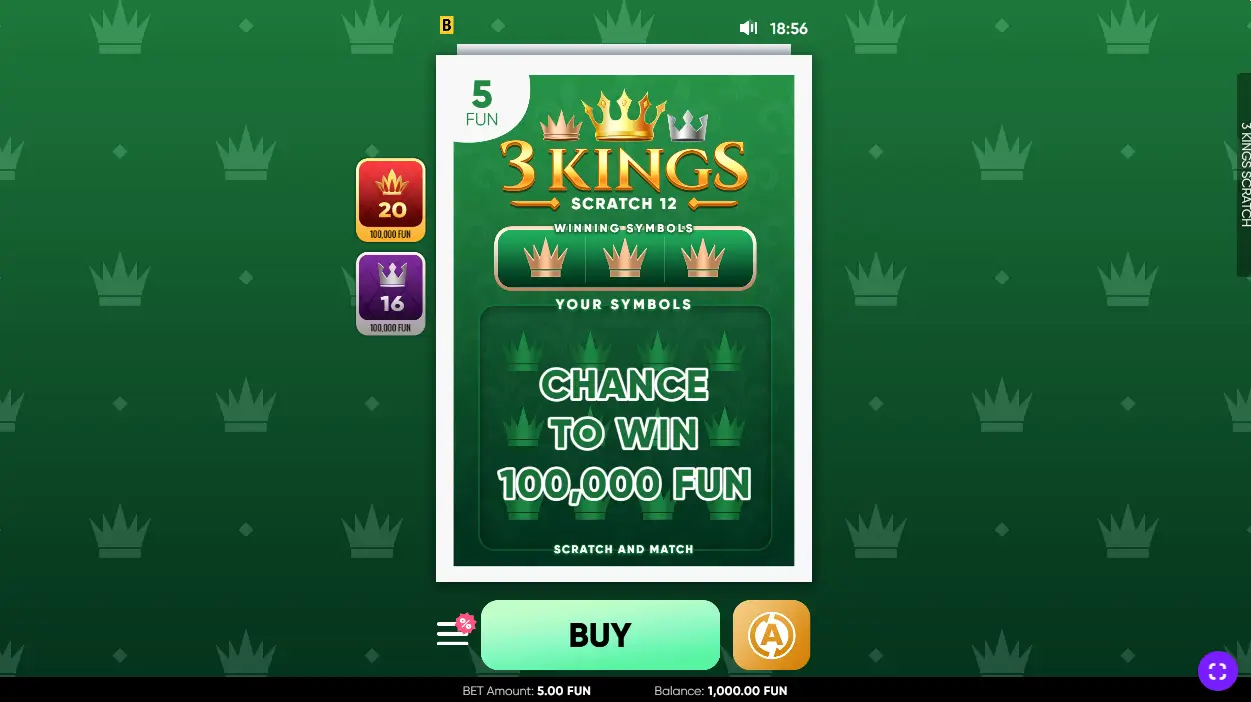
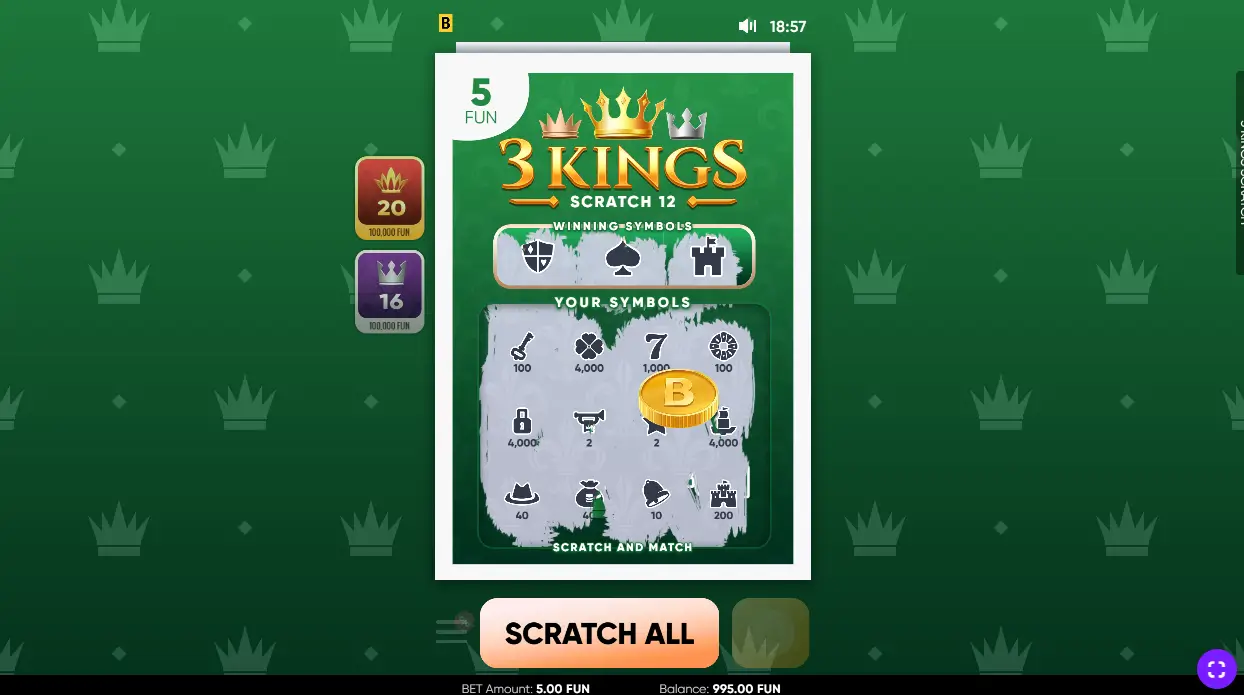
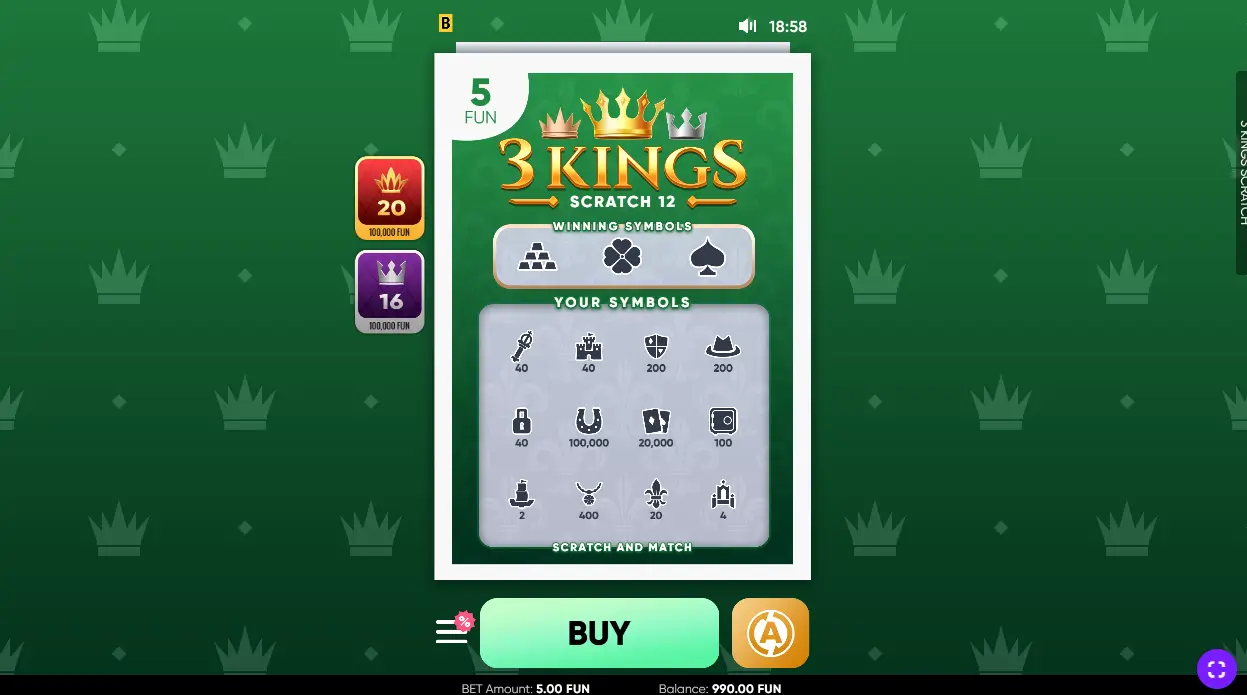
The mechanic is consistent across all three. Every round begins with three symbols displayed in a small upper field. These are your target symbols for that round. Below that sits the larger scratch grid. You scratch the panels — either manually by clicking or swiping, or all at once using the “Scratch All” button — and if any symbol in the lower grid matches one of the three shown at the top, the corresponding payout triggers. Each symbol carries its own value, listed clearly beneath the symbol in the upper field.
The maximum win across all three card types is x20,000 your bet. That’s the headline figure BGaming advertises, and it applies to the red card in practice given its wider grid and higher bet tier.
Theme and Visuals
BGaming went with a clean, classic royal aesthetic for this one. The colour palette is rich — deep reds, purples, and golds — without going overboard into garish territory. Crown symbols, royal seals, and king-related iconography fill the scratch grids. It’s not the most elaborate visual production you’ll find from a premium game studio, but it fits the format well. Scratch cards don’t need cinematic animations; they need clarity and responsiveness.
The interface is uncluttered. The card sits front and centre, bet controls are at the bottom, and the card-switching option is accessible without digging through menus. The payout values are visible at all times during the reveal phase, which matters — there’s nothing more frustrating in a scratch card game than having to hunt for what your symbols are worth while the result is already on screen.
Animation-wise, the scratch reveal is satisfying without being slow. You can watch the coating peel back with a swipe or skip it entirely with Turbo mode (more on that shortly). BGaming kept the feedback loop tight, which is the right call for a game built around quick, repeated rounds.
How to Play
The flow of a round in 3 Kings Scratch is straightforward:
- Select your card type (Green, Purple, or Red) from the card selector
- Set your bet amount using the controls at the bottom of the screen
- Confirm your bet — the card loads with its protective coating applied
- Scratch the lower field either panel by panel or all at once
- Any revealed symbol that matches one of the three shown in the upper field triggers a payout at the value listed under that symbol
- Collect your win (or not) and go again
The “Scratch All” button is the most practical way to play, especially for longer sessions or mobile use. It reveals every panel in the lower grid simultaneously, which removes the tactile element but speeds things up considerably.
The bet selection is worth pausing on. The available bet range is operator-dependent — the specific minimum and maximum per-round stake will vary by casino — but the three card types each have their own bet tier range, with the green card occupying the lower end and the red card the higher end. You choose both the card type and the bet level within that card’s range before committing to a round. Once you confirm the bet, the result is determined and the scratch is just the reveal.
One thing to note: unlike a lot of slot-style games, there are no bonus rounds, no free scratches, and no second-chance mechanics beyond what the grid itself offers. What you see is what you get. The game doesn’t dress up its outcomes with near-miss celebrations or prolonged reveal animations. A round starts, you scratch, the result is there. That directness is either the appeal or the limitation depending on what you’re looking for.
The Three-Card System in Detail
The decision to include three card types isn’t just cosmetic. It has genuine implications for how the game plays and who it suits.
Green Card (4×3 Grid)
The green card is the entry point. Its smaller 12-panel grid means fewer potential matching symbols per round, which affects both win frequency and the size of wins you can realistically hit. It’s designed for players who want to manage their bankroll carefully or test the game without committing to higher stakes. For casual sessions where you want to stretch a modest deposit, this is the sensible starting point.
The lower grid density also means the experience is faster — fewer panels to scratch, quicker results.
Purple Card (4×4 Grid)
The purple card sits in the middle. Its 16-panel grid expands the playing field, giving each of the three target symbols more chances to appear in the lower area. At a medium bet level, it’s probably the card that gets the most use among regular players — enough grid to feel like there’s something at stake in each reveal, without the commitment of the red card’s price point.
Red Card (5×4 Grid)
The red card is where the real action is. Twenty scratch panels, the highest bet tier, and the strongest link to that x20,000 maximum payout. The larger grid means more symbols revealed per round, and more opportunities for a high-value match. That said, the increased win potential comes with a higher cost per round, and the very high volatility of the game applies to all three cards — meaning large wins are genuinely possible, but they can go long stretches without appearing.
If you’re playing the red card expecting regular payouts, you’re likely to be disappointed. It’s built for high-variance sessions where patience and bankroll depth matter.
RTP and Volatility: What the Numbers Actually Mean
This is the section most reviews skim or distort, so it’s worth being precise.
RTP: 90%
3 Kings Scratch has a published Return to Player rate of 90%. For context, most online video slots sit somewhere between 94% and 97% RTP. A figure of 90% is on the lower end for a certified online casino game, and it’s worth understanding what that means in practical terms.
RTP is a long-run statistical figure. Over a large enough number of rounds, the game will return 90 cents for every dollar wagered in aggregate across all players. That doesn’t mean you personally will lose 10% of every bet. It means that the house edge is 10%, which is meaningfully higher than what you’d find in most modern video slots.
For a scratch card game, 90% is not unusual — physical lottery scratch cards often carry RTPs in the 60–70% range, so digital scratch games with 90% are still more player-friendly than their offline equivalents. But if you’re comparing 3 Kings Scratch to, say, a 96.5% RTP slot game, you should factor in that the house edge here is roughly double.
Volatility: Very High
This is the other number that matters. BGaming classifies 3 Kings Scratch as very high volatility. In scratch card terms, that’s a significant statement. It means the distribution of wins is heavily skewed toward infrequent but larger payouts. In any given session of 50 to 100 rounds, you should not expect a steady stream of small returns — the game is built to cluster wins unpredictably, with long dry spells between them.
Put the two together — 90% RTP and very high volatility — and the picture becomes clear. This is a game for players who are comfortable with variance, who understand that the path to a meaningful payout is not linear, and who have the bankroll and patience to ride out losing runs without chasing losses.
To give this some practical shape: if you sit down with 100 units and play through them at whatever bet size fits your budget, very high volatility means you might end the session with 0 units after 40 rounds, or with 300 units after a single lucky card, or somewhere in between. The average across millions of rounds trends toward 90% return. Your specific session will almost certainly deviate significantly from that average — in either direction.
That unpredictability is the point for some players. The possibility of a single scratch card turning a modest stake into x20,000 is genuinely meaningful, and it’s only achievable through a high-variance distribution. The tradeoff is that most sessions won’t look like that outcome. Most sessions end before the big hit arrives.
It is not well-suited to players who expect scratch cards to behave like lottery tickets with frequent small wins. If that’s what you’re after, the green card’s lower bet threshold helps manage the cost of a session, but the underlying volatility doesn’t change regardless of which card you choose. Picking the green card doesn’t lower the variance; it just lowers the stake per round, which gives you more rounds before your session budget is exhausted.
Features
Autoplay
Autoplay lets you set a number of consecutive rounds and let the game run without input. You define the number of rounds upfront, and the game executes them in sequence. Autoplay in 3 Kings Scratch also includes configurable stop conditions:
- Stop if a win exceeds a set amount
- Stop if cumulative losses reach a set threshold
These are responsible gambling features as much as convenience tools. If you’re using Autoplay for extended sessions, setting a loss limit is a practical way to avoid the session running away from you in a downswing.
Turbo Mode
Turbo mode is available within Autoplay. When activated, the scratch animation is skipped entirely — the result appears immediately without any reveal sequence. This makes sessions significantly faster and is particularly useful on mobile where repeated swiping to scratch panels can become tedious.
One thing to be clear about: Turbo mode does not alter the outcome or the RTP. It’s purely a display setting. The results are determined by the RNG before the scratch animation plays; Turbo just removes the time between bet and result.
Pack Purchases
BGaming included a discounted card pack purchase option in 3 Kings Scratch, allowing players to buy multiple rounds at a reduced per-card rate. The exact discount structure is operator-dependent and may vary by casino, so check the in-game terms wherever you’re playing. The existence of this feature suggests the game is designed with multi-round sessions in mind rather than one-off spins.
RNG Certification
BGaming certifies all its games through independent RNG testing. 3 Kings Scratch is no exception. The randomness of each round’s outcome is verified and not influenced by previous results, previous sessions, or anything outside the certified algorithm.
Mobile Performance
3 Kings Scratch runs well on mobile. The interface scales cleanly to smaller screens, the card takes up most of the viewport in portrait mode, and the controls are large enough to use with a thumb without hitting the wrong button. The scratch mechanic — either swiping across panels or tapping “Scratch All” — works reliably on touchscreens.
The game was tested on a range of Android and iOS devices at the time of various reviews, with consistent results across Samsung Galaxy devices and iPhones. Given how minimal the animation requirements are — no heavy particle effects, no video sequences — the load time is short and frame performance stays stable even on mid-range hardware with a 4G connection.
For sessions where you want to play one-handed, the “Scratch All” button combined with Turbo mode in Autoplay makes the experience genuinely viable on a phone without becoming frustrating.
One practical note for mobile users: landscape orientation works but isn’t really necessary. The card layout is designed with portrait use in mind and fits comfortably on screens from around 5.5 inches upward. Smaller devices will still run it, but the scratch grid panels get compact enough that “Scratch All” becomes the obviously better choice over individual panel tapping.
Honest Pros and Cons
No game is right for everyone, and a review that doesn’t acknowledge what a game does poorly isn’t worth much. Here’s a straight read:
What Works
The three-card system is genuinely useful. Being able to switch between Green, Purple, and Red mid-session gives players real control over their stake exposure that most single-card scratch games don’t offer. It’s not just visual variety — the grid size and bet tier differences have real mechanical consequences.
The interface is clean and fast. There’s nothing extraneous in the UI. The payout values are always visible, the card switching is instant, and the reveal sequence (when you use it) is quick and satisfying.
Turbo mode + Autoplay is a strong combination for efficiency. If you want to cover a large number of rounds without babysitting each one, this setup works well. The stop conditions add a layer of control that casual scratch card formats rarely include.
Mobile optimization is solid. The game plays exactly as well on a phone as it does on desktop. No degraded experience, no UI elements that become unusable on a small screen.
Max win of x20,000 is competitive. For a scratch card game, a ceiling of x20,000 your bet gives the format genuine high-end potential, particularly on the red card at higher bet levels.
What Doesn’t Work
90% RTP is a meaningful drawback. This needs to be said plainly. If you’re used to playing video slots with RTPs of 95–97%, the extra house edge in 3 Kings Scratch will be felt over any sustained period of play. It doesn’t make the game unplayable, but it’s a real cost.
Very high volatility is a poor fit for typical scratch card expectations. Players who gravitate toward scratch cards often do so because they want frequent, low-intensity wins — the lottery mindset. Very high volatility runs counter to that. Long dry runs between meaningful wins are the norm, not the exception.
No bonus mechanics to break up the format. Once you understand how the three cards work, you’ve seen everything the game offers in terms of variety. There are no multiplier reveals, no bonus scratch panels, no escalating win conditions. Sessions can become repetitive for players who want more structured progression.
Win confirmation requires attention. The match between upper and lower fields is visually clear once you know what you’re looking at, but first-time players can miss wins because they’re not sure which symbols in the grid count. A clearer “win” indicator for new players would help.
Pack purchase terms vary by operator. The discounted pack feature is listed as part of the game, but its availability and exact terms differ by casino. That inconsistency can be confusing if you’re switching platforms.
Who Should Play 3 Kings Scratch?
The game suits a specific profile of player.
It’s a good fit if:
- You’re already comfortable with high-volatility games and understand that dry runs are part of the structure
- You want a scratch card experience with more decisions to make than a standard single-card format
- You prefer fast-paced sessions where Autoplay + Turbo mode lets you work through a set bankroll efficiently
- You’re a slot player looking to try the scratch card format with a game that has familiar variance characteristics
It’s probably not the right game if:
- You want frequent small wins and a gentle, low-pressure session — the volatility and RTP work against that
- You’re new to online casino games and want something that rewards patience with steady feedback
- You’re comparing RTP carefully and prioritizing the highest return — 90% is below average for certified online games
- You want deeper bonus mechanics or any form of progressive feature
The green card entry point means even cautious players can test the format without committing to high stakes. But no amount of card selection changes the underlying math of the game.
Context: BGaming’s Scratch Portfolio in Early 2026
BGaming entered the scratch card space roughly six months before releasing 3 Kings Scratch, according to statements from Mikalai Dzneladze, the studio’s Chief Casual Game Producer. By the time 3 Kings Scratch launched in March 2024, the format had already become a “highlight of our portfolio for many players,” in Dzneladze’s words. That context matters for understanding what this game is.
3 Kings Scratch wasn’t a one-off experiment — it was an evolution of BGaming’s scratch format, designed to introduce more complexity into a category that typically offers very little. The three-card-in-one structure was a deliberate response to feedback that single-card games felt too limited. Whether that evolution goes far enough is a fair question; the underlying mechanics are still those of a classic scratch card, just with more options attached.
It’s worth noting that BGaming built its name primarily on slots and crash games. The scratch card category is relatively new territory for the provider, and 3 Kings Scratch reads as a considered rather than rushed entry into it. The mechanical choices — the three-tier card system, the Turbo and Autoplay combination, the discounted pack option — all suggest the studio looked carefully at what makes scratch card sessions feel unsatisfying before designing around those friction points.
By early 2026, the game is available in 44 countries. It is not currently available in the US New Jersey market. Most major casino aggregator platforms that carry BGaming’s catalog include it, and demo play is accessible without an account on BGaming’s own site.
Final Verdict
3 Kings Scratch is a well-executed scratch card game that does what it sets out to do. The three-card system is a genuine improvement over single-card formats, the interface is fast and clear, and the mobile experience holds up. For players who specifically want a scratch card game with high-variance potential, the x20,000 maximum win is competitive.
The honest caveat is that 90% RTP and very high volatility make this a demanding game. You won’t grind consistent returns out of it, and sessions can go cold for a long time before producing anything meaningful. That’s not a flaw, exactly — it’s the nature of high-variance design. But it’s something you should know before choosing this over a video slot with a significantly higher return rate.
The game doesn’t overpromise. There are no bonus rounds it’s hiding, no jackpot it forgot to mention. What BGaming has built here is exactly what it says: a straightforward, well-structured scratch card with three difficulty/stake tiers and the mechanical depth to hold attention for longer than most of its competitors in the format.
If you’re curious about scratch card games and want a clean introduction with room to scale, start with the green card in demo mode, try a few hundred rounds, and see whether the format suits how you like to play. The game reveals its character quickly enough. There’s no mystery to it, and that’s something I’d call a strength rather than a limitation.