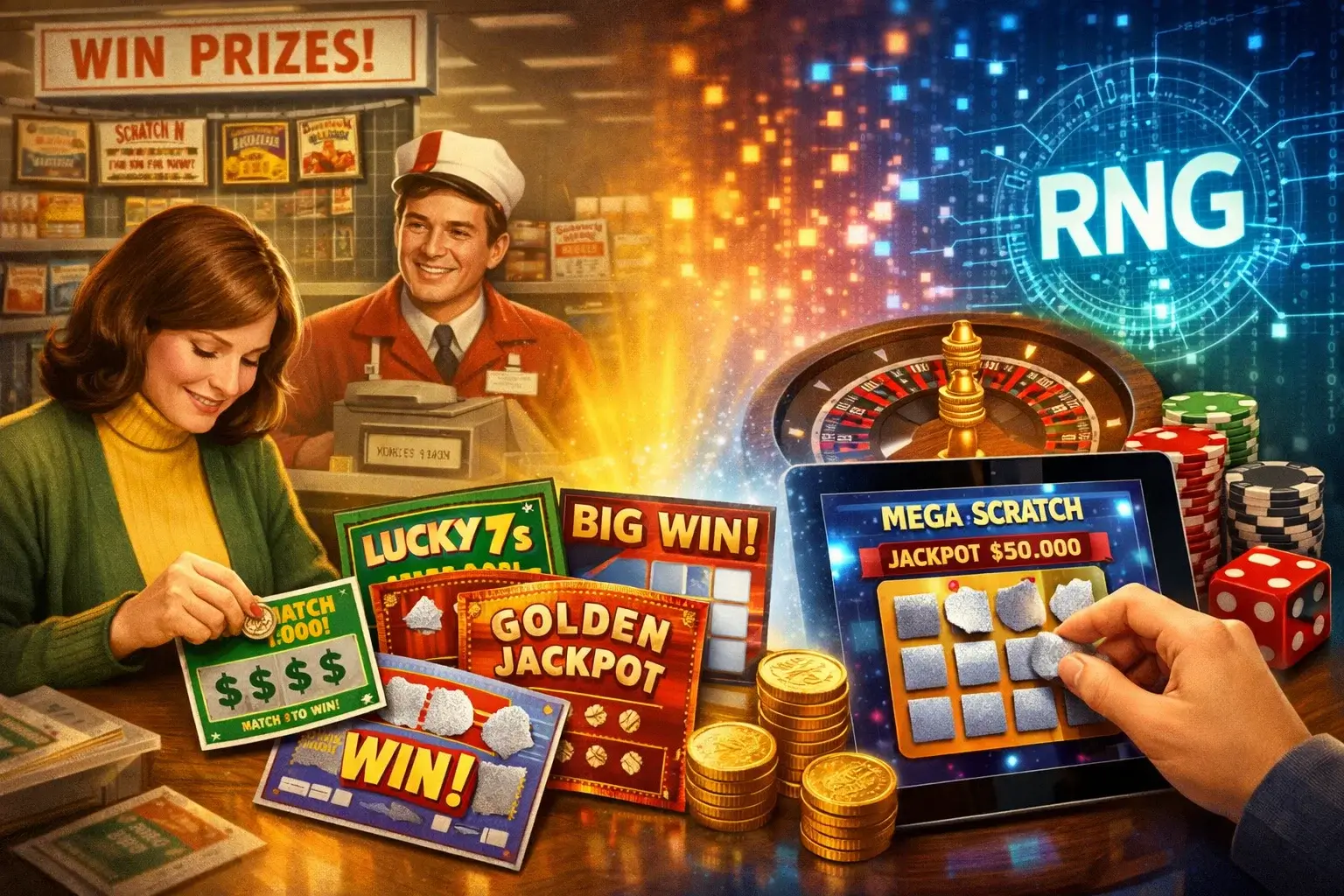
I’ve got this old photo from 1978 that I found while researching this. It’s from a grocery store in Ohio. On the checkout counter, there’s a small display with what looks like index cards with some kind of scratch-off coating. The sign says “Instant Cash Prizes!” in that distinctly 70s font. The prizes listed go up to fifty dollars. That’s probably over two hundred dollars in today’s money, adjusted for inflation.
That simple display marks the beginning of something that would eventually turn into a multi-billion-dollar industry. But back then, nobody thought of it as particularly special or revolutionary. It wasn’t like the invention of the lightbulb or the internet. It was just a clever marketing gimmick. A way to get people excited about shopping at their local grocery store. A way to increase foot traffic and boost sales. Pretty mundane stuff, actually.
What’s fascinating is how this simple idea evolved and spread. Within five years, scratch cards were in every state. Within ten years, they were generating billions in revenue. And now, fifty years later, they’re one of the most profitable gambling products in the world.
The path from that humble beginning to the digital RNG algorithms running on servers today is actually pretty interesting to trace out. It’s a story about technology, psychology, mathematics, and how an industry adapts when the rules change. It’s also a story about how innovation sometimes creates social problems that weren’t there before. And how those problems become so economically important that they’re hard to address.
I’ve spent months researching the history of scratch cards. I’ve read technical papers about RNG algorithms. I’ve interviewed former lottery commission employees. I’ve talked to game designers. And what I’ve found is that the evolution of scratch cards is really the story of how we’ve gotten better and better at extracting money from people using psychological techniques.
That might sound cynical. But I think it’s accurate.
The Accidental Invention: How a Couple of People in 1974 Started Something Huge
The modern scratch-off lottery ticket was invented in 1974 by John Koza and Daniel Bower, two computer scientists working at Scientific Games Corporation. But here’s the thing: they weren’t trying to invent a lottery ticket. They were trying to solve a completely different problem entirely.
Koza was interested in computer graphics and cryptography. Bower was interested in computer-based decision-making systems. They weren’t gaming experts. They weren’t trying to revolutionize gambling. They were just computer scientists working on technical problems.
They were working on security printing technology when Koza had an idea: what if you could use this printing technology to create a game where you had to physically scratch off a coating to reveal a hidden number? The idea was elegant in its simplicity. You print information underneath a special coating. You can’t see it without removing the coating. The coating is tamper-resistant. But it’s designed to be easily removed by the user.
The coating they used was something called latex. It was opaque, so you couldn’t see through it. It was durable, so it wouldn’t flake off or degrade easily. And it could be applied to paper in a way that was tamper-resistant. It was originally developed for security purposes, like on documents that needed to hide information from casual viewing—think security envelopes or things like that. But Koza realized it could be used for gambling.
What they didn’t realize at the time was that they were creating something that would fundamentally change how states raised revenue and how gambling would evolve over the next fifty years.
The first official scratch-off lottery game was called “The Game” and it launched in Massachusetts in 1975. It was an instant success. Not mega-huge in the early days, but successful enough that other states started paying attention. They could see that players loved the instant gratification. They could see that retailers loved the impulse purchases. They could see that states could generate significant revenue with minimal cost.
By the end of the 1970s, there were multiple states running scratch-off games. By the 1980s, it was becoming the dominant form of state lottery revenue. Every state wanted a piece of this action.
The brilliance of the invention wasn’t just the technology itself. It was the immediacy. Before scratch cards, if you played the lottery, you bought a ticket and waited days for the drawing. You had to check numbers. You had to go claim your prize. The entire experience was delayed. But with scratch cards, you knew instantly. That immediate feedback was addictive in a way that traditional lottery drawings weren’t.
Koza went on to do other things and eventually became known for his work in genetic programming, which is pretty interesting in itself. But his scratch card invention would be what defined Scientific Games for decades and made the company one of the largest gaming technology companies in the world.
The Golden Age: 1980s-1990s, Retail Dominance, and the Rise of the Lottery Commission
The 1980s and 1990s were the golden age of physical scratch cards. It was the time when the infrastructure was being built. The marketing mechanisms were being refined. The psychological hooks were being optimized. Every state was running scratch games. Retailers loved them because they generated impulse purchases and kept people in stores longer. People loved them because they were fun and offered instant gratification. States loved them because they generated massive revenue with minimal overhead compared to traditional lottery drawings.
During this period, the technology didn’t change much on the surface. You still had paper cards. You still had latex coating. You still scratched with a coin. But what did change was the sophistication of the games themselves.
In the early days, the games were simple. Match three numbers. Simple pattern recognition. But by the 1980s, game designers were getting creative. You’d have games with multiple play areas on a single card. Games where you were playing tic-tac-toe against a dealer. Games with bonus multipliers that could increase prizes. Games with themed graphics that tied into current trends.
The printing technology improved significantly too. Security features got more sophisticated to prevent counterfeiting. The latex coating got better quality and more resistant to wear. The paper stock improved. But the fundamental mechanism was the same.
What’s interesting about this period is that the odds and payouts weren’t that different from what we see today. States were already running games with 40-50% payout rates. They were already targeting lower-income neighborhoods with more aggressive marketing and higher visibility. The psychology was already well-established. Game designers understood that small frequent wins were addictive. They understood that near-misses created the urge to play again.
I’ve talked to some people who worked in lottery commissions during this period, and they all said the same thing: they knew this was a regressive form of gambling that hit lower-income people harder. They could see it in the data. They knew the math meant people would lose money. But the state budgets depended on the revenue. That was always the priority.
One person I interviewed, a former lottery commission employee in Texas, told me something that stuck with me. She said that by the late 1990s, they were already having internal discussions about responsible gambling. They knew that some people were developing addictions to scratch cards. They could see it in the data. Some people were showing up at lottery offices multiple times a day. Retailers reported regular customers who would spend hundreds of dollars on cards. But when you brought up responsible gambling concerns in meetings, the response was always the same: the state needs the revenue.
By 2000, scratch cards were generating over $20 billion in annual revenue for state lotteries in the United States. That’s just the U.S. The global market was even bigger. Canada was running major programs. Europe was booming. Australia had huge scratch card revenue. Every state and most countries had recognized the money-making potential.
The lottery commission employees I interviewed said that by the end of the 1990s, there was almost a sense of resignation about it. They knew what the product was doing. They knew it was regressive. They knew it was addictive. But they also knew that states had built budgets around this revenue. Education funding depended on it. Infrastructure projects were funded by lottery revenue. You couldn’t just shut it down. The machine was too big and too profitable.
The Digital Transition: When Scratch Cards Met the Internet
The 2000s brought the internet. And with the internet came the first question: can you do scratch cards digitally? Can you replicate the experience on a computer or phone?
The answer was yes, but it took a while to figure out how to do it right.
The first attempts were pretty clunky. Some lottery commissions created simple web-based games where you’d click a button and it would reveal prizes. It worked mechanically. The game functioned. But it didn’t feel like scratching a card. There was no tactile feedback. No sound. No real sense of anticipation. It felt sterile and computer-like.
But the technology improved quickly. By the mid-2000s, you were starting to see decent digital scratch card implementations with better animations and sound design. Online casinos outside the U.S., which operated in less-regulated jurisdictions, were offering digital scratch cards. Some were legitimate operations. Some were sketchy. Some were outright scams.
The U.S. was slower to adopt digital scratch cards through state lotteries because of regulatory complications. Each state had its own laws about online gambling. Online gambling existed in a gray area legally. There were constitutional questions about whether states could legally sell lottery tickets online. There were payment processing complications. So while other countries were rapidly moving to digital scratch cards, the U.S. state lottery system was still pretty much entirely physical.
What changed everything was smartphones. The iPhone came out in 2007, and Android followed shortly after. It opened up a completely new distribution channel. Suddenly, lottery commissions could reach people through apps on their phones. You didn’t need a retail location. You didn’t need physical tickets. You didn’t need security printing. You just needed an app.
By 2010, several states were experimenting with lottery apps. The early ones were rough. Limited game selections. Clunky interfaces. Limited payment options. But they worked. By 2015, major states like New York and California had official lottery apps. By 2020, digital lottery ticket sales were significant. During the COVID-19 pandemic, when people weren’t going out to stores, digital sales increased dramatically.
The transition wasn’t as fast or as complete as you might expect given the obvious advantages of digital. Physical scratch cards still dominate in terms of revenue and volume. But the digital channel is growing rapidly. And the experience has evolved dramatically from those early clunky web versions.
One thing that helped digital adoption was that it actually allowed better security in some ways. You couldn’t counterfeit digital tickets. You couldn’t steal them and claim the prize. Everything was tracked and verified electronically. States could see exactly who was playing what, which was valuable data.
The downside was that digital access also lowered barriers to excessive play. With physical cards, you had to go to a store. With an app, you could play anytime, anywhere. This created new problems with problem gambling that states weren’t necessarily prepared for.
RNG Technology: From Physical Randomness to Algorithmic Probability
Here’s where things get really interesting from a technical perspective.
With physical scratch cards, the randomness is baked in during printing. When they print the cards, they’re physically printing the winning and losing cards. The randomness isn’t mathematical. It’s real—in the sense that the actual paper card either has a winning combination printed underneath the scratch material or it doesn’t.
But with digital scratch cards, there’s no physical card. There’s just code. And the randomness has to be generated by an algorithm.
This is where RNG comes in. RNG stands for Random Number Generator. It’s the algorithm that determines whether you win or lose on a digital scratch card.
Modern RNG algorithms are incredibly sophisticated. They have to pass rigorous testing. Gaming regulators test them to make sure they actually produce random results. If the RNG is biased in any way, it gets rejected.
The interesting thing is that generating truly random numbers on a computer is actually harder than you’d think. Computers are deterministic. They follow rules. Getting them to produce something that’s genuinely unpredictable requires special techniques.
Modern RNGs use techniques like Mersenne Twister, which is a pseudorandom number generator that’s been tested extensively. Some use cryptographic algorithms. The goal is to produce numbers that are indistinguishable from truly random numbers for practical purposes.
I’ve read some of the technical documentation on these systems, and it’s genuinely complex. The algorithms have to be auditable. They have to produce results that can’t be predicted. They have to be resistant to attacks. They have to work at scale without bias.
The irony is that digital RNG scratch cards are actually more provably random than physical cards in some ways. With physical cards, you’re trusting that the printing process distributed prizes randomly. But with RNG, every single draw can be mathematically verified.
Some modern platforms allow players to see the seed that generated their result, so they can verify that the RNG actually did produce that outcome. That level of transparency didn’t exist with physical cards.
The Regulation Nightmare: Different Rules Everywhere
One of the biggest challenges in the evolution of scratch cards has been regulation.
Physical scratch cards in the U.S. are regulated by state lottery commissions. Each state has its own rules. The odds have to be published. The RTPs have to be within certain ranges. There’s consistency within each state, but variation between states.
Digital scratch cards broke that model. You could theoretically operate across multiple states from a single server. You could operate in multiple countries. You could target different markets with different odds. The regulatory framework that made sense for physical retail distribution didn’t translate well to digital.
This has created a messy landscape. Some countries have adapted their regulations quickly to digital gambling. The UK, for example, has a dedicated gambling regulator that oversees digital operations. Malta has gaming licenses. But in the U.S., it’s been slower and more complicated.
Some states allow official state lottery apps. Others don’t. Some states allow third-party companies to operate digital scratch games. Others don’t. Some jurisdictions allow play from anywhere in the world. Others restrict it.
This fragmentation has actually slowed the adoption of digital scratch cards in the U.S. compared to other countries. A company that wanted to operate digital scratch cards in Europe could get a license and operate across multiple countries. In the U.S., they’d need to navigate dozens of different state regulations.
The companies that have succeeded in digital scratch cards in the U.S. are mostly the state lottery commissions themselves, operating through official apps. Third-party operators have struggled because of regulatory complications.
Internationally, it’s been different. Companies like LottoSmile operate across multiple countries with different licenses. They can offer different RTPs and different games depending on jurisdiction. The business model works because there’s less regulatory restriction.
The Psychology Evolves: Understanding How to Keep People Playing
One thing that’s been consistent throughout the evolution of scratch cards is the psychology behind them. Whether it’s physical or digital, the goal is the same: create a game that keeps people coming back. Make them spend more. Make them feel like they might win big. Make the experience sticky and addictive.
The psychology of scratch cards is well-studied now. Researchers know that the near-miss effect is incredibly powerful. They know that frequent small wins create addiction potential. They know that immediate gratification is addictive. They know that variable ratio reinforcement schedules—where you don’t know when you’ll win but you know you might—produce compulsive behavior.
The interesting thing is that this psychology wasn’t intentional at first. Koza and Bower weren’t psychologists. They were just computer scientists who figured out a way to hide numbers under a scratch coating. The psychological appeal emerged organically from the mechanism itself. You don’t know what you’re going to get until you scratch. That uncertainty creates dopamine release.
But what’s changed over time is how sophisticated the application of this psychology has become.
In the 1970s and 1980s, scratch card games were designed intuitively. Designers looked for games that felt fun. But there wasn’t a huge amount of data-driven optimization. They were mostly figuring it out as they went. The games worked because the basic mechanism was addictive, not because they were carefully optimized.
By the 1990s and 2000s, games were being designed with more psychological sophistication. Game designers understood what made games addictive, and they were deliberately designing for addiction potential. They studied what kept people playing. They looked at data about which games sold best. They noticed that games with certain themes did better. Games with certain color schemes did better. Games with certain prize distributions did better.
By the 2010s and 2020s, with digital games, it got even more sophisticated. Digital games can track every single interaction. Designers can see which games people play longest. Which ones produce the most spending. Which animations keep people engaged longest. Which sounds make people more likely to buy another card. And they can optimize for all of these things.
Modern digital scratch card platforms can A/B test different game designs. They can see that, for example, adding a celebratory sound effect when you’re about to reveal a big prize increases spending by 8%. So they add that sound effect. They can see that certain color combinations keep people playing longer. So they use those combinations more. They can see that cards with more play areas on them get more repeat plays. So they design cards with more play areas.
It’s not necessarily malicious, but it’s definitely optimized for engagement and spending, not for player welfare or responsible gambling.
I’ve seen analytics dashboards from digital gambling platforms that show this level of optimization. The data is pretty stark. The platform providers aren’t designing games that are fun. They’re designing games that are engineered to extract maximum revenue while staying legal and passing regulatory oversight.
The evolution of scratch cards isn’t just technological. It’s also psychological. And that psychological evolution has made the games more addictive and more expensive for vulnerable populations.
Where We Are Now and Where It’s Heading
Today, scratch cards exist in both physical and digital form. Physical ones still dominate in terms of revenue in the U.S., but digital is growing rapidly and will likely eventually surpass physical.
The technology continues to evolve at a pace that most people don’t realize. Mobile games are becoming more sophisticated. Augmented reality technology could eventually allow you to see a physical card through your phone camera and have the game overlay digital elements. Virtual reality could create immersive scratch card experiences where you feel like you’re in a game show or casino. Blockchain technology and NFTs are being explored for provably fair gambling in some jurisdictions.
The regulation is slowly catching up, but it’s still fragmented and inconsistent. Some jurisdictions are getting stricter about responsible gambling messaging and player protection. Others are staying hands-off and letting the market operate freely. Some countries are banning certain types of games or limiting how much people can spend. Others are allowing anything that’s technically legal and generates revenue.
What’s clear is that scratch cards aren’t going away. They’re too profitable for states, too profitable for operators, and too appealing to players. The form might change. The technology might evolve dramatically. The interface might shift from physical cards to phones to AR to VR. But the basic concept—instant gratification, variable rewards, psychological hooks—will probably persist in some form as long as gambling is legal.
I think what’s important going forward is understanding what scratch cards actually are. They’re not a fun game you play for entertainment. They’re not a way to make money. They’re not a legitimate investment vehicle. They’re a mechanism for extracting money from people using psychological techniques that exploit cognitive biases. They’re engineered by game designers, optimized by data scientists, and marketed by teams of professionals specifically designed to maximize revenue extraction.
That doesn’t necessarily mean people shouldn’t play them. It just means people should know what they’re actually playing. Understand the odds. Understand the psychology. Understand that the game is designed to make you spend more, not to give you a good experience or a fair chance at winning. Understand that the longer you play, the more you lose. Understand that occasional wins are designed to keep you playing, not to make you money.
The evolution from a simple grocery store promotion in 1978 to a sophisticated digital game with proprietary RNG algorithms and behavioral optimization hasn’t made scratch cards better or fairer for players. It’s just made them more efficient at what they’ve always done: turn money into state revenue while making players feel like they might win big. It’s made the psychological hooks more sophisticated. It’s made the games more addictive. It’s made access easier. And it’s made them better at targeting vulnerable populations who can’t afford the losses.
The technology has evolved dramatically. But the fundamental nature of the game—and the fundamental advantage held by the operator—has remained exactly the same. The house always wins. The math is immutable. And the evolution of scratch cards is really just the story of how we’ve gotten better at making sure of that.