
Most crash games ask you to watch. You sit there while a line climbs, a plane flies, or a rocket rises, and you decide when to pull out before everything collapses. The action, if you can call it that, is entirely passive. MegaBlock by InOut Games does something different. It puts a block in your hands — metaphorically — and asks you to drop it at exactly the right moment. Miss, and the round is over. The game went live on February 10, 2026, and it is one of the more structurally interesting instant games to arrive in this category in recent memory.
The numbers on paper: 95.5% RTP, bets from $0.01 to $200, a hard max win of $20,000, and four difficulty modes that change the game’s risk profile so drastically they might as well be four separate titles. I tested all four modes across multiple sessions at different stake levels. Here is what you actually need to know.
About InOut Games: The studio behind MegaBlock holds a Curacao license and has been operating since 2024. Their catalogue runs to over 30 titles, with a focus on crash games, mines, plinko, and trading-format instant games. They report more than three million monthly users across their network. MegaBlock is positioned as their flagship title — the one that shows up first in most integrations and gets the most promotional placement in their partner casinos. The studio is B2B, meaning you access their games through casino platforms rather than directly. Most of the platforms carrying MegaBlock are crypto-friendly or internationally oriented rather than regionally licensed in specific jurisdictions like the UK or Malta, though exceptions exist.
What MegaBlock Is and How It Works
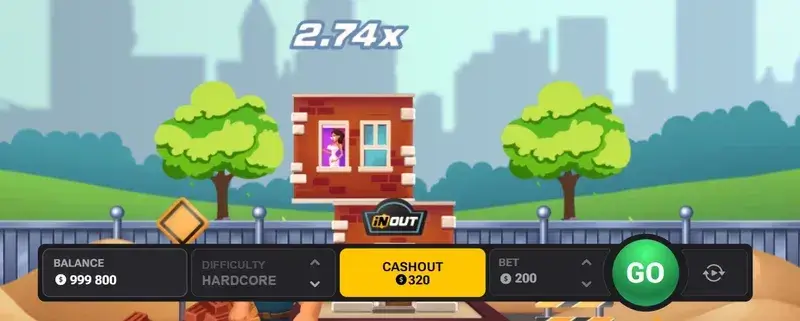
The setting is a construction site. Not a realistic one — a cartoon version with a city skyline in the background, a small brick building at the base marked with the InOut Games logo, sand piles, red bricks, safety barriers, and a crane swinging overhead. It looks clean without being sterile. There are no flashing lights competing for your attention, which turns out to matter more than you might expect.
The loop is simple. You select a stake amount and a difficulty mode, then press Go. The crane starts moving, swinging a block from side to side above your tower. You press Go again to drop the block. If it lands accurately on the floor below, the multiplier goes up and a new block appears overhead. If it misses, the round ends and your stake is gone. At any point between blocks — after a successful placement — you can press Cash Out to take the accumulated multiplier times your stake and end the round.
That last part is the whole game. Stack blocks, watch the multiplier climb, decide when to leave.
What separates MegaBlock from passive crash games is not just the visual metaphor. The action of pressing a button to drop a block creates a different psychological relationship to the game than watching a line move. In Aviator or standard crash variants, you are an observer who chooses an exit point. In MegaBlock, you are a participant who causes each outcome. A bad drop feels like your fault. A good run feels earned. Whether that is mechanically true is another question — the outcomes are determined by a Provably Fair RNG, meaning the position where each block lands is calculated before you see the crane swing. But the felt experience of participation is real, and it affects how players behave during sessions in ways worth understanding. More on that later.
On Provably Fair: InOut Games uses a standard server seed and client seed system combined with a nonce. Before each round, the server generates a hashed server seed. The client seed is produced on your side. The combination of both, plus the nonce that increments with each round, determines where each block lands. After the round, you can verify the result yourself using the unhashed server seed, which is revealed once a new server seed replaces it. Any casino platform running MegaBlock should provide these verification tools. If it does not, that is a platform issue rather than a game issue.

The Difficulty Modes: Where the Real Decisions Are Made
Most reviews list the four modes with their block counts and peak multipliers and stop there. That is the least useful way to understand them. The number that actually matters is not the ceiling — it is the multiplier you can realistically capture mid-tower, because that is where most sessions live.
Easy Mode: 24 blocks, 1.01x to 23.75x
Easy is the widest mode. You get 24 blocks, the crane swings are more forgiving, and the multiplier climbs gradually. The flip side is that the ceiling is only 23.75x. To reach it, you need all 24 blocks placed correctly. In practice, a mid-tower exit around floors 10 to 14 gives you a modest multiplier — somewhere in the low single digits depending on how the curve compounds at those heights. Easy is not designed for big wins. It is designed for players who want extended sessions with low variance and a chance to get comfortable with the timing mechanic without burning through a stake every round. If you are new to MegaBlock entirely, start here.
Medium Mode: 22 blocks, 1.09x to 2,116x
This is where the curve starts to steepen. You have 22 blocks and a ceiling of 2,116x, which means the upper floors pay out far more aggressively than Easy, but the risk compounds accordingly. A mid-tower exit in Medium — around floors 10 to 14 — lands you somewhere in the range of a few hundred x if you make it that far cleanly. The majority of rounds will not. Medium is the mode where the gap between a careful, consistent player and an impulsive one becomes visible. The error margin is tighter than Easy, and the temptation to keep going when the multiplier starts accelerating in the final third is noticeably stronger. This mode suits players who have a few sessions of Easy under their belt and want to trade some variance tolerance for better payoff potential.
Hard Mode: 20 blocks, 1.2x to 48,348x
Hard cuts your block count to 20 and launches the ceiling to 48,348x. The math on the multiplier curve here means the majority of the payoff potential is concentrated in the final five or six floors of the tower. Reaching those floors requires near-perfect execution across 14 to 15 consecutive blocks first. Most rounds in Hard end in the lower half of the tower, and the multipliers available at those heights are modest compared to the exits available in Medium. Hard is a mode where you need to accept that most sessions will produce a string of low-multiplier cashouts or outright losses, with the occasional run that reaches the upper floors paying for a lot of the preceding activity. Using Hard with full manual control and no Autoplay configuration is how you burn through a session budget quickly. Pre-set your exit target before the round starts.
Hardcore Mode: 15 blocks, 1.6x to 2,941,884x
The multiplier ceiling is nearly three million times your bet. The cap is $20,000 regardless, so if you are betting $200 per round, you hit the cap at 100x — which, in Hardcore, means landing somewhere around floor 6 or 7 cleanly. That is theoretically achievable, but the actual probability of getting there without a miss in Hardcore is extremely low. The error margin is close to zero from floor one. Even the first few blocks carry real risk. This mode is not for building a session around. It is a high-variance bet format where you accept that most rounds will end early, in exchange for the off chance of hitting a large multiplier in the rare instances you land consecutive blocks. Treat each Hardcore round as an individual bet, not part of a structured session.
One thing the 95.5% RTP does not tell you: That figure applies across all four modes combined — or rather, it is a property of the game engine regardless of which mode you select. But the experienced volatility per session is completely different depending on your mode. Easy delivers the closest approximation to a smooth, consistent experience. Hardcore is something closer to buying lottery tickets with a casino-style interface. The RTP number alone tells you nothing about what your session will feel like. Mode selection is the real volatility dial.
Autoplay, Cashout Steps, and Session Recovery
Auto Game lets you set a number of rounds to play automatically, combined with a pre-configured cashout floor. Cashout Steps gives you exit options from 1x up to 24x in increments you define. This combination is more useful as a discipline tool than as a passive “set and forget” mechanism.
Here is a concrete way to think about using it. Say you are playing Medium at $1 per round and you have decided your exit target for this session is 5x. You can set that as an automatic cashout and run 20 rounds. What you are doing is removing the in-round decision from the equation. The exit happens automatically when the multiplier hits 5x, which means you never face the “maybe I should hold one more floor” moment that tends to erode planned exits. In Medium mode, reaching a 5x cashout requires getting somewhere into the mid-tower range, which is achievable but not guaranteed every round. You will have losing rounds. The Autoplay setup means you do not change your target after a string of losses.
Using Autoplay on Hardcore with a high cashout target is a different story. Pre-setting an exit at, say, 500x in Hardcore and running it automatically means most rounds will collapse before that target is reached. You are not going to use Autoplay productively in Hardcore unless you set a very conservative exit target — one that the early floors of Hardcore can actually deliver.
Session Recovery handles interrupted rounds. If your connection drops during a round, the game restores the in-progress round when you return. This matters more in mobile sessions on unstable connections than on desktop, but it is a useful safeguard.
Bet Range and the $20,000 Cap
Minimum bet is $0.01. Maximum is $200. The range covers effectively everyone from a player testing the game for the first time with minimal risk to a high-stakes player running serious session budgets.
The $20,000 absolute win cap is the thing that changes calculations for anyone betting near the maximum. At $200 per round, the game’s mathematical maximum payout (2,941,884x) is completely irrelevant — you hit the $20,000 cap at roughly 100x. In Hardcore, 100x is reachable at around floors 6 or 7 on a clean run. If you are betting $200 in Hardcore and land six or seven blocks perfectly, that is your maximum return regardless of what the multiplier does after that.
For players betting $1 or less per round, the cap is practically irrelevant at all difficulty levels. At $1 per round, you would need to reach 20,000x — which is within range of Hard mode’s theoretical ceiling (48,348x) — to bump into it. That is an extremely rare scenario.
Demo Mode: What to Actually Do With It
A demo exists, and it runs with virtual credits in the same way the real-money version works. Most reviews mention this and move on. The demo is more useful than that if you approach it deliberately.
The first thing to do is spend time in Easy just reading the crane. MegaBlock is a timing game at its core, and the crane’s swing speed and rhythm is something your timing instinct needs to calibrate to. It is not random-feeling — there is a pattern you can read — but it takes a few rounds before drops start feeling intuitive rather than guessed.
The second thing to do is test the same difficulty in demo that you plan to play for real money. A player who tests only Easy and then moves to Hardcore with real stakes has not practiced the game they are about to play. The error margin differences between modes are large enough that Easy timing habits do not transfer directly to Hardcore.
Third: configure Autoplay in demo before using it with real money. Test whether your intended exit multiplier actually matches your expectations for how deep into the tower you want to go in each mode. Demo is the right place to find out that your Autoplay settings are miscalibrated, not a live session.
Fourth: use the demo to test across sessions, not just a few rounds. The variance in MegaBlock can make a short sample look deceptively smooth or deceptively brutal. Twenty rounds in Easy demo is not enough to understand how the mode actually behaves — run closer to 50 or 60 and pay attention to how the multipliers you actually capture compare to the targets you planned. You will likely find you cash out earlier than you intended on a regular basis, which is the insight the demo exists to give you before money is involved.
One practical note: the timing feel on mobile is slightly different from desktop because you are tapping rather than clicking. If you primarily play on mobile, run your demo sessions on mobile.
Mobile Performance
MegaBlock is HTML5 and requires no download or app installation. It runs in any modern mobile browser on Android or iOS. The single-tap mechanic for dropping blocks is well-suited to mobile input — you do not need precision gestures or complex controls. The construction site visual theme is clean enough that it remains readable on smaller screens without losing clarity on the multiplier display or the tower state.
No significant performance issues on mid-range Android or current iOS devices in testing. The game is clearly designed with mobile sessions in mind from the start rather than ported from a desktop-first build.
MegaBlock vs. Tower Rush: An Honest Comparison
Tower Rush by Galaxsys is the closest structural competitor — it uses the same fundamental loop of stacking floors to build a multiplier, with a cashout decision on each floor. The two games serve similar player appetites. They are not identical.
Tower Rush has something MegaBlock currently does not: bonus floors. Frozen Floor locks in the current multiplier, giving you a free block placement without risk of collapse. Temple Floor triggers a multiplier wheel bonus. Triple Build automates several floor placements at once. These mechanics inject mid-round variety and create moments where the variance temporarily shifts in the player’s favor. Tower Rush’s RTP also runs higher than MegaBlock’s — up to 96.12% to 97% depending on configuration, compared to MegaBlock’s flat 95.5%. On a volume basis, that gap is meaningful. Run 1,000 rounds at $1 per round: the RTP difference costs a MegaBlock player approximately $15 compared to a Tower Rush player at 97% RTP. Not significant for casual players. Relevant for anyone logging consistent volume.
What MegaBlock has that Tower Rush does not is a more deliberate risk architecture. The four difficulty modes give a player precise control over their volatility profile before the round starts. There is no equivalent in Tower Rush of MegaBlock’s Hardcore mode — a mode that compresses the entire game into 15 blocks with a multiplier curve that reaches nearly 3 million times the bet. MegaBlock’s max multiplier ceiling also exceeds Tower Rush’s.
The honest framing is this: Tower Rush rewards players who want mid-game events and a higher base return rate. MegaBlock rewards players who want full control of their risk profile upfront, cleaner round structure without bonus interruptions, and access to an extreme high-multiplier ceiling. Neither is categorically better. They are aimed at slightly different preferences.
Bankroll Management by Mode
The single biggest mistake in MegaBlock sessions is treating all four modes the same way. They require different session frameworks.
Easy: Extended sessions are viable here. The variance is low enough that a session budget of 40 to 60 rounds at your chosen stake gives you meaningful time at the table without high risk of a fast wipeout. Target mid-tower exits in the 3x to 6x range for conservative play. Autoplay is useful in Easy with a preset cashout in that range if you want to remove in-round decisions entirely. Easy is also the right mode for establishing what your actual timing accuracy looks like before increasing the stakes.
Medium: Plan for shorter sessions than Easy — 20 to 30 rounds at stake. The loss frequency starts to climb noticeably compared to Easy, and session budgets get consumed faster. Targeting 5x to 12x on Medium is a reasonable range depending on how deep you are willing to go in the tower per round. Medium is where the Autoplay cashout configuration starts to pay dividends: setting an automatic exit at 8x and running 25 rounds means you are not re-evaluating your target after each individual round outcome.
Hard: Treat Hard as a short burst format rather than a long session mode. The loss frequency in Hard is high, and the multipliers available at mid-tower without reaching the upper floors are modest. Set a session budget that allows for a string of losses before an upper-tower run that offsets them. Autoplay with a firm exit target is strongly recommended here because manual Hard sessions have a tendency to escalate. If you are in Hard manually and you hit floor 12 cleanly, the urge to keep going to floor 15 or 16 — where the curve steepens sharply — can override the rational exit plan you had before the round started.
Hardcore: Each round is its own bet. Never commit more than 1–2% of your total session budget to a single Hardcore round. The expected outcome for any given round in Hardcore is a loss. The occasional multi-floor run is what the format is built on, but it should not be what you plan around. And remember the $20,000 cap when sizing stakes — at maximum bets, the game’s theoretical multiplier ceiling is unreachable.
A rough framework for session planning:
| Mode | Session Length | Stakes Per Round | Suggested Auto-Exit |
|---|---|---|---|
| Easy | 40–60 rounds | Low (explore range) | 3x–6x |
| Medium | 20–30 rounds | Moderate | 5x–12x |
| Hard | 10–15 rounds | Lower than Medium | 15x–40x |
| Hardcore | Per-round basis | 1–2% of session budget | Manual or very conservative |
These are guidelines for managing exposure, not formulas for profit. Every round in every mode carries genuine loss risk.

The “One More Block” Problem
This deserves explicit attention because MegaBlock makes it worse than most crash games.
In a passive crash game, the decision to keep holding is emotionally charged but physically passive — you are not doing anything, just watching. In MegaBlock, every floor requires you to press a button. You drop the block. You placed it. The next block is already swinging. You press Go again.
The physical act of pressing the button creates a sense of momentum and personal involvement that passive observation does not. The mental framing shifts subtly from “I am choosing to stay in” to “I am building this.” The tower is yours. That attachment to what you have built makes it harder to cash out than the multiplier number alone would suggest it should be.
The counter to this is straightforward but requires pre-commitment: decide your exit floor before the round starts, not during it. Write it down if needed. Use Autoplay to remove the in-round decision entirely. The game is fair, the RNG is verifiable, and the outcomes are not influenced by how many floors you feel you “deserve” to land. Every block placement is an independent event.
Verdict
MegaBlock is a well-constructed game with a genuinely original mechanic for the crash game category. The block-stacking concept works. The construction site visual is clean and focused without being dull. The Provably Fair implementation is standard and verifiable. The difficulty system is the most interesting design element — four modes that function as distinct volatility profiles, giving players more genuine pre-round control than most crash titles offer.
The weaknesses are real. The RTP at 95.5% sits below Tower Rush’s ceiling by 1.5 to 1.5 percentage points, which matters at volume. There are currently no in-game bonus features — no Frozen Floors, no multiplier wheel events, no Triple Build equivalent. The round structure is pure: block, multiplier, cashout decision. Players who enjoy mid-round variance events will find Tower Rush more varied. Hardcore mode is genuinely punishing and should not be approached without a clear bankroll framework.
Who this is for: players who prefer active input over passive observation, who want explicit control over their risk profile before each round, and who find the clean structure of a mechanic-only game preferable to one with bonus interruptions. If you want the highest multiplier ceiling in this category combined with a difficulty system that lets you dial in exactly how much variance you are willing to accept, MegaBlock is the current best answer to that specific request.
If you want bonus features and a higher base RTP, Tower Rush is the more obvious pick.
Quick Reference
| Spec | Value |
|---|---|
| Provider | InOut Games |
| Release Date | February 10, 2026 |
| RTP | 95.5% |
| Max Win | $20,000 |
| Max Multiplier | 2,941,884x (Hardcore) |
| Bet Range | $0.01–$200 |
| Easy Mode | 24 blocks, up to 23.75x |
| Medium Mode | 22 blocks, up to 2,116x |
| Hard Mode | 20 blocks, up to 48,348x |
| Hardcore Mode | 15 blocks, up to 2,941,884x |
| Autoplay | Yes |
| Session Recovery | Yes |
| Demo Available | Yes |
| Mobile | HTML5, no download |
| Bonus Floors | None (as of early 2026) |
| License | Curacao |
MegaBlock is a real-money gambling game. RTP figures represent theoretical long-term averages and do not predict individual session outcomes. Set a session budget before playing. If gambling is causing problems, contact a support service in your region.