Quick facts:
- Developer: BGaming
- Release date: September 13, 2024
- Game type: Crash
- RTP: 97% (range: 96.88%–98.92%)
- Max multiplier: x10,000
- Max win: €250,000
- Bet range: $0.20–$25 per panel
- Dual bet panels: Yes
- Mobile: iOS and Android
Verdict
Top Eagle does one thing genuinely different from most crash games: it puts the camera above the plane instead of beside it. That top-down view changes how the game feels, even if the core loop remains the same bet-and-cashout mechanic you already know. The RTP sits at 97% as a headline figure, though the actual return range runs from 96.88% to 98.92% depending on how you play. The max multiplier is x10,000, bet sizes run from $0.20 to $25 per panel, and you can run two bets at once. A progression system tied to unlockable plane skins gives sessions a side goal beyond just profit.
It is not a dramatic leap forward for the genre. But for a game released in late 2024, it is competently built, honestly presented, and does enough to stand apart from its peers. Players already tired of Aviator’s side-scroll format may find the overhead view refreshing. Those hunting for wildly innovative mechanics will not find them here.
About BGaming
BGaming is a Malta-based game development studio that has been building certified casino content since 2018. By 2024 their catalog had passed 200 titles, spanning video slots, crash games, card games, lottery, dice, and scratch formats. The studio is known in the crash space in particular — their XY series built a loyal following, and Top Eagle is a continuation of that investment in the genre.
The company holds multiple industry awards, including Best Exclusive Game Partnership at SBC Awards Europe and Best Gaming Experience at SIGMA Americas, both in 2025. Their games appear across a wide network of licensed casinos internationally, which means Top Eagle is broadly accessible in regulated markets.
BGaming’s approach to crash games has consistently been provably fair architecture with certified RNG. Top Eagle follows the same standard.
What Top Eagle Is and How It Works
At its core, Top Eagle is a crash game. A plane takes off, a multiplier starts climbing, and your job is to cash out before the aircraft goes down. If the plane crashes before you pull out, you lose your stake. If you cash out in time, you take whatever multiplier the altimeter showed at that moment.
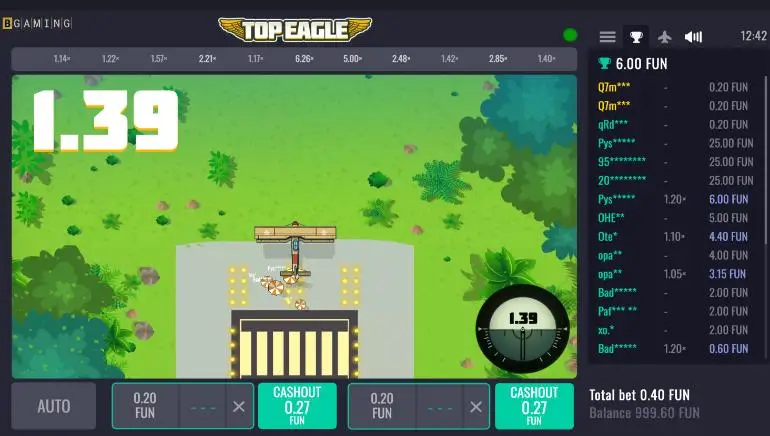
Where Top Eagle parts ways with the majority of its competitors is the camera angle. The playing field is viewed from directly above rather than from the side. You are watching the plane course across a landscape below you, not watching it arc upward from a horizon. The altimeter in the bottom-right corner of the screen shows the growing multiplier, and the Best Drop icon in the top-right records your personal highest-value cashout so far.
This perspective is not cosmetic window-dressing. It changes the sense of movement and scale within the game, and it shifts the visual framing enough that players who have spent a lot of time with Aviator or Spaceman will notice the difference immediately.
There is a five-second countdown before each round starts. During that window you set your stakes and confirm. Once the round is live, you watch and decide when to pull the parachute cord.
The game can also include combat events during flight — ships and other aircraft can fire at your plane, and the plane can dodge. This is an animated detail that adds life to the playing field without affecting the underlying RNG result. It is the kind of small touch that makes extended sessions feel less repetitive than staring at a blank climbing curve.
RTP and Volatility
The headline RTP is 97%, which BGaming states in their official game details. This puts Top Eagle in line with most quality crash games on the market — Aviator from Spribe also runs at 97%, for reference.
However, the range published on the BGaming game page runs from 96.88% to 98.92%. The lower end applies in certain play conditions, and the upper end is achievable in others. BGaming has not publicly detailed the exact mechanism behind this range in their promo materials, so the precise trigger for the higher-return configuration is not confirmed. What can be said is that the spread is meaningful: the difference between 96.88% and 98.92% is real over a long enough session.
Volatility is a point where the information available is limited. BGaming’s official promo pack for Top Eagle does not specify a hit rate or variance level. From playing the game, behaviour appears consistent with medium-to-high variance typical of crash titles — the plane can crash instantly before the multiplier even clears x1.01, and it can also fly out past x20 or further. There is no published figure to anchor this assessment, so it stands as an observed pattern rather than a confirmed stat.
For players trying to manage bankroll, this matters. There is no official guidance on expected hit frequency.
Features
Dual Bet Panels
Top Eagle allows two simultaneous bets per round. Each panel has its own stake selector and its own cashout button. This is standard for the genre at this point, but it is implemented cleanly here. You can run one panel on auto cashout at a conservative multiplier and manage the second panel manually — a common approach for players who want some guaranteed returns alongside higher-risk plays.
Automatic Cashout
Each bet panel supports an auto cashout target. You set the multiplier value, and if the plane reaches it before crashing, the game cashes you out automatically. This is useful for players who find manual reaction times inconsistent, or for anyone running the conservative leg of a split strategy.
Autoplay Mode
Autoplay allows you to preset a number of consecutive rounds and let the game run without manual input per round. Combined with automatic cashout, this enables fully automated session play. Whether that makes for an enjoyable experience is personal preference; the option is there.
Flight History Bar
Running across the top of the screen is the Flight History bar. After each round, it logs the multiplier reached before the crash. Rounds where you successfully cashed out show in white; rounds where you did not are in pale gray. This gives you a visual record of recent round outcomes.
It is worth being direct about what this does and does not tell you. The history bar shows you what has already happened. Since each round’s outcome is generated independently by a certified RNG, past results carry no predictive weight for future rounds. Players sometimes try to read patterns into crash history bars. That approach does not hold up statistically. The bar is useful for tracking your own session, not for predicting the plane’s next flight.
Best Drop Marker
The Best Drop icon appears at the top-right of the playing field and records your highest-value cashout during a session. When you beat your own record, it updates. This is a small personal progression tracker that gives you something to chase beyond raw profit — particularly useful during sessions where the multipliers are running modest.
Leading Achievement
On your first cashout, your flight distance is marked on the playing field as a personal milestone. If you clear that distance on a subsequent round, you earn the Leading achievement. This resets your benchmark and gives you a new target to beat. It is a simple mechanic, but it keeps sessions from feeling like a blank sequence of random outcomes.
Altimeter
The altimeter sits in the bottom-right corner and displays the current multiplier in real time as the plane flies. It is the primary reference point for cashout timing when you are not using automatic cashout.
Plane Skins
There are six airplane skins in total: the default skin available from the start, and five additional skins unlocked by reaching specific cashout milestones. The trigger multipliers are x2, x5, x10, x50, and x100 — one skin per milestone.
To be clear about what these skins do: they change the visual appearance of your plane on the playing field. They do not alter RTP, modify volatility, affect the RNG, or introduce any gameplay difference. They are cosmetic. That said, they function as a progression system that gives players a reason to target those specific multiplier thresholds. Hitting x100 to unlock the final skin requires meaningful risk. Whether that adds value to a session depends on how you approach the game.
The milestone structure is sensible in design. Reaching x2 is achievable regularly. Reaching x100 is a genuine accomplishment given how rarely multipliers climb that high in a typical session. The skin unlock system scales with risk in a way that makes the cosmetics feel earned rather than arbitrary.
Soundtracks
You can toggle between two in-game soundtracks: Attack and Recon. Both are described as energetic. The option to switch moods without leaving the game is a minor but considered detail — sound design affects how long players stay comfortable in a session, and giving players control over it reduces friction.
Gameplay Feel and Interface
The interface is clean and functional. BGaming has built the screen layout so that the playing field takes up the majority of the display, with the leaderboard to the right showing other players’ active bets, winning multipliers, and payouts. The leaderboard is live — you can watch other players cashing out or losing in real time. This is the social element of crash gaming that keeps the format engaging beyond pure mechanical repetition.
The animation quality is straightforward. The game is not visually elaborate. The top-down perspective gives it a distinct look, but the art style is simple rather than detailed. For players used to slot game production values, this will register as sparse. For players focused on the mechanics, it will not be a problem.
The combat animation detail deserves a separate mention. During a flight, ships on the ground and enemy aircraft can fire at your plane. The plane has a chance to dodge these attacks and keep flying. This does not affect the RNG result — the crash point is already determined before the round starts — but it adds a layer of visual activity that makes longer flights more engaging to watch. Rather than a bare multiplier climbing on a blank field, you have an actual scene playing out below you. This kind of atmospheric detail is easy to dismiss as irrelevant, but it makes a difference in how engaged you feel during rounds where you are holding out for a higher multiplier.
Round pacing is fast. The five-second countdown creates a consistent rhythm. Sessions move at a clip, which can compound losses quickly if you are not managing stake sizes with discipline. A losing run of five or six consecutive instant crashes happens — that is the nature of crash game variance — and the speed of the format means those losses arrive before you have time to reconsider your approach for the session.
The Best Drop marker and Leading achievement system together create a layer of personal record-keeping that gives individual sessions a shape. You are not just grinding through round after round — you have personal benchmarks on screen that you are either defending or trying to beat. This is a meaningful design decision for a game type that can otherwise feel like watching a random number generator run.
For demo play, BGaming’s own website hosts the game in free-to-play mode without registration. This is the cleanest way to learn the interface before committing real money, and it gives you access to the full feature set — dual panels, auto cashout, skin progression tracking — without any stake required.
Bet Limits and Payouts
The minimum bet is $0.20 per panel. The maximum is $25 per panel. With two panels active, maximum exposure per round is $50.
The maximum multiplier is x10,000. If the plane reaches x10,000, the game automatically cashes you out — you do not have to act. The maximum win is €250,000, as stated on the BGaming game page.
At the $25 maximum stake with both panels active and a x10,000 multiplier, the theoretical max payout per round from a single panel would be $250,000 in most currency configurations. In practice, the plane reaching x10,000 is an extreme edge case.
The stake structure means that progressive betting systems like the Martingale are difficult to run properly. From the $0.20 minimum to the $25 maximum, you have limited room to double stakes before hitting the ceiling. Starting at $0.20 and doubling, you reach $25 in six steps: $0.20, $0.40, $0.80, $1.60, $3.20, $6.40, $12.80, $25.60 — the last step exceeds the maximum, so in practice you cap at six full doublings. For a system that requires recovering all losses in a single win, that ceiling arrives quickly. This is not a game where aggressive progressive staking makes mathematical sense.
Strategy Considerations
Before anything else: crash games run on certified RNG. No strategy changes the underlying return percentage or makes outcomes predictable. What strategy does affect is how you manage your bankroll across a session and what kind of variance you expose yourself to.
Conservative play means targeting low multipliers — in the x1.20 to x1.50 range. These cash out frequently. The profit per round is small, but the frequency of wins keeps your balance more stable. Over a long session, this approach produces less dramatic swings in either direction. The trade-off is that one instant crash wipes out several consecutive small wins.
Aggressive play means targeting x5, x10, or higher. These hit less often. When they do hit, the payout is significant relative to the stake. But there will be extended runs of losses between hits, and those require bankroll depth to survive without abandoning the approach mid-session.
The split panel approach combines both. One panel runs on automatic cashout at a conservative multiplier, say x1.30 or x1.50. The other panel is managed manually and aimed at higher multipliers. The conservative panel generates frequent small returns that offset some of the losses on the manual panel. This is the most commonly recommended approach for sustained play in the crash format, and the dual-panel structure in Top Eagle supports it directly.
Session discipline matters more than multiplier targeting in the long run. Setting a loss limit before you start — and sticking to it — does more for your bottom line than any particular cashout strategy. The fast round pace in Top Eagle means a losing streak can eat a significant portion of your session bankroll in a short window. Having a predetermined stop point is not strategy; it is basic session management.
A practical note on the skin unlock milestones as strategy reference points: some players use the x2, x5, and x10 thresholds as natural targets for their auto cashout settings. This gives the session a concrete goal beyond a blank multiplier number. If you are going to target a round number anyway, anchoring to the skin milestones costs nothing additional in terms of risk-to-reward. The higher thresholds — x50 and x100 — are genuinely high-variance targets and should not be treated as regular cashout goals unless you are specifically chasing the cosmetic reward.
Finally, a word on the Flight History bar and how players typically misuse it. Watching the recent round history is natural — the bar is right there on screen, and patterns feel meaningful when you are in the middle of a session. Seeing six consecutive crashes below x2 can create a sense that a long flight is overdue. It is not. Each round is independent. The RNG has no memory of previous outcomes. The bar is useful for reviewing your own session results, not for forecasting the next round. Treating it as predictive is the most common strategic error in crash gaming, and Top Eagle’s prominent Flight History display makes this temptation particularly easy to fall into.
Mobile Performance
Top Eagle runs natively on iOS and Android without a dedicated app download. Opening the game in a mobile browser on a casino that carries BGaming titles is sufficient. The interface adapts to different screen sizes. The touchscreen controls — setting stakes and hitting cashout — are functional and do not require excessive precision.
BGaming has consistently built mobile-first across their catalog, and Top Eagle is no exception. The altimeter, Flight History bar, and dual cashout buttons are all accessible without zooming or awkward navigation. The game does not impose demanding hardware requirements, which means it performs on mid-range devices without issues.
Top Eagle vs Aviator: Key Differences
Aviator from Spribe is the reference point for the crash genre. Most players coming to Top Eagle will have played it. The comparison is fair.
Both games run at 97% RTP. Both support dual bets and automatic cashout. Both use certified RNG. At the mechanical level, they are closely matched.
Where they diverge:
Perspective. Aviator shows the plane climbing from left to right on a rising curve. Top Eagle shows the playing field from directly above. This changes the visual experience significantly for players who have spent time with Aviator’s format.
Progression. Aviator has no skin unlock system. Top Eagle has five unlockable plane skins tied to cashout milestones. This gives Top Eagle sessions a cosmetic goal layer that Aviator lacks.
Social layer. Aviator features a live chat panel and displays other players’ cashouts as real-time annotations on the multiplier curve, which many players use (rightly or wrongly) as a social cue. Top Eagle has a leaderboard showing bets and payouts but does not display other players’ cashout decisions overlaid on the game field.
Personal tracking. Top Eagle’s Best Drop marker and Leading achievement give individual players a record to beat. Aviator does not have an equivalent personal milestone system.
RTP range. Top Eagle’s 96.88%–98.92% range is worth noting. Aviator’s RTP is fixed at 97%. The significance of Top Eagle’s upper bound depends on what drives that variation — which BGaming has not fully disclosed.
Neither game is objectively better. The choice comes down to whether you prefer Aviator’s social-proof feel and familiar side-scroll format, or Top Eagle’s overhead view and personal progression mechanics.
Who Should Play Top Eagle
Players who have spent time with Aviator and are looking for something that sits in the same genre but approaches the visual experience differently will get the most out of Top Eagle. The top-down perspective is a genuine change of pace, and the personal progression system — tracking your Best Drop, chasing the Leading achievement, working toward skin unlocks — gives sessions more texture than a blank cashout loop.
It also works well for players who approach crash games methodically rather than reactively. The dual-panel setup combined with auto cashout on one panel creates a structured framework that suits a deliberate, planned-out session style. Players who like to set parameters and work within them will find the interface supports that approach better than some competitors.
On the other side: if you are looking for something with slot-style bonus rounds, expanding features, or a high-production visual identity, this is not the game. The art style is functional at best. There are no scatter bonuses, no free spins equivalent, no multiplier boost features tied to specific in-game events. It is a crash game, full stop.
Players who rely heavily on watching other players’ live cashout decisions as part of their session — using the social proof of others bailing out at certain multipliers as a timing signal — will find Top Eagle less useful for that approach than Aviator. The leaderboard shows results, not live decisions in progress.
High-stakes players should note the $25 per panel ceiling. With two panels that is $50 maximum exposure per round, which is moderate by crash game standards. If your regular bet is above that range, you will need to look elsewhere.
Suits: Aviator veterans wanting a fresh visual format, methodical dual-panel players, mobile-first players, those who appreciate personal progression tracking.
Does not suit: High-stakes players, anyone wanting social-proof live cashout data, players who need published volatility figures before committing.
Final Thoughts
Top Eagle is a well-executed crash game that earns its place in the category without trying to pretend it has reinvented anything fundamental. The top-down view is a genuine visual differentiator. The skin progression system works as a light session goal. The RTP range up to 98.92% is competitive. The dual panels, auto cashout, and autoplay give you the full toolkit expected from a modern crash title.
What it lacks is depth beyond the core loop. The skins are cosmetic only. Volatility data is absent from official sources. The max bet of $25 per panel will frustrate higher-stakes players.
As a package, it holds up. If you are looking for a crash game that covers the fundamentals well and does something visually distinct from the standard side-scroll format, Top Eagle is worth spending session time on. If you are already happy with Aviator and not looking for anything different, there is no pressing reason to switch.
Rating: 7.5/10
The score reflects a game that does its job well, adds genuine novelty in its perspective and progression system, and loses points only for the absence of volatility transparency and the ceiling on stakes.