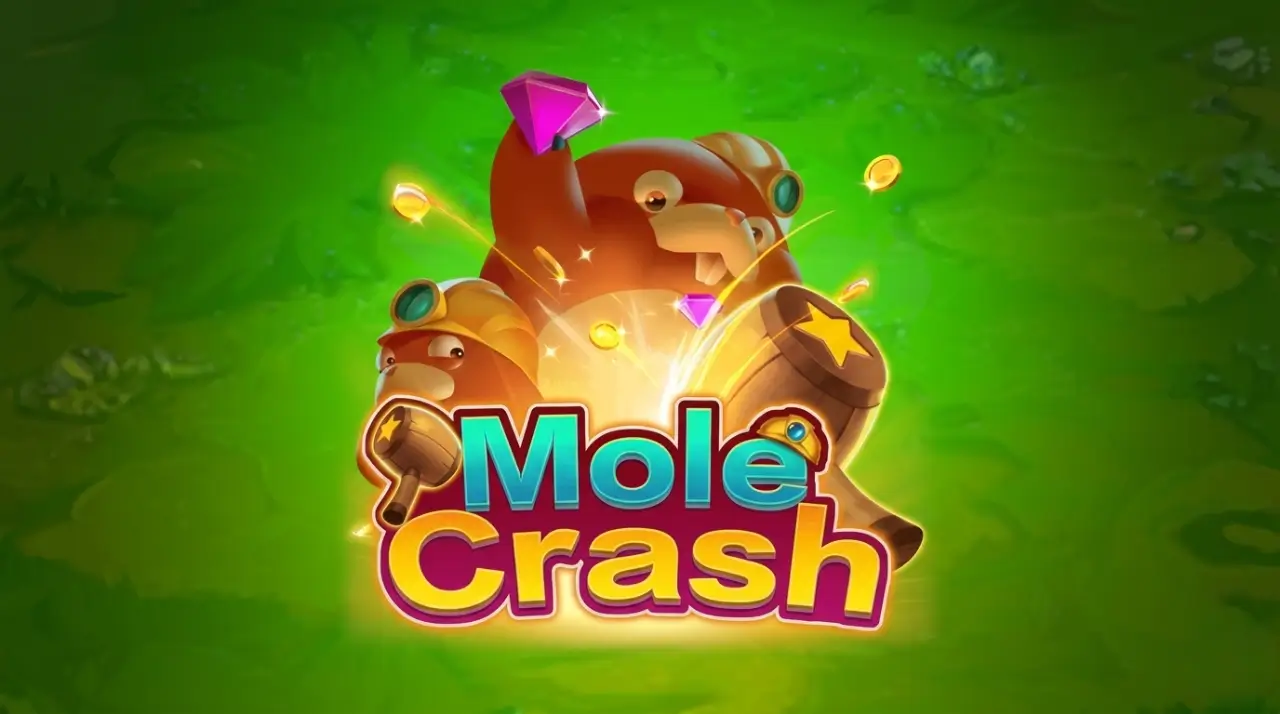
JDB Gaming built its reputation on slots and fish shooting games aimed squarely at Asian markets — Vietnam, the Philippines, Thailand, and beyond. Crash games are not what the studio is known for. So when Mole Crash landed in May 2024, it was a genuine step outside JDB’s comfort zone: a crash-format title dressed in cartoon animal visuals, positioned at the quieter end of the volatility spectrum. This review covers what the game actually is, how it plays, where it falls short, and who it makes sense for.
What JDB Gaming Is, and Why That Context Matters
JDB was established in 2010, originally under the name JDB168, and rebranded in 2018 around the motto “Just Do The Best.” The company is headquartered in Vietnam and holds GLI certification for its random number generation — a certification that was renewed in 2024. Their catalogue runs to well over 100 titles, dominated by slot games and fish shooting games that remain a staple of the Asian online casino market.
Crash games are a smaller part of JDB’s output. The studio has expanded into the format, but it has not built its identity around it the way Spribe has with Aviator or SmartSoft has with JetX. Mole Crash is one of those expansion moves: a title that takes an established genre format and brings JDB’s characteristic lighter, character-driven visual style to it. Whether that works for you will depend a lot on what you want from a crash game.
Theme and Visual Design
The crash genre has a visual language that is hard to miss. A rocket accelerating toward the sky. A plane climbing to dangerous altitudes. A spaceship powering through multipliers in the void. Nearly every major crash title leans on some variation of the same metaphor: upward motion, speed, and the threat of catastrophic failure.
Mole Crash takes a different direction. The protagonist is a cartoon mole, and the visual register is light and playful rather than dramatic. Think colourful, rounded character design — the kind of aesthetic JDB has applied to many of its slots and arcade titles. It is not premium-tier art direction. There is no minimalist tension in the design the way Aviator achieves with its stripped-back plane against a clean sky. Instead, you get something closer to a mobile casual game aesthetic: friendly characters, bright colours, a visual tone that communicates low stakes rather than high drama.
Whether that is a positive or a negative depends entirely on what you want from the game. For players who find the intensity of Aviator or Spaceman a bit much — or who simply prefer something lighter to look at during a session — the visual choice works. For players who want the full crash game atmosphere, the mole theme does not deliver it.
The audio follows the same logic. JDB games tend toward cheerful sound design, and Mole Crash is no exception. There is no soundtrack building tension during a round. It is a casual experience, and the sound reinforces that.
How Mole Crash Works
Mole Crash follows the standard crash game structure. You place a bet before a round starts. Once the round begins, a multiplier climbs from 1.00x upward. Your job is to cash out before the crash — the point at which the multiplier collapses and any uncashed bets are lost. If you cash out in time, you receive your bet multiplied by the value at the point of cashout. If the crash arrives first, you lose the bet.
This format is now familiar enough that most online casino players have encountered it, but it is worth being precise about what distinguishes it from a slot. There are no reels, no paylines, and no spin button. The outcome is not determined by a symbol combination. The variable is entirely about when the crash happens and whether you have exited before it. Each round is a single decision stretched over a few seconds: do you take the current multiplier, or hold for more? The tension is real, and it is the core of why crash games attract players who find slots passive.
What separates Mole Crash from a bare-bones implementation of the crash format is the random multiplier feature. During a round, a separate random multiplier can activate unexpectedly, producing a boost on top of the climbing base multiplier. This is not a feature you can predict or plan around. The trigger conditions are not publicly documented by JDB. You should treat it as an occasional occurrence that adds a burst of variance to rounds — not a mechanic to build any strategy around. But it does mean individual rounds can produce surprise outcomes that a pure base multiplier would not. This is the most meaningful design difference between Mole Crash and a generic crash implementation, and it is the feature that gives the game a reason to exist beyond its theme.
The cashout system works in two modes. Manual cashout means you watch the multiplier climb and press the cashout button at the moment you choose. Auto cashout lets you set a target multiplier in advance; if the multiplier reaches that value before the crash, the game cashes you out automatically. Both modes have practical trade-offs. Manual cashout gives you flexibility to react to a climbing multiplier in the moment — but human decision-making under pressure is inconsistent, and it is very easy to hold one beat too long. The psychological pull of “one more second” is well-documented in how crash games are played, and it leads to more losses than disciplined auto cashout strategies. Auto cashout removes that decision point entirely. You set the target before the round, and the game either hits it or it does not. For a low-variance game with a ceiling of 1,000x, setting a realistic auto cashout target and removing the emotional variable from the equation is a reasonable approach.
One thing to note about the round structure in crash games generally: each round is an independent event. The crash point of the previous round has no mathematical influence on the next one. It does not matter if Mole Crash ran to 50x on the last round — the following round has no memory of that. Players who look for patterns in crash history displays are doing something that feels analytical but has no mathematical basis. The history display is useful for understanding the game’s general behaviour during a session, but it is not a predictive tool.
Bet Range: $0.10 to $500
The confirmed bet range runs from $0.10 at the low end to $500 at the high end. The minimum is accessible — you can run a session on a small budget and keep stakes low enough that individual round losses are not painful. The maximum of $500 is reasonable for recreational play but sits well below what high-roller crash players typically want. Aviator, to use the obvious comparison, accommodates much larger bets depending on the casino. Players who want to put $1,000 or more on a single crash round are not the target audience for Mole Crash.
One note on the minimum: SlotCatalog lists $0.10 and Casino Guru lists $1.00 as the minimum bet. There is a discrepancy between the two sources. This likely reflects operator-level configuration differences — the same game can have different bet limits depending on the casino running it. Before starting a session, it is worth checking the actual limits in the game interface at your specific casino rather than relying on aggregator data.
Max Win and What Low Variance Actually Means
The maximum win in Mole Crash is 1,000x the stake. On a $0.10 bet, that is $100. On a $500 bet, it is $500,000. In theory. The practical reality of a 1,000x cap on a low-variance crash game is considerably more constrained.
Low variance in a crash game context means the multiplier tends to collapse at lower values more consistently. Rounds crashing quickly — below 2x, below 3x — happen more frequently than on a high-variance title. Extreme multipliers in the hundreds or thousands are rare events. The game is designed to produce moderate, recoverable outcomes more often, rather than large, infrequent ones.
Compare this to the competition:
| Game | Developer | Max Win | Variance | RTP Disclosed |
|---|---|---|---|---|
| Mole Crash | JDB Gaming | 1,000x | Low | No |
| Aviator | Spribe | Varies (100x+ per casino) | High | Yes (97% base) |
| Spaceman | Pragmatic Play | 5,000x | High | Yes (96.5%) |
| JetX | SmartSoft | 10,000x | High | Yes (96–97%) |
The 1,000x ceiling on Mole Crash is genuinely limiting when put alongside the competition. Aviator rounds regularly push beyond 10x, and occasional runs into the thousands of x do happen. JetX has documented 10,000x potential. Mole Crash is not in that category. If the primary appeal of crash games for you is the possibility of a single round multiplying your bet by 500x or more, Mole Crash is probably the wrong choice.
Where Mole Crash’s low variance positioning does work is in session consistency. A low-variance crash game is less likely to eat your entire session budget in a rapid sequence of early crashes. Moderate multipliers — 2x, 3x, occasionally higher — occur often enough to maintain balance over a session. For players who find high-variance crash games financially bruising, or who are learning the format for the first time, that consistency is worth something.
The RTP Problem
Here is the part of this review that no other article on Mole Crash has addressed clearly: the RTP is not publicly disclosed.
Casino Guru lists it as “Unknown.” SlotCatalog does not display a figure. JDB has not published an RTP for Mole Crash on its official game page. As of early 2026, there is no confirmed public figure for the house edge on this game.
This is a genuine problem. RTP transparency is one of the most basic pieces of information a player needs to make an informed decision about a casino game. Aviator publishes 97% — and goes further to explain that individual operators can configure it between 94% and 97%. Spaceman publishes 96.5%. JetX publishes its range. These figures allow players to understand the long-term cost of playing and to compare games on an apples-to-apples basis.
JDB uses adjustable RTP across its portfolio. The company has confirmed elsewhere that operators can select from a range of RTP settings for JDB titles. This means even if a figure were published as a baseline, the actual RTP at your casino could be lower. The practical advice here is straightforward: check the game’s information panel at whatever casino you are playing at. Some operators display the configured RTP inside the game interface. If that information is not visible and the casino cannot provide it on request, you are playing a game of unknown house edge — which is a reasonable reason to look elsewhere.
This is not a minor footnote. For a genre where provably fair systems (Aviator’s SHA-256 hash, for example) allow players to independently verify the outcome of every round, Mole Crash offers no equivalent transparency. There is no confirmed provably fair mechanism documented for this game in any source reviewed for this article.
How Mole Crash Compares to Aviator
Aviator is the obvious benchmark. It is the game that established the modern crash format as a mainstream casino product, launched by Spribe in 2019, and it remains the market leader by a considerable margin as of 2026. Any crash game review that does not address Aviator directly is leaving out the comparison that most players will make on their own.
The differences between Mole Crash and Aviator are substantial — and they run deeper than max win numbers.
Aviator is high variance and publishes its RTP. The base RTP is 97%, and Spribe is transparent about the fact that individual operators can configure it lower — some casinos run Aviator at 96% or 94%. That information is published. Players can factor it into their decision. Mole Crash does not publish its RTP. The difference between a 97% RTP game and a hypothetical 93% RTP game is significant over a session of any length, and not knowing which side of that range you are on is a real informational gap.
Aviator uses a provably fair system based on SHA-256 cryptographic hashing. Before each round, the casino commits to a result by publishing an encrypted hash. After the round, the hash can be decrypted and verified against the actual outcome. This means a player on a provably fair platform can confirm, independently, that the result of every round they played was generated honestly and not manipulated. There is no confirmed equivalent mechanism for Mole Crash.
Aviator also includes a live social layer that has become one of its most recognisable features: a real-time feed showing the bets placed and cashout points of other players in the same round. You can see usernames, bet amounts, and the multiplier at which others cashed out — or that they were caught in the crash. This social dimension changes the psychological texture of the game. You are not playing in a vacuum; you are watching how other people make the same decision you are making. Whether Mole Crash includes an equivalent live bets display has not been confirmed in any source reviewed for this article.
On the design side, Mole Crash offers something Aviator does not: the random multiplier feature. Aviator’s base mechanics are clean and simple — a multiplier climbs, you cash out or you do not. The absence of additional features is partly a design philosophy. Mole Crash introduces unpredictability through the random multiplier, which changes individual round outcomes in ways the base climbing multiplier cannot. For players who find pure crash mechanics monotonous over longer sessions, that additional variable is worth something.
The visual distinction is also real. Aviator’s minimalist plane on a clean background has become an iconic piece of casino game design. Mole Crash’s cartoon mole is neither iconic nor minimalist. It is a lighter, more casual visual register. Some players will actively prefer that; others will consider it a step down in production quality. Neither position is wrong.
The bottom line comparison: Aviator is more transparent, more proven, more widely available, and more capable of producing extreme multipliers. Mole Crash is lower variance, lower stakes accessible, and visually distinct. They are not direct substitutes for each other.
Playing Mole Crash: What to Expect in Practice
Going through the game in demo mode gives you a reasonable read on the session rhythm.
Rounds move fast. Crash games by nature are quick — a round can be over in a few seconds if the multiplier collapses early. On a low-variance title, early collapses happen regularly. You will see rounds that crash below 2x. You will see rounds that crash before you have had time to consider cashing out. The auto cashout function earns its value here: setting a fixed target before rounds start removes the pressure of watching the multiplier and making a real-time decision each time.
The random multiplier does activate occasionally. When it does, it boosts the current value. Because its trigger conditions are not documented, you cannot know in advance when it will appear or how often. In demo play, it creates a notable spike — a sudden jump above the climbing base multiplier — that can push a round’s value significantly higher than it would otherwise have reached. It is the most distinctive feature in Mole Crash’s mechanics, and it is the primary reason to play the game over a stripped-down crash alternative.
The interface itself is clean and functional. Bet adjustment, cashout controls, and round history are available. Nothing in the UI presents any friction for a player familiar with crash games. For someone new to the format, the relative simplicity is appropriate.
Mobile performance is consistent with JDB’s general approach to HTML5 development. JDB games are designed to run on mobile devices, and Mole Crash is no exception. The layout adjusts to smaller screens. Controls are accessible without requiring pinch-and-zoom. For markets where mobile is the primary way players access casino games — which covers a substantial portion of JDB’s core user base in Southeast Asia and similar regions — this matters.
Strategy Notes for a Low-Variance Game
No strategy eliminates the house edge. That is true of every casino game, and crash games are no exception. What strategy can do is change how your session budget behaves over time, and how much decision fatigue you accumulate during a session.
For a low-variance crash game like Mole Crash, the most consistent approach is setting a modest, fixed auto cashout target and sticking to it. Targeting 2x–3x consistently is more aligned with the game’s actual multiplier distribution than setting auto cashout at 20x or higher. The high end of the multiplier range does exist — the 1,000x cap is real — but treating it as a reliable target would mean losing the large majority of rounds while waiting.
The math works like this in broad terms. At a 2x auto cashout, you need the multiplier to reach 2x on more than 50% of rounds to generate positive returns over time. Whether Mole Crash’s actual distribution supports that frequency cannot be calculated without a confirmed RTP figure. But the low-variance classification suggests the game is designed to reach modest multipliers more consistently than it crashes early. Players should calibrate to that design rather than fighting it with strategies built for high-variance titles.
Consider the difference concretely. A player running $1 bets with an auto cashout at 2x wins $2 when the round hits the target, and loses $1 when it crashes below. Over 100 rounds, the outcome of that pattern is entirely determined by what percentage of rounds reach 2x. On a low-variance game, that percentage should be higher than on a high-variance alternative — that is precisely what low variance means. Contrast this with a 10x target: the percentage of rounds reaching 10x is significantly lower, and on a low-variance game, lower still than on a high-variance one. Setting a 10x target on Mole Crash and expecting to hit it regularly is a mismatch between strategy and game design.
The Martingale system — doubling your bet after each loss — gets mentioned in most crash game strategy discussions. It has a certain appeal in theory: recover previous losses with the next win. In practice, a sequence of early crashes will push bet sizes up very quickly, and the bet ceiling ($500 in Mole Crash) creates a hard limit that the strategy runs into during any sustained losing streak. Martingale is not an approach this review recommends, but players who use it should at minimum be aware that the $500 maximum bet caps how many doublings are possible before the system breaks.
A practical session structure is simpler and more robust. Decide your total budget before opening the game. Set a stop-loss at roughly half that budget — if you reach that point, close the session. Use auto cashout at a realistic target for the game’s variance profile. These practices do not change the underlying mathematics, but they do prevent the fast-session nature of crash games from exhausting a budget without the player noticing.
The random multiplier, as noted, is not predictable. Do not raise bet sizes in anticipation of it. It is a variance event — it can help you or it can arrive on a round that was already going well. It is not a trigger to try to exploit. Any strategy that relies on predicting when the random multiplier will activate is based on information that does not exist publicly.
Who Should Play Mole Crash
The case for Mole Crash is clearest for a specific type of player.
You are new to crash games and want something lower-pressure to learn the format on. The low variance means you are less likely to lose your session budget in a fast sequence of early crashes, which is a real risk on high-variance titles when starting out. The accessible minimum bet extends how long a small budget can last.
You find the visual aesthetic appealing. The mole theme is distinctive, and if you prefer lighter, more casual-feeling game design over the minimalist drama of Aviator or the space-themed intensity of Spaceman, Mole Crash offers that.
You play on a platform where Mole Crash is available and other crash options are limited. JDB has a solid integration footprint across Asian markets and is expanding into other regions. If Mole Crash is one of the crash options available at your casino, it is a reasonable choice — provided you check the configured RTP before playing.
The case against Mole Crash is also clear.
You want multiplier potential beyond 1,000x. The cap is real. If a single round multiplying your stake by several thousand is what you are after, this game does not offer it.
You want RTP transparency. The undisclosed house edge is a meaningful drawback. This is not a deal-breaker for all players, but for players who factor RTP into their game selection — which is sensible practice — the absence of that information should give pause.
You want provably fair verification. If being able to check individual round outcomes cryptographically matters to you, Mole Crash currently has no documented mechanism to support that.
You are used to Aviator or similar high-variance titles. The session feel is genuinely different. Lower multipliers, less dramatic run-ups, fewer moments of extreme tension. Some players will find that preferable; others will find it flat.
Verdict
Mole Crash occupies a specific position in the crash game genre: a low-variance title from an established Asian developer, with a cartoon aesthetic, a $0.10 minimum bet, a 1,000x ceiling, and a random multiplier feature that adds genuine unpredictability to individual rounds.
It is not trying to compete with Aviator or JetX on multiplier potential, and it does not need to. There is a real audience for a low-variance crash game — players who want consistent, moderate returns over a session rather than rare high-risk jackpot moments. For that audience, Mole Crash does what it is designed to do.
The undisclosed RTP is the game’s most significant drawback, and it is one the whole category of JDB crash titles shares. Competing crash games from other developers publish their RTPs and often support provably fair verification. Until JDB addresses that transparency gap, Mole Crash asks players to take on more informational risk than the alternatives require. That is worth knowing before you start.