Understanding the Core Differences Between Online and Live KENO
The first time I walked into a physical casino and played KENO at a desk, then went home and played KENO online, I realized they weren’t the same experience despite using identical rules. The games look the same on the surface—you pick numbers, 20 get drawn, you either match them or you don’t. But the fundamental experience, the pace, the psychology, and even the technical aspects are quite different. Understanding these differences before you choose which format to play is critical.
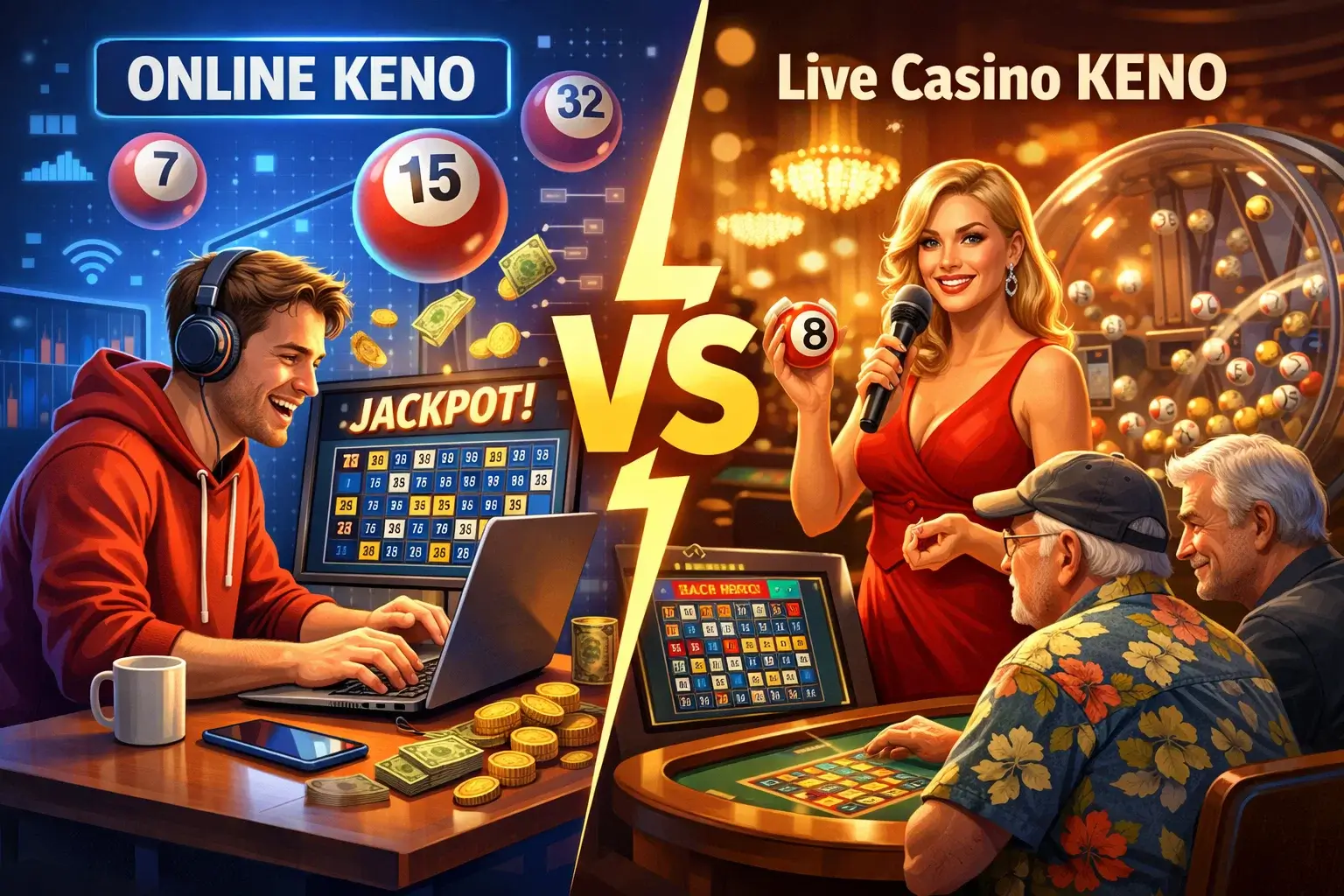
Online KENO on platforms like RajaBaji or JabiBet happens entirely on your device. You select your numbers, place your bet, the draw happens almost instantly, and results appear immediately. There’s no human interaction, no physical tickets, no waiting in a casino environment. Live casino KENO, whether you’re at a physical location or watching through a live stream, involves an actual person conducting the game, physical or virtual ball draws, and a more theatrical experience overall.
The regulatory framework is completely different too. Online KENO operates under whatever licensing the platform holds, which varies dramatically depending on jurisdiction. Live casino KENO in physical locations is regulated by local gambling commissions and casino authorities. Live streamed KENO falls somewhere in between—it’s technically online but with elements of live verification. These regulatory differences matter because they affect game fairness, payout rates, and what happens if something goes wrong.
Most players I know who’ve tried both formats have a preference, but that preference comes from specific needs rather than one format being objectively superior. Some people love the speed and convenience of online. Others feel more comfortable in a physical casino where they can see the game happening in real time. Neither preference is wrong—it’s about understanding what works for your situation.
Online KENO: Speed, Convenience, and Complete Control
Online KENO is where I spend most of my gaming time these days, and there are legitimate reasons why millions of South Asian players prefer it to physical casinos or restrict themselves to online play. The convenience factor alone is genuinely massive. I can play during my lunch break at work, while commuting on the bus in traffic, or late at night when I can’t sleep and need something to occupy my mind. I don’t need to get dressed up, travel anywhere, or deal with crowds of people. The game happens in seconds from my mobile device. The accessibility is simply incomparable to physical casinos.
The pace is something else entirely that fundamentally changes the experience. In a live casino, a KENO draw might happen every few minutes—maybe four to six draws per hour depending on staffing. Online, it can happen every 30 seconds to two minutes depending on the platform and the game variant. This speed difference is exciting and engaging but also dangerous from a bankroll preservation perspective. You can lose money much faster than you realize because you’re making betting decisions every 30 seconds. What would take an hour in a physical casino happens in maybe five minutes online. This accelerated pace suits some players perfectly and terrifies others who understand the implications.
Speed affects decision-making quality in subtle ways. In a physical casino, the slower pace gives you time to think, to reconsider your bet, to talk to other players about strategy or numbers. You have natural pauses built into the experience. Online, everything happens so fast that you’re constantly making rapid decisions without reflection. I’ve made impulsive bets online—bet sizes I wouldn’t normally consider—that I never would have made in person simply because the game momentum keeps pushing forward relentlessly. There’s no pause button. The next draw is coming whether you’re ready or not. The system doesn’t care about your hesitation.
The convenience of picking numbers on a mobile app versus filling out a physical ticket is genuinely underrated. Online, you can save your favorite number combinations and apply them repeatedly with a single tap. You can instantly try different spot games without printing different tickets or filling out new forms. You can change your bet size between every single play. The friction is removed entirely. This is good for convenience and player experience but objectively bad for your bankroll because removing friction makes it easier to spend more money faster. You go from thinking “should I play another round?” to just playing another round automatically.
Online KENO also offers features live casinos literally cannot provide. You get detailed game history showing every draw from the past week or month. You can see exactly which numbers have been drawn over the last hundred games, allowing you to track patterns if you want (even though the patterns are meaningless mathematically). You can set betting limits directly, session time limits, and maximum loss limits. Some platforms let you exclude yourself automatically after losses reach a certain threshold—you literally cannot play anymore even if you want to. These responsible gambling features exist only online and are absolutely valuable tools for players who struggle with self-control.
The downside is significant: all online KENO happens entirely through software code. You’re completely dependent on the platform’s random number generator to be fair. You can’t see balls being drawn or physically verify the process. You have to trust that the RNG is truly random and not weighted toward certain numbers or outcomes. Most regulated platforms use certified RNGs that are tested and audited by independent third-party companies, so the trust is reasonably justified. But I completely understand why some players feel psychologically more comfortable seeing a physical draw they can witness with their own eyes. The visual verification provides peace of mind even if statistically it shouldn’t matter.
Live Casino KENO: Transparency, Social Experience, and Pace Control
I’ve spent considerable time in physical casinos playing KENO, and there’s something fundamentally different about the experience that genuinely appeals to certain types of players. When you watch actual balls get drawn from a machine or see a real person conducting the game live in front of you, you get visual verification that the process is actually fair and transparent. You’re not relying entirely on trust in invisible software code—you’re observing the game happening in real time with your own eyes.
The social aspect is genuinely real and meaningful for many players. In a physical KENO area of a casino, you’re surrounded by other players who are also invested in the outcome. You talk about numbers, share stories about big wins from the past, commiserate about losses with people who understand the frustration. There’s a community element and shared experience that online KENO simply cannot replicate no matter how advanced the technology gets. Some players genuinely crave this human interaction and the social environment. Others find it distracting or emotionally stressful. But if you’re someone who enjoys the social experience of gambling and the camaraderie with other players, physical casinos provide something online absolutely cannot.
The pace in a physical casino is noticeably slower, which functions as both a pro and a con depending on your perspective and your self-control. If you struggle with the rapid pace and constant decision-making of online gaming, the physical casino format forces you to slow down naturally. Draws happen every few minutes by necessity, not every 30 seconds. This gives you real time between bets to think, to reconsider your number choices, to step away if you need mental space. For players who recognize they have impulse control issues around gambling, this slower pace can actually be surprisingly protective even if you don’t realize it initially.
Physical tickets create a fundamentally different psychological relationship with your money and your bet. When you hand over actual cash and receive a physical ticket in exchange, the transaction feels more real and more consequential. You’re holding your money in your hands and trading it for a piece of paper. This makes the loss feel more concrete and harder to rationalize when you lose. Some experienced players find this helps them respect their bankroll more and gamble more carefully. Others find it makes losses feel significantly worse psychologically because the tangibility of losing is unavoidable.
Live streamed KENO—which combines video of the game happening from an actual draw facility with the convenience of online betting—is becoming increasingly popular on mobile platforms. You get the visual verification and peace of mind of a live draw combined with the convenience of betting from your phone or home. Platforms increasingly offer this hybrid experience that tries to give you both worlds. It genuinely splits the difference between the speed and convenience of online with the transparency verification of live draws.
The major downside of physical casinos for KENO play is pure accessibility. You need to physically travel to a casino location. For many South Asian players, this might be impossible depending on where they live. Physical casinos have limited operating hours. You cannot play at 3 AM when you can’t sleep because the casino is closed. The overhead and inconvenience of accessing a physical casino means you’ll probably play far less frequently, which actually might be protective for your bankroll since you’re not constantly tempted throughout the day. Sometimes inconvenience protects you.
Game Fairness and Technical Considerations
This is important and worth discussing carefully: both online KENO through properly regulated platforms and live KENO at certified casinos should be mathematically equally fair if they’re operated legally and properly regulated. Regulated online platforms use certified random number generators that are independently tested and audited by third-party testing laboratories. Certified physical casinos use certified draw machines that are also independently inspected and tested. The fairness should be mathematically equivalent if everything is legitimate.
That said, I want to be direct about something important: not all online KENO platforms are equally regulated or equally trustworthy. If you’re playing on a platform that operates in a gray legal area or has questionable licensing, you’re taking a significant risk. I personally stick exclusively to platforms that clearly display licensing information and demonstrate regulatory oversight. On platforms like RajaBaji and JabiBet, which operate with clear licenses and regulatory oversight, the fairness is independently verified. If you’re on a sketchy platform that can’t clearly prove they’re licensed and regulated, you’re gambling not just against the house edge but potentially against dishonest software that could be rigged against you. Avoid these platforms.
Online platforms can employ fairness verification techniques that physical casinos literally cannot. Some sophisticated online platforms use live feeds directly from licensed draw facilities—the physical balls are actually drawn at a certified facility, the entire process is video recorded, and the results are transmitted electronically to their system. This approach gives you some of the transparency and peace of mind benefit of physically witnessing a draw combined with the convenience of online betting from home. Other platforms use certified random number generators entirely that are tested and audited regularly. Both approaches can provide genuine fairness; they’re just using different methodologies.
From a technical accuracy standpoint, online KENO has a clear advantage: it’s almost impossible for the system to make errors. The computer won’t misread your numbers. It won’t miscalculate your payout amount. It won’t accidentally double-charge you. The software does exactly what it’s programmed to do consistently. Live casino KENO involves human casino staff handling the game, tickets, and payouts, and humans inevitably make mistakes sometimes. I’ve personally been in casinos where the initial payout was miscalculated. These errors get corrected after disputing them, but it’s inconvenient and stressful. Online completely eliminates this category of error.
The flip side of the reliability coin: online KENO can experience technical glitches that are beyond your control. The app crashes mid-game. Your internet connection drops at an inconvenient moment. A draw happens but doesn’t register properly on your device. These issues are genuinely rare with reputable and well-maintained platforms, but they do happen occasionally. In a physical casino, the game is happening in front of you with witnesses. If there’s a dispute about what happened, other people can corroborate your version. Online, disputes with the platform can be harder to resolve definitively.
Payment processing and financial security is vastly different between formats. Online, your deposits and withdrawals go through the platform’s payment system, which could have security vulnerabilities. If you’re in South Asia using bKash, Nagad, or Rocket, you’ll be hit repeatedly with transaction costs. These small fees add up significantly. Physical casinos typically operate with physical cash, cards, or chips. You won’t experience the repeated small percentage fees that accumulate when moving money through mobile payment systems for every deposit and withdrawal. However, physical cash also has its own security considerations.
Bankroll Management Across Formats
The speed difference between online and live KENO fundamentally changes how quickly you can deplete your bankroll if you’re not careful. I discovered this the hard way through actual experience. I had a 100-dollar bankroll that lasted about three weeks in a physical casino, playing KENO maybe twice a week during visits. The same 100 dollars lasted about three days playing online because I was making betting decisions every 30 seconds instead of every few minutes. The math was brutal: 20 draws per hour online versus maybe 10-12 draws per hour in person.
This critical difference matters immensely for bankroll management strategy. If you have 200 dollars you’ve decided to spend on entertainment, it might reasonably last an entire month in a physical casino playing occasionally. The same 200 dollars online might last a week or even less depending on your bet sizes and playing frequency. You need to account for this reality when planning. If you normally lose 20 dollars per session, an online session where you’re playing constantly and rapidly might cost 20 dollars in just a few minutes instead of an hour. Your burn rate is dramatically different.
Online platforms increasingly allow you to set hard-stop limits that actually work. You can tell the system you want to lose no more than 50 dollars per day or per session. Once you hit that limit, you’re literally locked out of playing for the rest of that period. You cannot override it even if you want to. This is genuinely a great feature that physical casinos cannot possibly offer. You should use it. It creates a circuit breaker that forces you to stop chasing losses once you’ve made a reasonable decision about your daily loss limit.
The problem with online gambling is that playing more frequently is far too easy and always possible. You’re constantly tempted to have “just one more session” during your lunch break, or while waiting for a meeting to start, or right before bed. In a physical casino, you make a discrete decision: am I going to the casino today or not? Once you make that decision, you’re either going or you’re not. There’s no middle ground. Online, the decision is continuous and always available. I’ve repeatedly surprised myself by playing more online KENO than I originally intended simply because the next game is always one tap away. The temptation is always there.
Physical casinos have a built-in protective limit: they close at specific times. You cannot go play KENO at 4 AM when you’re drunk or emotional or desperate to win back losses. The casino is physically closed. This actually protects your bankroll. You can’t make destructive, impulsive decisions in the middle of the night fueled by emotion. Online, you absolutely can. You can lose more money at midnight while emotional than you would ever lose in a physical casino.
If you’re going to play online, set hard time limits in addition to money limits. Decide you won’t play after 11 PM. Decide you won’t play more than three times per day. Write these rules down. Make the decisions when you’re thinking clearly and in a good emotional state, not when you’re tempted or frustrated. These predetermined limits will protect you better than willpower in the moment.
The Real Cost: Transaction Fees, Travel, and Hidden Expenses
When you play online KENO on South Asian betting platforms, you’re not just paying the mathematical house edge. You’re also paying transaction fees every time you deposit and withdraw money. If you’re consistently using bKash, Nagad, or Rocket, the fees range from 0.5% to 3% depending on the specific amount and the payment method you choose. These fees might seem small individually but they accumulate significantly. If you’re playing 20 dollars per day, that’s maybe 10 cents to 60 cents per day in transaction fees alone depending on your exact methods. Over a month, that’s 3 to 18 dollars in pure fees on top of your expected losses from the house edge.
I actually calculated my entire cost of playing online KENO for an entire month, including transaction fees in the analysis. My total losses attributable to the house edge were about 85 dollars on approximately 300 dollars wagered (roughly 28% house edge). My transaction fees for deposits and withdrawals added another 12 dollars. My actual total cost was 97 dollars for the month. If I’d been playing the same amount in a physical casino with zero travel costs and zero transaction fees, my cost would have been just the house edge loss of 85 dollars. The fees represented about 14% of my total loss.
Physical casinos have hidden costs too that are easy to overlook. Travel to the casino. If the nearest casino is an hour away, that’s two hours of travel time plus gas or transportation costs. Parking fees if applicable. Food and drinks while you’re at the casino. Incidentals. These costs accumulate. A single night at a physical casino might reasonably cost 20 dollars in travel, parking, and incidentals on top of your gambling losses. Over a month of visits, that could be 80 to 100 dollars in additional costs beyond the mathematical house edge loss.
Some casinos offer rewards programs that offset some of these costs. You earn comps—free food, free drinks, or occasional free betting credits—based on how much you’ve played. This effectively reduces your net cost somewhat. Online platforms sometimes offer bonuses and promotions, but these come with strict wagering requirements that often actually encourage you to play more than you otherwise would, which is a trap.
Be honest about your actual total cost across both formats. If you play online, carefully factor in transaction fees. They’re real money lost. If you play in person, carefully factor in travel costs and incidentals. Neither format is free. The question is which format’s total costs work better aligned with your financial situation and your playing habits. Which format will you actually stick to limits with?
Choosing the Right Format for Your Situation
After years of actually playing both formats and tracking my experiences carefully, I’ve developed a pretty clear picture of what works best for different types of players. If you value convenience and accessibility above all else and you have reasonably solid self-control around setting and maintaining betting limits, online KENO probably works better for you. If you struggle with impulse control and the ease and speed of mobile betting tempts you to play compulsively without thinking, a physical casino’s built-in friction and slower pace might actually protect you better despite the travel inconvenience.
If you love the social aspect of gambling and genuinely enjoy being around other players, hearing their stories, and being part of a community, physical casinos are clearly superior. No online experience, no matter how advanced, replicates the human community aspect. If you’re somewhat isolated geographically or you play at times when casinos are closed, online is your only practical option.
If you want to verify fairness with your own eyes and you feel uncomfortable trusting software algorithms, live KENO at a physical casino or live-streamed KENO offers you that visual confidence. If you trust certified random number generators and you value detailed game history and analytics that let you track your own play, online provides better tools and transparency for understanding your patterns.
If you’re genuinely concerned about responsible bankroll management and you know yourself well enough to recognize that you’re susceptible to chasing losses and playing emotionally, choose a platform with hard betting limits and session time limits built in. Online platforms have these tools. Physical casinos cannot enforce them. For certain players, this makes online demonstrably safer even if the speed is dangerous.
Consider your geographic situation carefully. If no physical casinos are reasonably accessible from where you live, online is your practical choice. If you live near a casino, you at least have real options. If you’re going to play online, absolutely choose regulated platforms with clear licensing. Do not play on sketchy platforms that can’t prove they’re legitimately licensed and regulated. It’s not worth the risk.
My current personal approach is genuinely hybrid. I play online KENO most of the time because it fits my daily schedule and I’ve set strict hard limits on the app that actually work. A few times per year, I visit a physical casino specifically to play KENO because I genuinely enjoy the change of pace and the social experience. This hybrid approach works for me because I’ve clearly separated the entertainment aspect (occasional, intentional casino visits) from the regular play (online with strict limits). Most players aren’t suited for this hybrid approach since it requires good self-control, but it illustrates the point: there’s no single right answer that works for everyone. The right answer is whatever works for your specific situation and your ability to gamble responsibly.
Neither Format is Better, Just Different
I’ve spent considerable money across both formats over my years of playing. The money I’ve lost is gone whether I lost it online or in person. The house edge is consistent. The variance is similar. What changed was the experience and the pace and the psychological aspects of how I engaged with the game.
Online KENO is faster, more convenient, and gives you tools for managing your bankroll. It’s also easier to lose track of how much you’re playing and how quickly you’re spending money. Live casino KENO is slower, more social, and gives you visual verification of the draws. It’s also less accessible and creates additional costs through travel.
Neither format will make you money. Both have negative expected value designed to profit the house. Your choice should be based entirely on which experience you prefer and which format actually fits your life and your ability to manage a gambling budget responsibly.
If you find yourself constantly playing online when you didn’t intend to, or if you’re chasing losses across multiple sessions, you might actually be better served by the friction of a physical casino. If you find yourself unable to visit a physical casino responsibly, the tools of online platforms might be what you need to set boundaries.
The best KENO strategy isn’t about choosing the perfect format. It’s about choosing the format you’ll actually stick to limits with. It’s about honest self-assessment of whether you play for fun or whether you’re chasing money. It’s about understanding the actual costs—not just the house edge but the transaction fees, travel costs, and opportunity costs.
Play online if it works for you. Play live if that’s your preference. But play responsibly regardless of format. Know what you’re spending. Know what you’re getting in return. And most importantly, know when to stop. That’s the skill that matters more than anything else—knowing when to walk away and actually doing it.